The consequences of airstrikes on Iran's industrial centers have not been limited to the destruction of buildings and equipment. Official assessments and economic analyses show that the effects of these attacks have encompassed a large part of the country's production chain, affecting everything from energy and steel industries to petrochemicals, small industries, and the raw material supply network. According to many experts, the major costs of the war will become apparent in the coming years in the form of reduced production, decreased exports, loss of foreign markets, and increased investment costs.
Different Estimates of Economic Damage
Published assessments of the extent of damage show different figures due to variations in calculation methods. Some reports have only considered the value of rebuilding damaged facilities, while others have included losses from production halts, reduced export revenues, supply chain disruptions, unemployment, and delays in development projects in their calculations.
According to one technical estimate, the total direct and indirect damage to the three sectors of South Pars, the petrochemical industry, and Mobarakeh Steel is estimated between 90 to 105 billion dollars. This figure is mainly allocated to losses from reduced production and revenue and does not fully cover the physical reconstruction costs of the facilities.
Among these, the largest share belongs to South Pars; where reduced gas and condensate production could result in tens of billions of dollars in lost revenue over several years. Additionally, the initial cost of rebuilding this complex is also estimated at billions of dollars.
In the steel industry, the damage is not limited to equipment damage. Reduced production capacity, export disruptions, damage to downstream industries, and reconstruction costs bring the total loss in this sector to several tens of billions of dollars. The petrochemical industry has also faced heavy losses due to damage to transmission infrastructure, storage tanks, auxiliary facilities, and reduced exports, and its reconstruction will require significant investment.
Conversely, some government officials have estimated the total economic cost of the war at around 270 billion dollars; a figure that includes not only physical damages but also widespread economic consequences. Simultaneously, reports have estimated only about 9 billion dollars in direct damage to civilian infrastructure. Experts emphasize that these numbers are not comparable, as each measures different aspects of the war's costs.
.
Steel Industry; A Blow to One of the Most Important Export Sectors
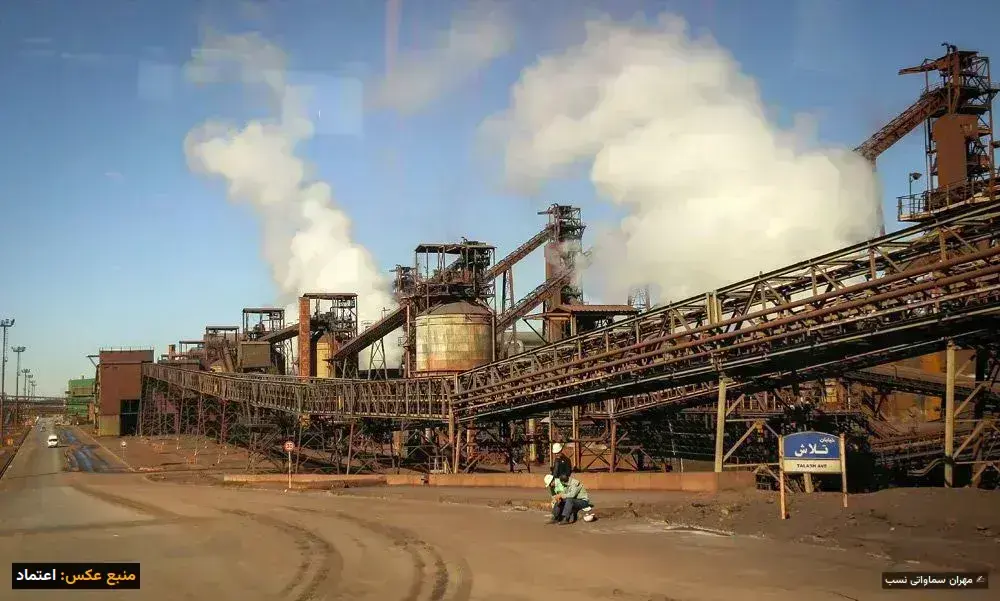
In recent years, steel has been one of Iran's most important non-oil foreign exchange sources. With an annual production of over 30
million tons of crude steel, Iran ranks among the world's major producers, and complexes like Mobarakeh Steel in Isfahan and Khuzestan Steel have a significant share in meeting domestic industry needs and exports.
For this reason, damage to these units is not just an industrial issue, but it also affects the construction market, automotive industry, home appliances, employment, and foreign exchange revenues. Reports indicate that these two complexes have been among the main targets of attacks, and their reduced capacity could have widespread consequences for the country's economy.
Experts believe that the most significant challenge for this industry is not necessarily the destruction of production lines, but the damage to power, gas, and control systems infrastructure. Steel factories have a high dependency on stable energy supply, and the shutdown of a power substation or auxiliary facilities can take the entire complex out of production for a long time, even without destroying the furnaces.
Although some officials have estimated the time to rebuild damaged units between six months to a year, achieving this goal depends on easy access to equipment, financial resources, and specialized parts; a matter that can prolong the reconstruction process under sanctions.
According to analysts, the most significant threat facing the steel industry is the loss of export markets. If the reconstruction process is prolonged, competitors like Turkey, Russia, and China could take over Iran's position in regional markets; a market that will not be easy to return to even after restoring production capacity.
Petrochemicals; Disruption in a Network on Which Dozens of Industries Depend
The petrochemical industry is one of Iran's most important non-oil revenue sources and a supplier of raw materials for many of the country's industries. For this reason, attacks on petrochemical complexes were not just damage to a few production units, but also disrupted shared infrastructure such as power facilities, steam production, feedstock transmission lines, storage tanks, and service networks; infrastructure that has interconnected the simultaneous operation of several complexes.
According to published reports, petrochemical facilities in Mahshahr, Bandar Imam, and Assaluyeh were among the affected areas, and some complexes, including Karun and Amir Kabir, also suffered damage. In many cases, even units that were not directly targeted had to halt production due to service interruptions or safety requirements.
Estimates provided by industry managers indicate that the reconstruction and renovation of these complexes require an investment of around 5
to 7 billion dollars. This amount is not only for compensating apparent damages but also includes replacing equipment, renovating infrastructure, and upgrading technology.
The revival of the petrochemical industry has been pursued in two phases; first, restoring units that were only halted due to service disruptions, and then starting the reconstruction operations of complexes that were directly damaged. In this regard, the priority of officials has been stated as meeting the needs of domestic industries and preventing shortages of raw materials for downstream units.
The importance of this sector lies in the fact that petrochemical products provide the main feedstock for industries such as plastics, packaging, automotive, home appliances, textiles, chemical fertilizers, medical equipment, and pharmaceuticals. Therefore, any reduction in production in this industry can lead to increased production costs, rising product prices, and disruptions in the operations of hundreds of industrial units.
Reconstruction; Beyond Repairing Factories
The summary of official reports and economic analyses shows that the real cost of war cannot be measured only by the value of destroyed buildings and equipment. A significant part of this cost will manifest in the form of reduced production, decreased exports, loss of foreign markets, increased investment costs, and supply chain disruptions.
In such conditions, reconstruction does not only mean repairing factories, but it requires reviving energy infrastructure, restoring production capacity, providing financial support to small businesses, and maintaining export markets. Otherwise, even after the completion of construction operations, part of the country's industrial capacity may remain inaccessible for a long time.
For this reason, many experts believe that the success of the reconstruction program is not only measured by returning damaged units to production, but the main criterion will be the revival of production chains, preventing businesses from exiting the market, and maintaining the competitive ability of Iranian industries in domestic and foreign markets.