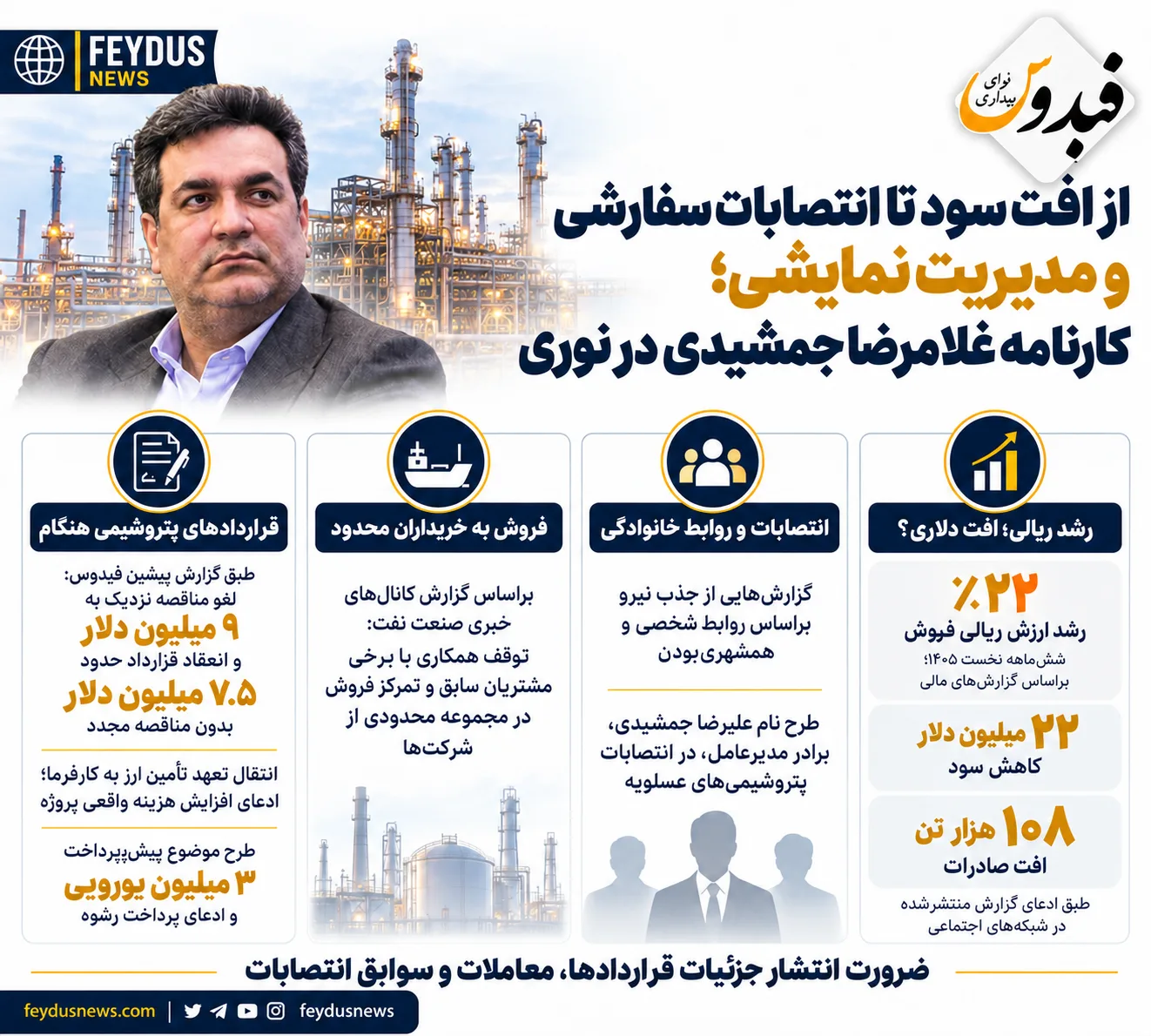

Nouri Petrochemical is one of the important and revenue-generating companies in Iran's petrochemical industry; however, the performance of Gholamreza Jamshidi, the CEO of this company, has been accompanied by ambiguities regarding contract transparency, product sales methods, managerial appointments, and possible connections of some contractors with managers. Reports published about his managerial background at Hengam and Shazand Petrochemicals, along with criticisms of the current performance of Nouri Petrochemical, have highlighted the necessity for the company's management to respond..
Gholamreza Jamshidi manages Nouri Petrochemical under conditions where media and social networks have published reports about his performance in project assignments, commercial contract signings, and hiring personnel.
One of the most important axes of these criticisms is the method of contract signing during Jamshidi's previous management at Hengam Petrochemical. Fidus previously reported that a tender worth nearly 9 million dollars was canceled, and subsequently, a replacement contract worth about 7.5 million dollars was signed without holding a new tender.
According to this report, in the initial contract, payments were anticipated in rials based on the NIMA exchange rate, but in the new contract, the responsibility for providing currency was placed on the employer. According to the report's sources, this change, despite the apparent reduction in the contract amount, increased the actual cost of the project. In this regard, the issue of confirming the payment of a three-million-euro advance and the allegation of bribery has also been raised.
Clarifying the reasons for the tender cancellation, the basis for selecting the new contractor, and changing currency commitments requires independent review by the board of directors and supervisory bodies and the publication of its results. It should also be determined to what extent these decisions were evaluated when Jamshidi was chosen to manage Nouri Petrochemical.
Ambiguity in Petrochemical Product Sales
Another part of the criticisms relates to Jamshidi's background in petrochemical product sales and marketing management. Some oil industry news channels have reported that during his tenure, cooperation with some former customers was halted, and product sales were limited to a select group of companies. Transparency in selecting petrochemical product buyers, especially under sanctions and currency restrictions, is of particular importance.
In this regard, Nouri Petrochemical management must explain the basis for selecting major customers, mechanisms for preventing conflicts of interest, and how supervisory bodies access major transaction information. Publishing overall sales statistics alone does not resolve ambiguities related to pricing, settlement conditions, and the selection of trading partners.
Appointments and the Possible Role of Family Relations
Managerial appointments and hiring personnel are also other axes of criticism of Jamshidi's performance. Some media and Telegram channels have reported that during his management at Nouri Petrochemical, individuals were recruited based on personal connections and being from the same hometown.
In other reports, the name of Alireza Jamshidi, Gholamreza Jamshidi's brother, has been mentioned in connection with appointments in Assaluyeh Petrochemical companies. Sources of these reports claim that he has achieved positions in petrochemical companies using family support.
These reports add to the necessity of publishing appointment records, position qualifications, and reviewing conflicts of interest in related companies. Appointing managers in large petrochemical companies should be based on professional competence and transparent and monitorable processes.

Growth in Rial Sales and Ambiguity in Profitability
The economic performance of Nouri Petrochemical has also faced criticisms. While financial reports indicate a 22% growth in the rial value of the company's sales in the first half of 1405, some reports published on social networks speak of a decline in dollar profits and a drop in export volume.
In one of these reports, it is claimed that the company's profit has decreased by about 22 million dollars and the export volume has also decreased by 108 thousand tons.
In an economy with severe currency rate fluctuations, an increase in rial income alone is not a sufficient criterion for evaluating the real improvement of the company's performance. Assessing this performance requires simultaneous examination of profitability, export volume, and the currency results of the company's activities.
Nouri Petrochemical management must explain changes in profit margins, operating costs, export levels, and the returns of commercial contracts. Relying on nominal sales growth, without providing these indicators, does not provide a complete picture of the company's economic situation and the results of its managerial decisions.