
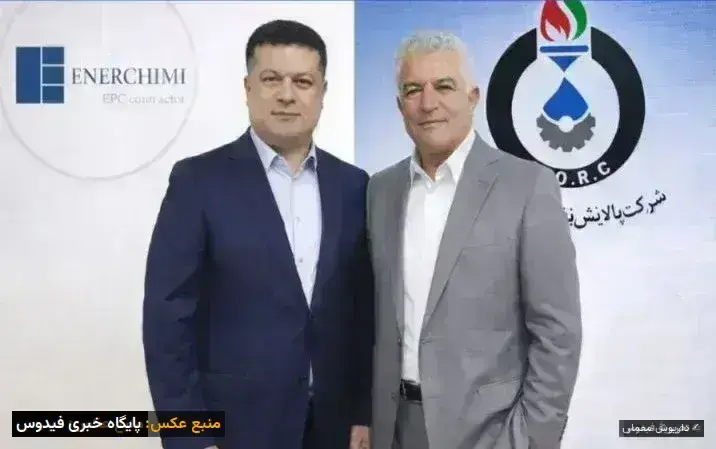
The development plan of phases one and two of Bandar Abbas Refinery, as one of the most strategic projects in the country's refining industry, has now entered its third year of operational suspension; a suspension that, given the allocation of financial resources, the presence of a specific contractor, and the approval of technical documents, is not only unjustifiable but also raises questions, causing a loss equivalent to 400 trillion tomans to date and corruption worth over one billion dollars.
The violations in the development plan of phases one and two of Bandar Abbas Refinery began from the contract awarding stage and the role of the company's CEO, and continued with unnecessary, unauthorized, and risky changes in the production cycle of the second phase, turning it into a costly and problematic model for the employer.
The manner of contract awarding to the 'Gener' consortium, consisting of four companies: Enerchemistry, Rojan Sanat, Jondi Shapur, and Nardis, strengthens the suspicion of financial connections and shared interests between some refinery managers and the managers of these companies. Among them, Nardis Company practically played a cover role, and given its affiliation with the Khatam al-Anbiya Construction Headquarters of the IRGC, it seems to have been included in the consortium as a tool to ensure the project's continuity in case of management changes and as a political and institutional pressure lever. Rojan Sanat Company, which mainly operates in the field of supply and refinery catalyst mediation, plays more of a cover role in the consortium structure than having an effective executive role.
Meanwhile, the role of Mohammad Ali Fatemi, the main shareholder of Enerchemistry, in the problematic processes of this one-and-a-half-billion-dollar project is assessed as more prominent than others.

The revision of the 722 million euro bid price of the Gener consortium for the first phase, after winning the tender and by removing five compressors from the contractual obligations, has practically turned into a tool to compensate for the price difference between Gener's bid and other competitors, undermining the competitiveness of the tender.
In the second phase of the project, the refinery management's attempt to unnecessarily change the final product from sponge coke (RDC) – which has profitability, a suitable sales market, and environmental and technical permits – to RFCC which lacks these advantages, has become a tool to halt project progress, redefine obligations, and increase foreign currency payments in favor of the contractor. This change turns the potential loss of the contractor in the second phase into significant profitability and, conversely, direct loss for the employer.
Another consequence of this technical revision is the possibility of relieving the contractor's obligation regarding the purchase and delivery of equipment from the 620 million euro prepayment; an issue that, under the pretext of changing technical specifications, has shifted the responsibility to the employer and increased the likelihood of circulating the received foreign currency resources in unrelated areas.
These changes, despite opposition from the Oil Research Institute and the National Refining and Distribution Company, due to lack of profitability, unrealistic estimates, and pollution, have merely provided grounds for creating additional work and new benefits for the contractor. A pattern that has previously been repeated in many foreign currency contracts between state and quasi-state companies and like-minded contractors, showing that imposing unnecessary technical demands is one of the main tools for profitability in such contracts.
Contracting Structure; Consortia and Concentration of Financial Interests
The first phase of the Bandar Abbas Refinery development project has been awarded to a consortium known as 'Gener Partnership'. This partnership consists of four companies: Enerchemistry, Jondi Shapur, Nardis, and Rojan Sanat.
Among these companies, Enerchemistry and Jondi Shapur play dominant roles; the majority of heavy equipment procurement is assigned to Enerchemistry, and site execution (C) is mainly assigned to Jondi Shapur. These two companies are the main players and beneficiaries in the contract. According to the data, the presence of Nardis Company, belonging to the Khatam al-Anbiya Construction Headquarters of the IRGC, in the consortium composition, has provided grounds for influence and collusion, reducing the risk of contract termination in case of a change in the refinery's management; a process carried out with the direct role of the owner of Enerchemistry and cooperation of the CEO of Bandar Abbas Refinery and some board members. The presence of Rojan Sanat in this partnership is also more of a cover.
Creating Opportunities for Contractors Through Price Revision
According to the documents, the three competitors of Gener in the tender had an average bid price of 799 million euros, and Gener won the tender with a bid of 722 million euros. The key point is the price revision ordered by Ahmad Hashemi, the CEO of the refinery, after Gener won, through price revision, which made Gener's bid price similar to that of other companies. (Appendix Documents No. 1)
The most significant example of these revisions is related to the SDA (Unit 181). The price of this unit increased from 36 million euros to about 98 million euros; an increase of over 60 million euros, without any fundamental change in the approved scope. This action reduced the price difference of this unit with the average of the top three companies from 62 million euros to about 449 thousand euros; a process that practically led to artificial price alignment in favor of the selected contractor.
Since this unit is a priority in the project's execution, the contractor has received all engineering, procurement, and execution adjustments at new rates from the beginning of the project, and its financial burden has been directly imposed on the employer.
In the next step, the most significant price difference is related to the DAOT (Unit 182); where the difference with the average of the top three companies reaches 43 million euros. Available data shows that the project management, with excuses such as reducing sulfur and producing low-sulfur fuel oil, pursued technical changes in the main equipment to remove the contractual price and replace it with a new rate. The result of this process has been the contractor's claim of 86 million euros in additional costs.
This pattern provides a clear picture of the systematic transfer of financial risk to the employer and the guarantee of contractor benefits.
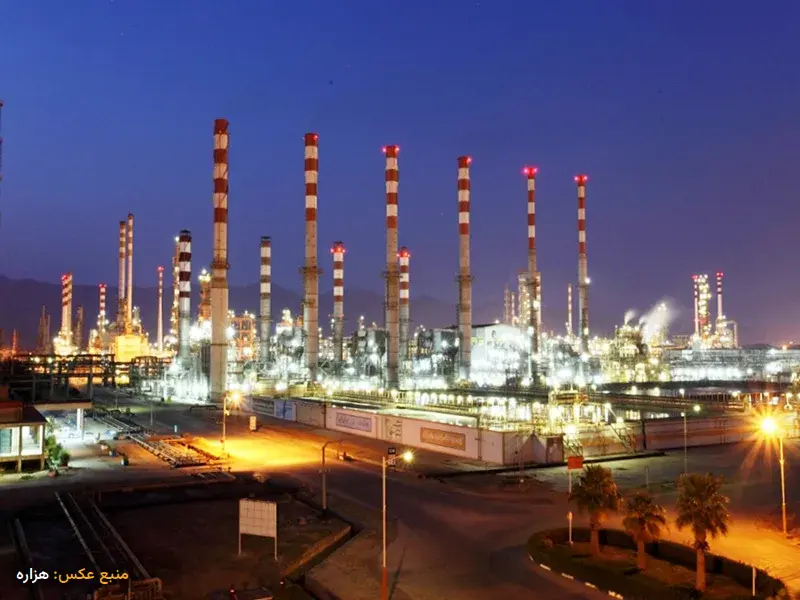
Project Dimensions; Significant Gap Between Approved Design and Execution Reality
The Bandar Abbas Refinery development plan is defined in two phases. The first phase, valued at approximately 722 million euros, includes the execution of main process units, and the second phase, as a complement to the refinery's value chain, includes a set of eight production units, including the sponge coke unit . These two phases, in total, play a key role in improving the quality of the refinery's product basket, reducing fuel oil production, and completing the country's downstream industries supply chain.
Based on the initial approved design, the execution of the sponge coke unit with a capacity of about 300,000 tons per year could fully meet the country's aluminum industry's needs and eliminate the import dependency of this sector.
However, for a project that was supposed to complete its first phase last year, not only has the execution of the phases not started, but the actual progress of phase one, according to available data, is estimated to be about 19 percent, creating a significant gap between financial progress and physical progress of the project.
Change in Technical Model; Expert Decision or Tool for Intentional Project Suspension?
One of the pivotal points of violation in this project, leading to suspension and stoppage in phase one, is the attempt to change the technical model from RDC delayed coker to RFCC . The RDC model had been previously approved, with FS, environmental permits, and necessary approvals for sponge coke production, and was economically justified.
In contrast, RFCC has higher energy and catalyst consumption, creates more pollution, and has had problematic experiences in the Shazand Arak Refinery.
In the technical-economic evaluation of the options for the Bandar Abbas Refinery development plan, a comparison between the sponge coke unit based on Delayed Coking technology and the RDCC unit provides a clear picture of the fundamental differences between these two paths.
From the perspective of final product and market, sponge coke is a fully marketable product with a clear and transparent market that has direct consumption in the aluminum industry. Stable domestic demand, along with the possibility of export and dollar-based, non-subsidized pricing, makes this product one of the few refinery outputs directly linked to market logic.
In contrast, RFCC primarily produces high-octane gasoline, LPG , and LCO ; products that are heavily dependent on fuel subsidy policies. For instance, the gasoline produced by RFCC is usually high in sulfur and requires additional units to comply with standards, and although LPG and propylene are economically profitable, their share in the overall production basket is limited.
In terms of operating costs, sponge coke has a clear advantage due to lower energy consumption, no need for catalysts, and a simpler and more stable process. In contrast, RFCC imposes a continuous financial burden on the refinery with very high energy consumption, constant need for expensive catalysts, heavy maintenance costs, and operational complexity.
From an environmental perspective, sponge coke, with controllable pollution and obtained environmental permits, is a lower-risk option, whereas RFCC has higher pollution, including CO₂, NOx , and particulates, and its problematic experience in the Shazand Refinery and the high sensitivity of obtaining permits create serious risks.
Ultimately, from a national interest perspective, sponge coke aligns with national interests by cutting anode coke imports, strengthening the aluminum chain, reducing foreign currency outflow, and creating real added value, while RFCC leads to increased production of high-octane subsidized gasoline, additional pressure on the government budget, and profitability dependent on temporary policies.
Nevertheless, the management of Bandar Abbas Refinery, with the hidden political support of Gener, especially Fatemi and Fateh Sanat Holding in the parliament and the Ministry of Oil, has kept the project in suspension by repeatedly proposing this change over the past two years. RFCC has neither an approved FS nor an environmental permit, but this ambiguity has become a tool for altering the contract's subject matter and suspending and delaying the project in favor of the contractor.
In the alleged report to the Refining and Distribution Company, efforts have been made to fabricate statistical realities to claim profitability and return on investment contrary to the truth of the process, and a ten percent gap in the claimed profit has been asserted.
Phase Two; The Core of Hidden Profitability
Phase two of the project holds special economic significance. In the initial approved scenario, this phase had limited profitability for the contractor and was even estimated to be loss-making in some calculations. However, if the subject matter is changed and redesigned, the project will have significant profitability for the contractor in the equipment procurement and installation stages.
Considering the contract text, which conditioned the execution of the highly profitable phase one on accepting the obligation for phase two with potential losses, the consortium companies' managers, in collaboration with Hashemi, the CEO of Bandar Abbas Refinery, have taken control of the opportunity to compensate for losses and keep both phases in a state of forced delay.
According to source information, the refinery's CEO, along with the owner of Enerchemistry and one of the consortium partners, have attempted to change the entire logic of phase two with a new, unauthorized design. This action has effectively held phase two, and even phase one, hostage to this change.
Creating Additional Work; The Heart of the Corruption Model
The dominant pattern of financial violations in this project is the definition of superficial changes and the receipt of heavy additional work. A notable example is the change in the pipeline transfer line design from one line to seven lines without any real change in the number of pipelines, piping size, or transfer routes. Despite this, an amount of about 350 billion tomans has been approved as additional work. (Appendix Documents No. 7)
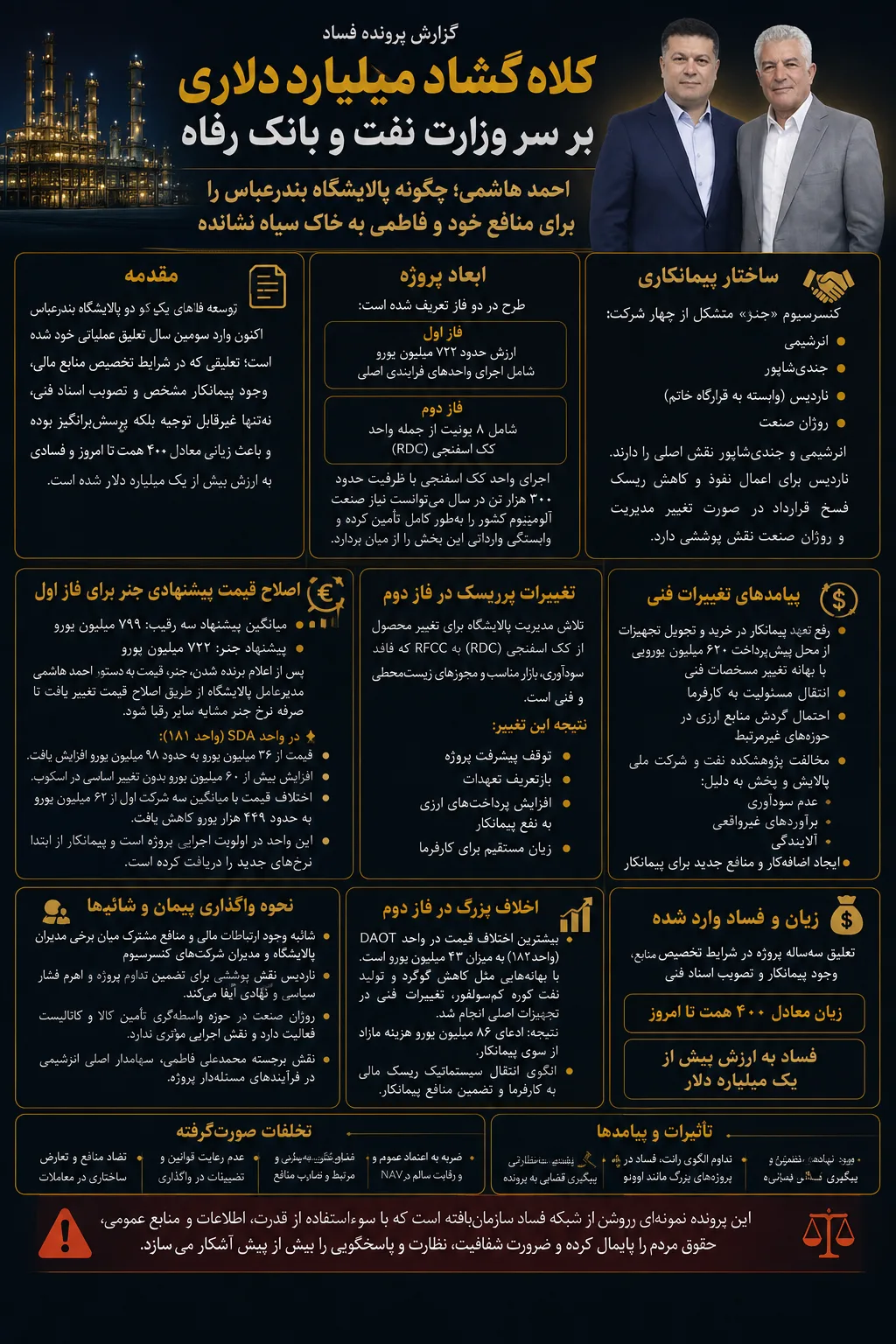
The continuation of the report below the infographic image
In the technical layer, the role of Mohammad Jafar Mousavi, the refinery's engineering manager, is prominent. Manipulating pressure drop calculations, changing compressor sizes, attempting to reject the research institute's selection and replace Chinese compressors, and preparing fabricated reports are among the actions taken to justify the changes.
In the official report presented to the Refining and Distribution Company, false claims such as converting the refinery into a petro-refinery and changing the production process contrary to the approved plan have been made; while this issue is a prelude to project delays, cost increases in favor of the contractor, and the creation of unnecessary damages. (Appendix Documents No. 8)
Financial Relations Between Hashemi and Fatemi: The Key to Solving the Mystery of Insistence on Violations
One of the most important layers of this case is the violation by the refinery's CEO. According to existing documents, supervisory boards have repeatedly warned about the increase in the employer's loss level in favor of the contractor's interests, given the planned and unjustified delay. These violations began from the stage of selecting the Gener consortium as the chosen contractor and continued in subsequent stages.
According to obtained documents, with the insistence of Ahmad Hashemi, the CEO of the refinery, the purchase of reactors, boilers, distillation towers, and columns has been awarded to Enerchemistry Company, owned by Mohammad Ali Fatemi; an awarding that has led to the concentration of financial resources and the main profit of the project in this collection. As a result, a significant portion of the foreign currency amounts of phase one of the project has practically been paid to Enerchemistry.
Reviewing the data and documents obtained from informed sources shows that the suspension of this project is neither due to a lack of capital nor the result of technical ambiguities, but rather the outcome of a chain of purposeful managerial decisions, unnecessary changes in the technical subject matter, and the unconventional concentration of financial interests of the Gener consortium, Enerchemistry Company, and Mohammad Ali Fatemi as the main axis of this project, especially in the equipment supply and construction section.
Moreover, according to the data, Mohammad Ali Fatemi's subsidiary companies play a key role in manipulating the financial cycle of this project. The suspension of the project has practically become an opportunity for these companies to retain the foreign currency amounts received without delivering the equipment for phase one, which over 70 percent of its foreign currency amount, valued at 620 million euros, has been paid for equipment procurement, but under the pretext of technical changes in phase two and the need for technical evaluation for potential changes required in phase one, the received foreign currency amounts have practically remained with the contractor and may be subject to potential financial circulation in other parts of the Fateh Sanat workgroup.
The Real Cost of Suspension; National Opportunity Loss
According to existing FS documents, the units of this plan could generate approximately 200 trillion tomans in annual revenue if launched. A two-year suspension of the project means about 400 trillion tomans in opportunity loss for the country's economy; a figure that goes beyond an accounting calculation, equivalent to lost job opportunities, reduced exports, and continued dependency of downstream industries.
Understanding the corruption network headed by Ahmad Hashemi, the CEO of Bandar Abbas Refinery, is not possible without understanding the influential Nourabadi network in various pillars of this company and through managerial arrangements and the opportunity for violations in various project sections to a series of supply and equipment contracts. This network is specifically considered one of the pillars of harm to the company's interests and the violation of the rights of its employees and workers.
The overall data provides a clear picture of a national project caught in the intersection of problematic managerial decisions, unnecessary technical changes, and the concentration of financial interests. The financial relationship between the CEO of Bandar Abbas Refinery and the owner of Enerchemistry, as a key member of the consortium, has played a pivotal role in directing these decisions. Continuing this trend, without serious intervention by supervisory bodies, will turn the Bandar Abbas Refinery development plan into a classic example of national resource waste under the guise of changing the subject matter and creating additional work.
The full report and referenced documents are in the attached PDF file