
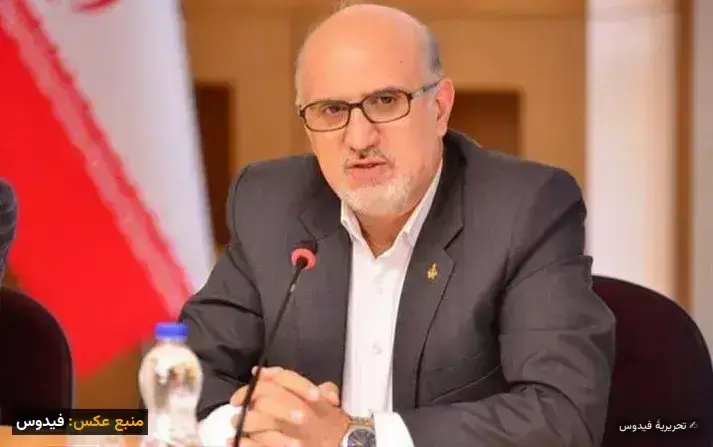
An examination of the decision-making process, contracts, and managerial changes during the tenure of Behzad Mohammadi, former CEO of the National Petrochemical Company of Iran, from late 2018 to November 2021 has raised serious questions about conflicts of interest, special privileges, and their economic consequences for public resources. These questions have taken on new dimensions with his subsequent role at the helm of the Kimia Development Group, known as "Kimia Group".
According to contract documents and attached records, during Behzad Mohammadi's governmental tenure, a project titled Petronad under the "Amine Production Project" received a series of privileges; officially aimed at meeting the needs of the country's gas refineries, but according to informed sources, it significantly facilitated the operations of a specific private entity. This trend was solidified in the final years of Hassan Rouhani's government and led to direct managerial shifts from governmental to private sectors before 2021.
The Key Role of Khosrow Abbas Nejad
Meanwhile,
Khosrow Abbas Nejad played a key role. During Behzad Mohammadi's management at the National
Petrochemical Company, he served as a senior advisor and simultaneously joined the board of
Maroon Petrochemical Company. This managerial arrangement resulted in a 10-year exclusive
contract between Maroon Petrochemical Company and Petronad, which, according to expert evaluations,
is considered one of the most sensitive points of interest connection between the government and
the private sector in the downstream petrochemical chain.
It is noteworthy that after his governmental role ended, Behzad Mohammadi was appointed as the CEO of Kimia Development Group, under which Petronad now operates as a subsidiary. Thus, the individual who managed the issuance of licenses and facilitated the exclusive Maroon-Petronad contract in a governmental capacity, assumed leadership of an entity that is a direct beneficiary of the same contract in a private capacity. This situation is a clear example of structural conflict of interest from an economic rights and corporate governance perspective.
According to the terms of the ethylene oxide (EO) sales contract, which is available in the attached documents, Article 18 stipulates that for each ton of undelivered product, a penalty of $230 is to be charged to Petronad. Based on official correspondence, since December 21, 2023, despite Maroon Petrochemical Company's official readiness to deliver the product, due to the incomplete Petronad project and lack of infrastructure, the receipt of EO has not been possible. This delay has resulted in the non-receipt of approximately 90,000 tons of ethylene oxide and a penalty of about $20 million for Petronad, a figure that should be recorded in the company's financial statements according to accounting rules.
However, in 2023, coinciding with the depletion of Petronad shareholders' financial resources, not only were these penalties not enforced, but in a process that raises expert doubts, 45% of Petronad shares, valued at over 2.2 trillion tomans, were transferred to Maroon Petrochemical Company. This transfer occurred when the total valuation of the Petronad project at the end of 2023 was announced to be around $120 million, estimated at approximately 5 trillion tomans at an exchange rate of 42,000 tomans. Thus, part of the shares of a loss-making company was effectively purchased with pension funds and public investments.
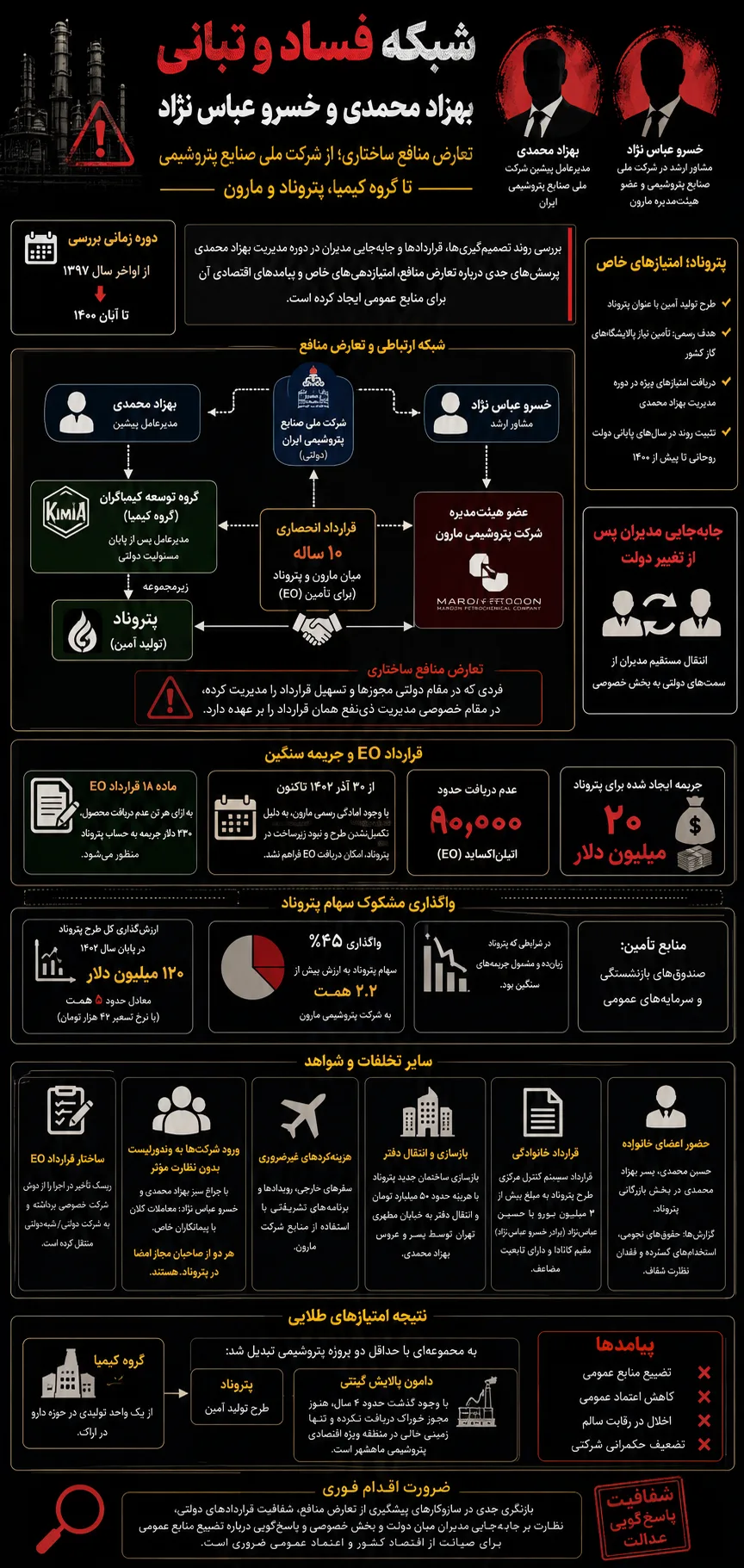
The EO contract documents available in the attached file show that the contract structure is designed in such a way that the risk of execution delay is effectively transferred from the private company to the state or quasi-state company; a matter clearly visible in the contract text and its technical appendices.
Existing reports also indicate the entry of multiple companies into Petronad's vendor list without effective oversight by responsible bodies. According to informed sources, these companies have entered the supplier list solely with the green light from key managers, including Behzad Mohammadi and Khosrow Abbas Nejad, and large transactions with specific contractors have taken place. These two are currently among the authorized signatories in Petronad; a position that significantly increases their influence over the company's financial, contractual, and executive decisions.
Reconstruction for Invoicing
In addition to these issues, serious criticisms have been raised about the spending of resources. Reports indicate foreign trips, participation in events, and ceremonial programs using Maroon Petrochemical Company's resources. Moreover, the renovation of Petronad's new building at a cost of about 50 billion tomans and the relocation of the company's office to Motahari Street in Tehran were carried out by Behzad Mohammadi's son and daughter-in-law; a matter that raises serious oversight questions given the ownership structure and source of funding.
Another notable issue is the central control system contract for the Petronad project, valued at over 3 million euros, awarded to Hossein Abbas Nejad, Khosrow Abbas Nejad's brother, who resides in Canada and holds dual citizenship. This contract, along with other familial and managerial relationships, outlines a network of intertwined interests that faces significant oversight ambiguity.
Additionally, Hassan Mohammadi, Behzad Mohammadi's son, works in Petronad's commercial department, with reports of exorbitant salaries, extensive hiring, and lack of transparent oversight mechanisms, forming a set of indicators that critics attribute to the direct result of "golden privileges" from the governmental management period.
These privileges, according to existing documents, transformed Kimia Group from a pharmaceutical production unit in Arak into an entity with at least two petrochemical projects, including Petronad and the "Damon Refining Giti" project; a project that, despite nearly four years, has not yet received feedstock approval and remains effectively limited to an empty plot in the Mahshahr Petrochemical Special Economic Zone.
All these pieces of evidence and documents once again highlight the urgent need for a serious review of mechanisms to prevent conflicts of interest, transparency in government contracts, oversight of managerial transitions between government and private sectors, and accountability regarding the misuse of public resources; a matter that, if ignored, will bring heavy costs for the country's economy and public trust.
Full report and documents in the attached PDF