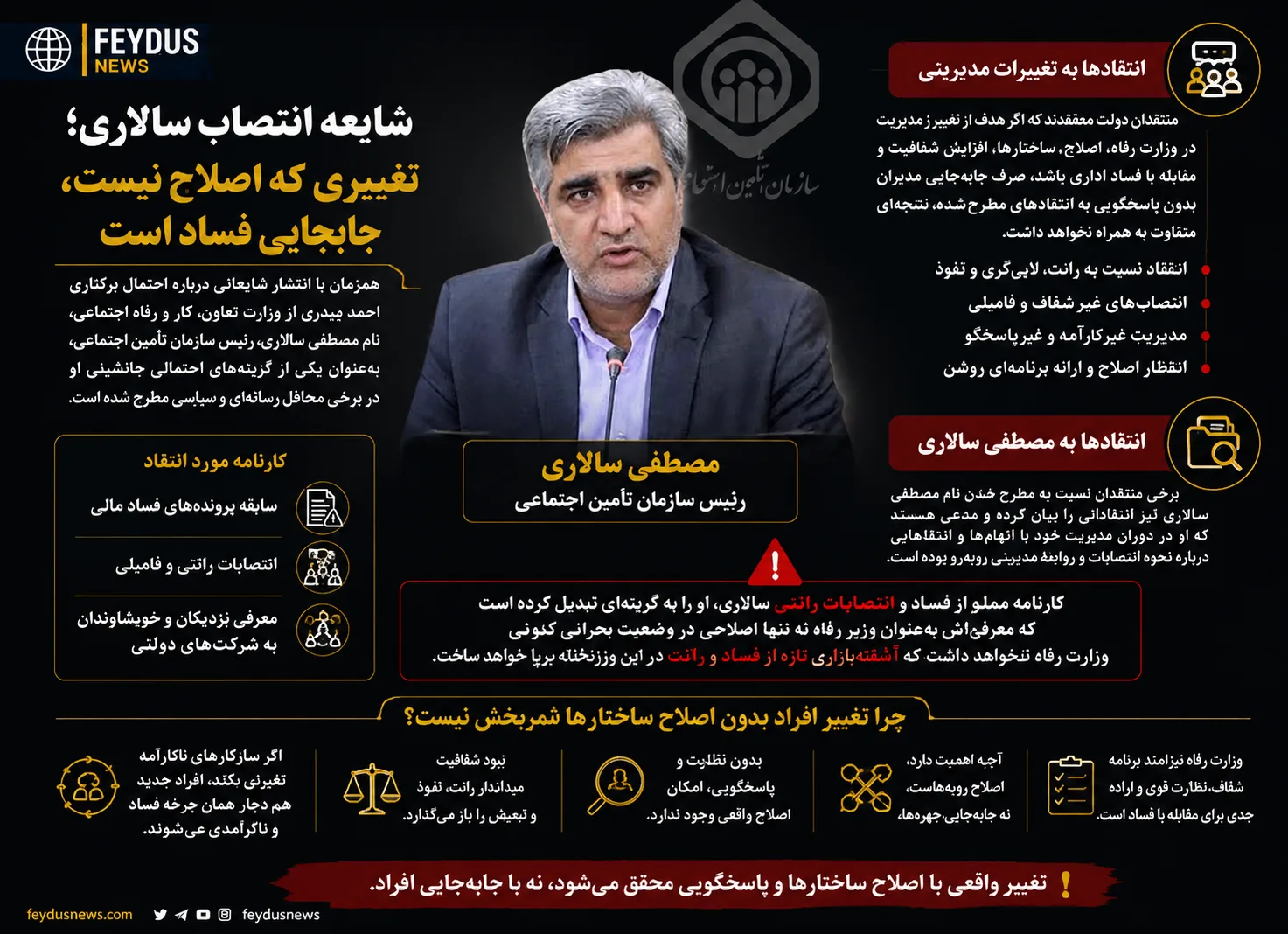

Simultaneously with the rumors about the possible dismissal of Ahmad Meidari from the Ministry of Cooperatives, Labor, and Social Welfare, speculations about potential candidates to succeed him have also increased. Among these, the name of Mostafa Salari, the head of the Social Security Organization, has been mentioned as one of the proposed candidates in some media and political circles.
Criticism of Managerial Changes
Government critics believe that if the goal of changing management in the Ministry of Welfare is to reform structures, increase transparency, and combat administrative corruption, merely replacing managers without addressing the raised criticisms will not yield a different outcome. They say that in recent months, there have been criticisms regarding favoritism, lobbying, non-transparent appointments, and management methods in the Ministry of Welfare, and it is expected that any managerial change should be accompanied by a clear plan to reform these processes.
Criticism of Mostafa Salari
In this context, some critics have also expressed criticisms regarding the mention of Mostafa Salari's name, claiming that during his management tenure, he faced accusations and criticisms about his appointment methods and managerial relations. Salari's record, filled with corruption and nepotistic appointments, even at the level of introducing relatives and close associates to state companies, along with his financial corruption cases, has made him a candidate whose appointment as Welfare Minister will not only fail to reform the current crisis in the Ministry of Welfare but will also create a new chaos of corruption and favoritism in this ministry.
From the perspective of these critics, if the potential changes are limited to merely replacing managers without reforming oversight mechanisms, transparency, and accountability, one cannot expect a significant transformation in the state of the Ministry of Welfare. In their view, what matters is not changing individuals but reforming the practices that provide the grounds for favoritism, influence, and inefficiency.