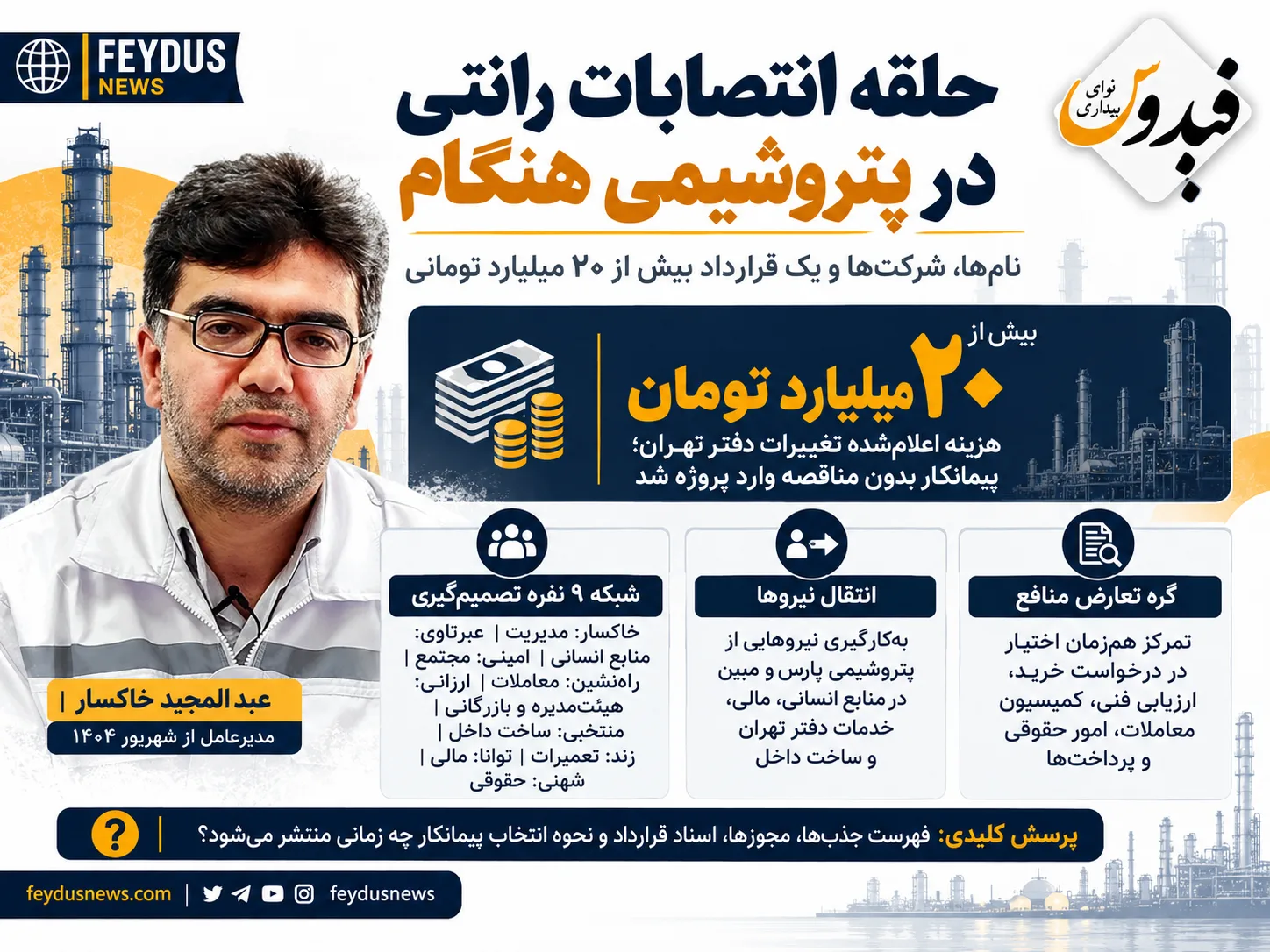

The information provided about the developments in Hengam Petrochemical indicates a series of human resource transfers between Pars Petrochemical, Mobin Petrochemical, and Hengam, as well as a contract allocation of over 20 billion tomans for changes in the Tehran office.
At the center of this circle of appointments and interests are the names Abdolmajid Khaksar, Shaker Ebratavi, Amini, Rahneshin, Arzani, Montakhabi, Zand, Tavana, and Shahni. These managers have each established their organizational influence network in parts of the human resources, procurement, transactions, maintenance, financial, or legal chain at Hengam.
On the other side of these developments, the name Sajad Keshavarzian has emerged in the circle of questionable transactions. The groundwork for his managerial promotion is being laid, and this process is linked to the administrative corruption network of Mohsen Beiglarbeigi's era, who are paving the way for completing the behind-the-scenes coalition of the ultimate corruption by selecting Keshavarzian as Hengam's CEO.
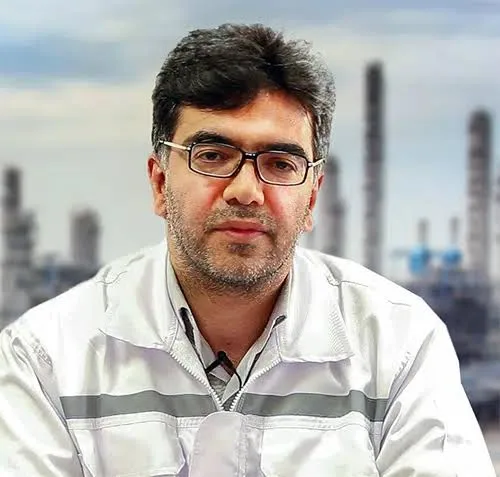
Khaksar and Ebratavi; The Axis of Human Resources Changes
Abdolmajid Khaksar has been managing Hengam Petrochemical since September 1404. Another key figure in the current structure is Shaker Ebratavi, the human resources manager at Hengam Petrochemical, whose presence in this position has been confirmed in public sources.
Information received from the conflict of interest network in the recent period indicates that some personnel whose cooperation with Pars Petrochemical under the management of Abdolkarim Pahlavani has ended have been transferred to or employed at Hengam.
In this power and nepotism circle, the names Javidan and Hosseini are specifically mentioned, and additionally, Hosseini has taken responsibility in the Tehran office services structure. This nepotistic appointment network relates to the financial sector. According to the provided information, two former Pars Petrochemical personnel have also joined Hengam's financial unit.
Additionally, the interest group regarding the presence of a relative of a financial manager from Pars Petrochemical as an intern at Hengam is raised, and the clear question for Hengam's management is: Since September 1404
exactly how many former Pars Petrochemical employees have been employed, assigned, or utilized at Hengam? Publishing the list of hires, the originating company, entry date, and the process of obtaining permission could clarify this issue for the public.

9 Names in Hengam's Decision-Making Chain
The information received from the opaque network is not limited to human resources and mentions a set of managers in various sectors:
Khaksar at the top of management, Shaker Ebratavi in human resources, Amini in the complex, Rahneshin in relation to the transaction commission, Arzani on the board of directors and commerce sector, Montakhabi in domestic production, Zand in maintenance, Tavana in financial affairs, and Shahni in the legal domain.
Among these names, the position attributed to Arzani in the nepotism and influence circle requires more structural attention. In addition to being a board member, he is active in the commerce sector and simultaneously participates in the technical commerce committee and the estimation committee.
This combination of positions indicates a nepotistic network that concentrates power and potential conflicts of interest: Should someone who plays a role in multiple stages of the procurement process be influential in the final decision on those transactions? This signifies systematic corruption institutionalized in the economic structure for embezzlement and plundering the public assets of the Iranian nation.
From Mobin Petrochemical to Hengam
The name Montakhabi is also prominent. He previously worked at Mobin Petrochemical and, after ending his cooperation with that organization, came to Hengam and took responsibility for "domestic production," meaning a significant portion of domestic purchases is related to the area under his responsibility.
Continuing the coalition of interests or the procurement chain, Zand, the maintenance manager, can be named, who issues purchase requests or Indent from the maintenance domain. After the procurement stages, financial affairs enter the payment process where Tavana's name is raised as the head of corruption.
This structure is completely abnormal; maintenance requests, procurement conducts the supply process, and finance makes the payment. The determining factor is whether there are independent controls and separation of duties among the requester, evaluator, supplier selector, and payment approver, or if they are all guided within an influence network.
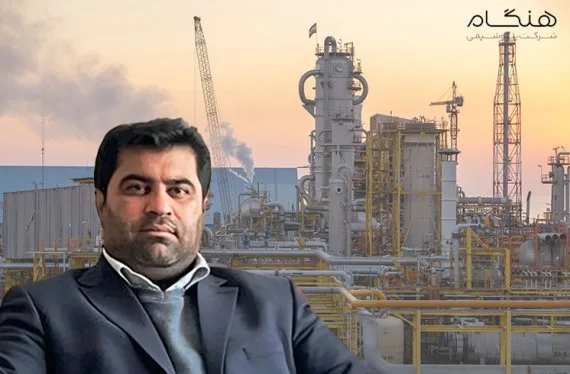
The Legal Role and Persian Gulf Holding
Yousef Shahne, the legal manager at Hengam, plays a powerful role in the process of obtaining the necessary permits for recruitment and coordinating this process with the higher level in the Persian Gulf Petrochemical Industries Group, where the name "Shams" is also mentioned. They should clearly provide the public with the examination of recruitment requests, the number and date of issued permits from the holding, employment contracts, and the time gap between the request and permit issuance.
Key Figure: Over 20 Billion Tomans
However, the largest figure is not related to human resources but to Hengam Petrochemical's Tehran office. This month, a project for designing and changing the Tehran office was implemented, costing over 20 billion tomans, and Shaker Ebratavi brought the contractor into the project without holding a tender. This is not the first time Hengam Petrochemical's transactions have been controversial. In the Shiploader project for urea and ammonia, the volume of criticism reached such a level that Hengam issued an official clarification statement in February 1404. The company explained the tender process, the EPC addendum, and financial proposals in that statement and spoke of a multi-million euro difference between the proposals.
Now, the new question is about a very specific figure: over 20 billion tomans for the Tehran office. The response to this case should not be difficult. If the contract was concluded according to regulations, publishing a few pages of documents could resolve a significant portion of the ambiguities.
But if the documents show that a limited circle of managers simultaneously had influence over human resources, purchase requests, technical evaluations, transaction commissions, legal affairs, and payments, the issue will no longer be a series of scattered appointments. At that time, an independent investigation into the power concentration structure and conflicts of interest at Hengam Petrochemical should be conducted.
In this case, names and figures are now on the table, from Pars and Mobin Petrochemical to Hengam and Persian Gulf Holding, from Khaksar and Ebratavi to Keshavarzian, and from personnel transfers to a contract over 20 billion tomans. However, what is still needed is the publication of documents that clarify exactly what decisions have been made behind these names and figures.