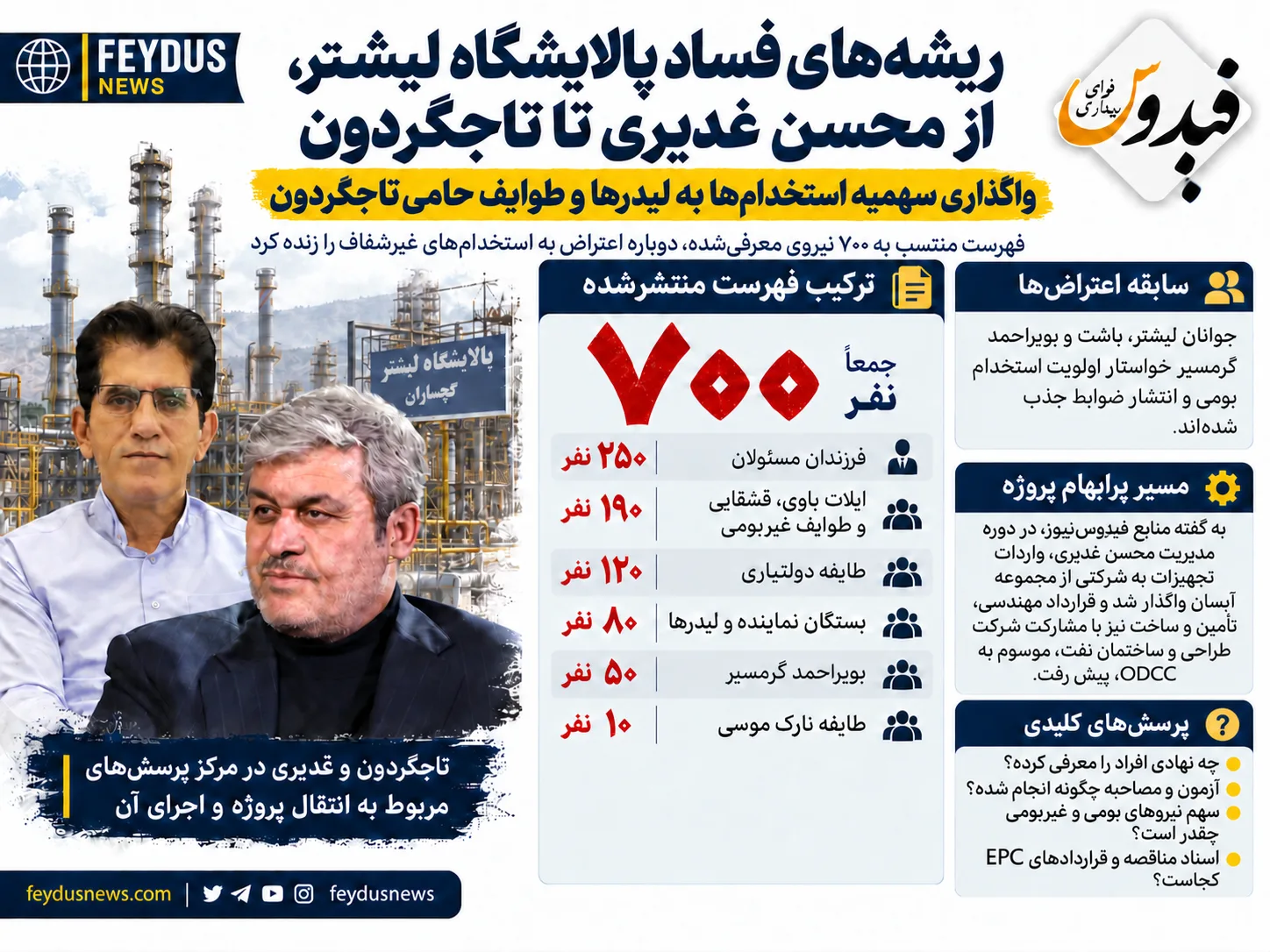

The Gachsaran Petro-Refinery, known as Lishtar, is facing a heavy file of rent-seeking and corruption during its initial stages of operation, from its import from the Philippines to the transfer of the project to Gachsaran.
The project is a showcase of rent-seeking, lobbying, and corruption involving the then CEO of Isfahan Refinery, Mohsen Ghadiri, and the role of Tajgardoon, the representative of Gachsaran, in employment and project transfer.
The publication of the list of personnel introduced for employment in the Gachsaran Refinery project in the Lishtar region has once again brought the old dispute over local hiring in this project to the forefront of discussions in Kohgiluyeh and Boyer-Ahmad province. The list, which is being circulated on social media, indicates that the introduced personnel were selected not through a competitive and transparent process, but through tribal quotas, connections with officials, and proximity to political networks..
According to the published information, out of the total 700 introduced individuals, 120 were allocated to the Dolatyari tribe, 50 to Boyer-Ahmad Garmasir, 250 to the children of officials, 80 to the relatives of the representative and electoral leaders, 10 to the Narak Mousa tribe, and 190 to the Bavi, Qashqai, and other non-native tribes.
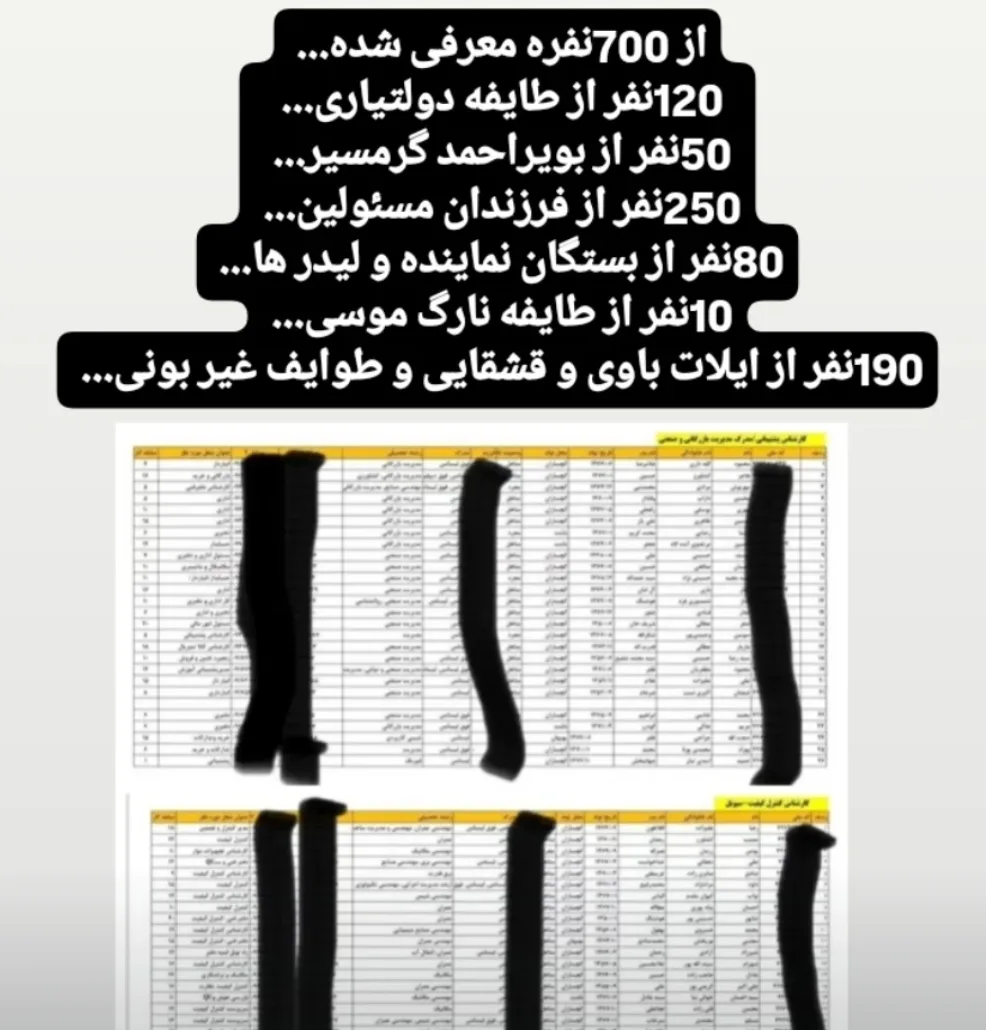
The importance of publishing this list is not just in its numbers. The Lishtar Refinery was initially introduced with the promise of creating jobs for the youth of Gachsaran, Lishtar, Basht, Kheirabad, Dasht-Mor, and Boyer-Ahmad Garmasir. Now critics are asking if the project transfer was justified by poverty alleviation and local employment, why is the list of accepted candidates, the scoring method, the required fields, and the results of the test or interview not made public?
Promise of Employment; The Starting Point of Protests
Protests against the hiring practices at Gachsaran Refinery are not new. Even before the recent list was published, groups of local youth had declared that job opportunities in the project were being given to people outside the area or those with political connections..
The ILNA news agency reported in July 1405 that the youth of Basht, Lishtar, and Boyer-Ahmad Garmasir regions demanded priority for local employment in the ongoing construction project of Gachsaran Refinery. Protesters told the media that hiring non-local personnel contradicts the promises and the principle of prioritizing the region's people. This protest shows that the dispute over hiring has existed for at least several months, and the publication of the 700-person list is just a new phase of the same crisis.
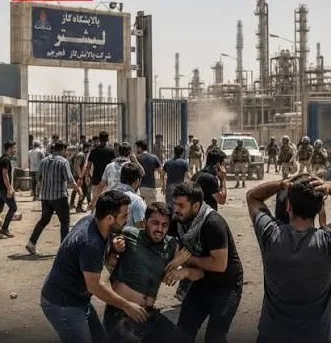
Following the protests, images of young job seekers gathering in front of the project site were published. The attendees described the recruitment process as "unfair and non-transparent" and demanded the publication of hiring criteria. Some social media videos also showed the sound of gunfire and the efforts of security forces to disperse the protesters. However, no official and reliable independent report on the number of injured or arrested has been released..
The repetition of protests shows that the problem is not just about the employment of a few people; the main issue is the distrust in a mechanism that does not clarify which entity introduced the individuals, how the local status was assessed, and what the share of expertise, experience, and testing was in the selections..
A Project That Changed Course Several Times
According to local sources, the Gachsaran Refinery is linked to the purchase and transfer of a second-hand refinery from the Philippines; a project that was initially supposed to be executed in Bandar Abbas and then its execution location changed to Isfahan and subsequently to Gachsaran.
The history of this petro-refinery goes back to the decision to transfer some of Isfahan's development projects to Hormozgan. Mohsen Ghadiri, the then CEO of Isfahan Refinery, announced in May 1403 that some projects would be transferred to Hormozgan province to expand activities and accelerate exports, and initial agreements for feedstock supply were under review. Two months later, he spoke about transferring all of Isfahan Refinery's development projects, including the LPG value chain and related projects, to Bandar Abbas.
Local sources claim that the final transfer of the project to Gachsaran was carried out with the support and lobbying of Gholamreza Tajgardoon, the representative of Gachsaran and Basht, and its main promise was to create job opportunities for the region's youth. His political influence in pursuing economic projects in his constituency and the expectation created about local employment have placed his name at the center of current criticisms..
Tajgardoon and other provincial officials must clarify whether there was a written commitment regarding the percentage of local hires for the project transfer. If such a commitment exists, its text and enforcement guarantee should be published; if it does not exist, it should be explained why local employment was advertised as the project's main achievement..
Ambiguity About Contractors and EPC Contract EPC
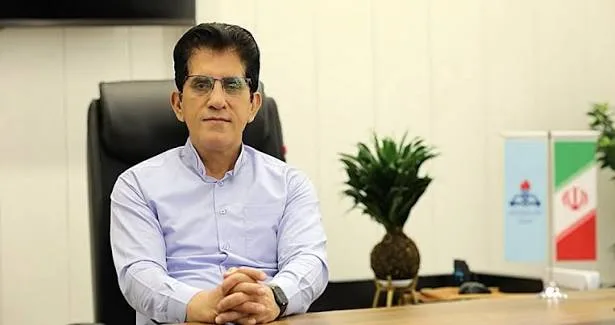
Ghadiri was initially responsible for transferring this refinery from the Philippines, and thus he had a special share in the lobbying and procurement of equipment during the initial transfer and construction phases. Informed sources say that during Mohsen Ghadiri's management, matters related to equipment imports were assigned to a company from the Absan group, and the engineering, procurement, and construction contract was advanced with the participation of the Oil Design and Construction Company, known as ODCC.
Ghadiri's close relationship with the then CEO of Absan, Mohseni, who is known for rent-seeking, led to the assignment of equipment procurement for this refinery to this company. Interestingly, the EPC work was also awarded to the Oil Design and Construction Company, ODCC, without formalities, but Ghadiri's order required participation with Absan Zolal in the EPC section.
Interestingly, the manager of the Absan and ODCC partnership was one of the managers Ghadiri had chosen at that time and was temporarily the workshop supervisor of one of the Isfahan projects with Ghadiri's coordination.
A Transparency Test for Project Officials and Executives
The Lishtar case now faces two sets of questions: first, the method of project transfer and assignment, and second, the hiring mechanism. Regarding the first part, the purchase documents of the refinery, reasons for location change, environmental assessment, contractor selection method, technical and financial scores of participants, and the final contract should be published. For the second part, providing a list of required fields, capacity for each job title, registration method, test and interview results, and the number of local and non-local personnel is necessary..
The Gachsaran Refinery was supposed to be a symbol of industrial development and employment in one of the country's deprived areas; however, continued silence may turn it into another symbol of distributing public opportunities among political and tribal networks. Transparent accountability is not a favor from managers and representatives, but a right of the youth who have been promised for years to be the first beneficiaries of this project..