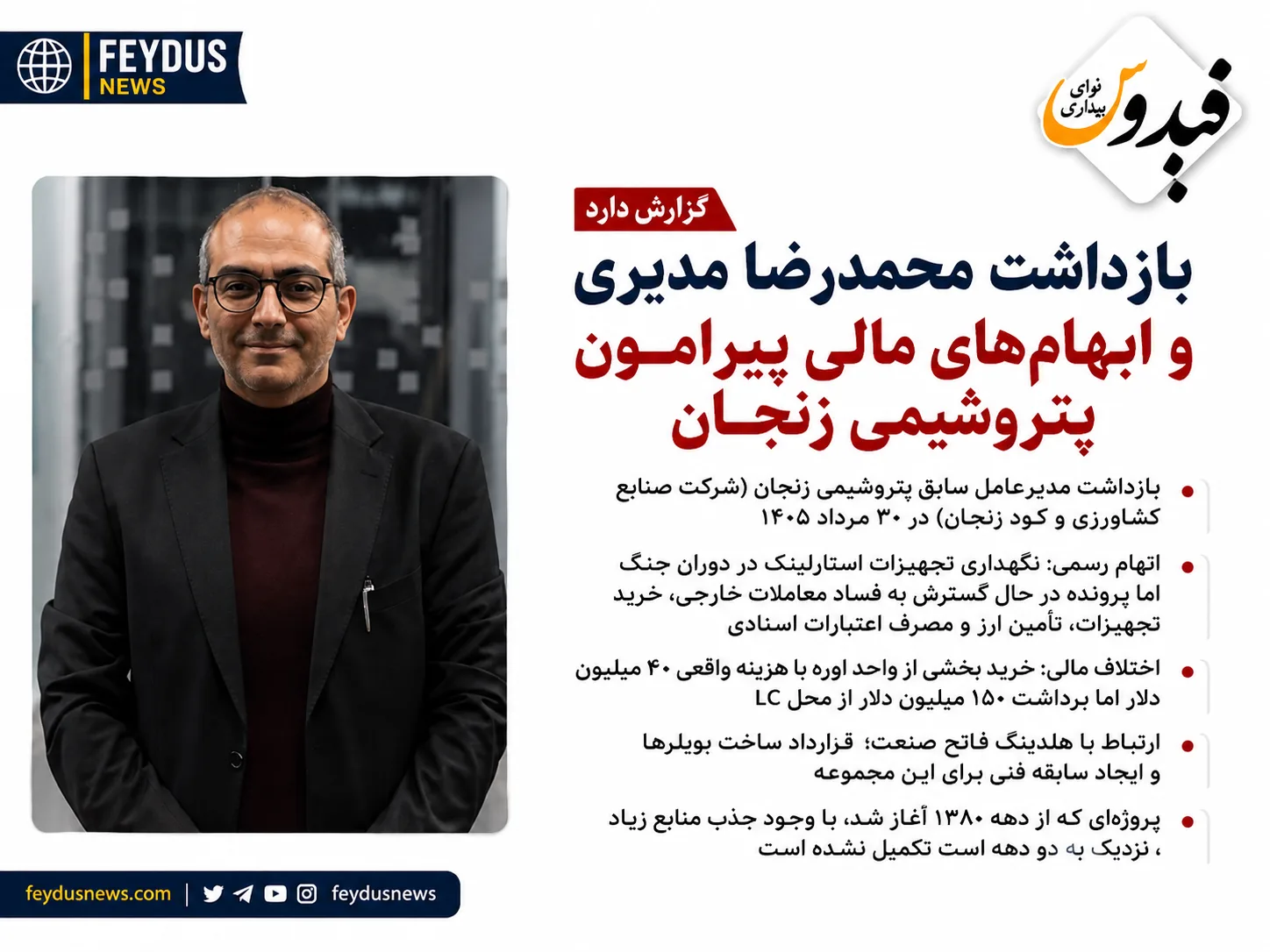
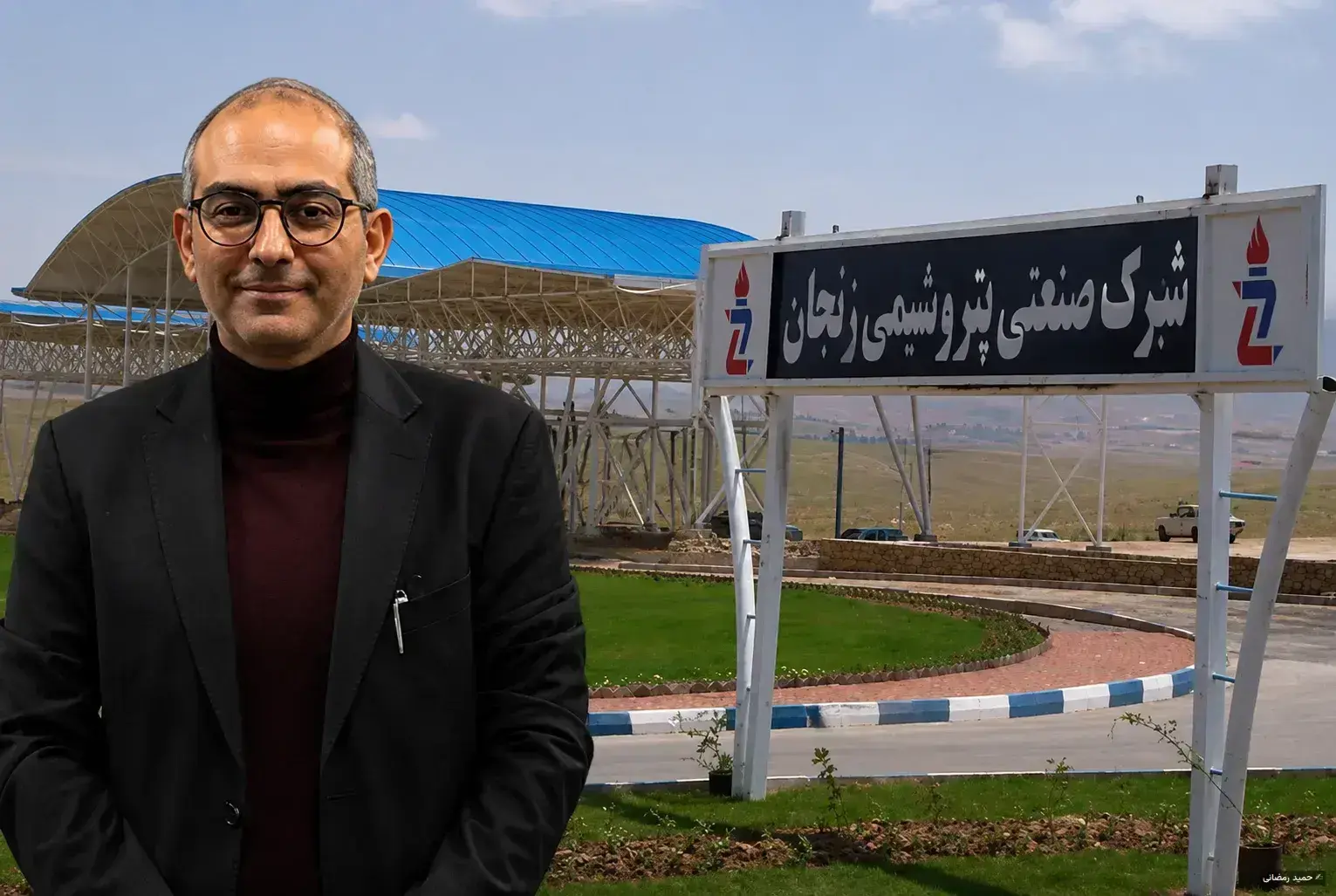
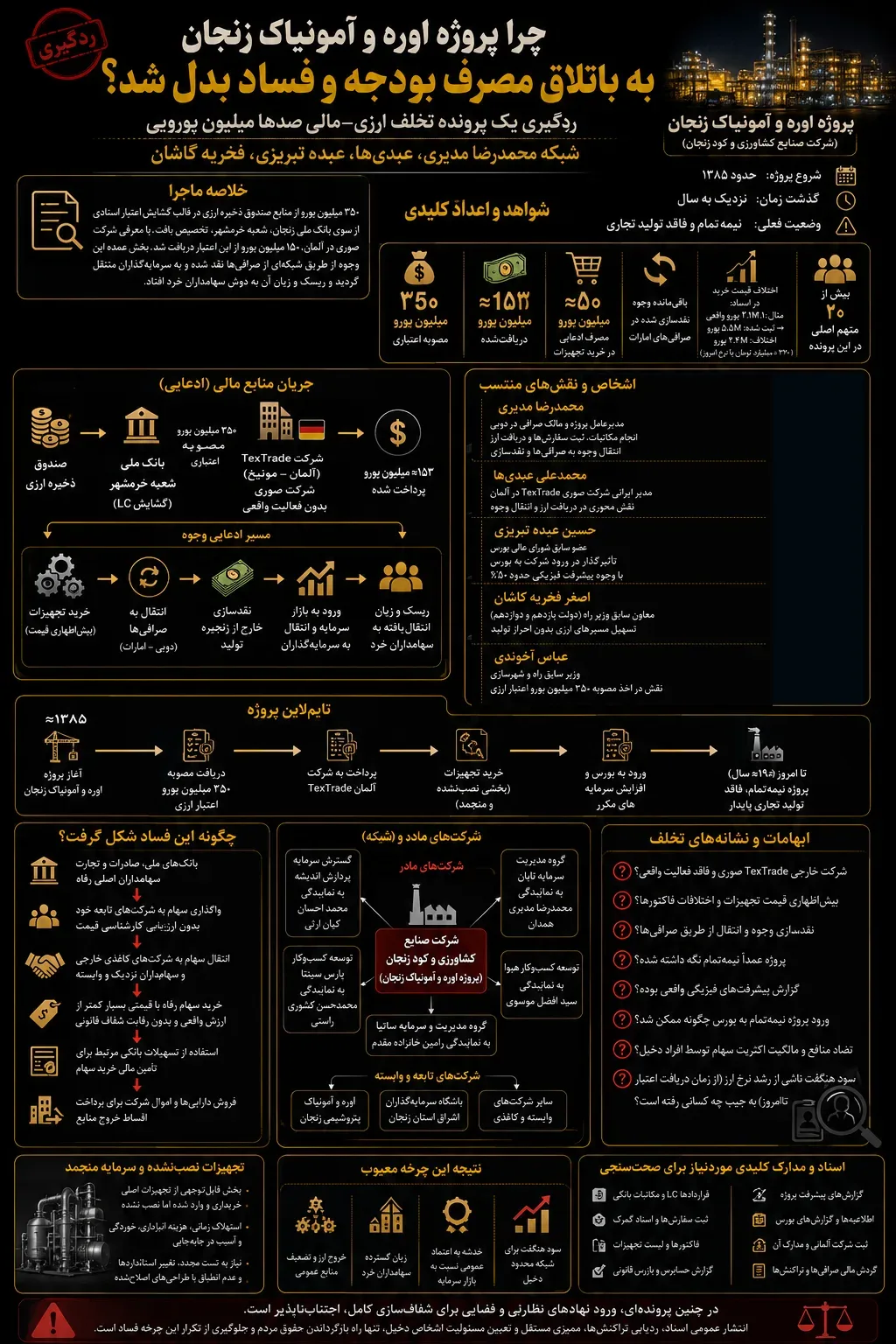
According to information received by Feydus on Thursday, August 30, 1405, Mohammadreza Modiri, known as "Vahid," the former CEO of Zanjan Agricultural and Fertilizer Industries Company, known as Zanjan Petrochemical, has been arrested. Informed sources have revealed that despite the announcement of Modiri's arrest due to possession of Starlink equipment during wartime, the management and financial conditions of Zanjan Petrochemical and the disclosure of widespread corruption have expanded the scope of the legal case against him to issues such as corruption in foreign transactions, equipment purchases, currency supply, the use of documentary credits, and the activities of commercial intermediaries.

Zanjan Petrochemical or Zanjan Agricultural and Fertilizer Industries Company is one of the old projects of Iran's petrochemical industry, designed to produce ammonia and urea and supply the necessary fertilizers for the agricultural sector. This company has a large number of small shareholders, and the company's published resources in different periods have shown that a significant portion of the project's financing has been done through shareholder contributions.
The project, which began in the mid-1380s, remains incomplete nearly two decades later. The company itself, in previous reports, has cited factors such as financing problems, the performance of the National Development Fund, Central Bank restrictions, sanctions, currency transfer issues, and delays in equipment supply as reasons for the project's lag. In one of Mohammadreza Modiri's official statements, it was also said that the failure to fulfill certain banking commitments in the years 1398 and 1399 caused about two more years of delay in the project.
Managerial and Financial Challenges
However, information from sources in this case presents a different narrative. These sources believe that a significant part of the prolongation of the project should be examined in terms of management, contracts, foreign transactions, and equipment purchases, and the change in the company's management cannot be independent of the questions raised about Mohammadreza Modiri's management period.
One of the fundamental questions for this case is why Modiri was removed from the management of Zanjan Petrochemical and what the real reasons for the management change were. An informed source claims that Hossein Abdeh Tabrizi and a person referred to as "Dr. Kashan" decided at some point to reduce Modiri's managerial role due to differences of opinion and dissatisfaction with his performance, and Kashan took on more direct responsibility in managing the project. This claim should be matched with board meeting minutes, registered manager changes, and internal company communications.
In the received information, the name Shaghayegh Hosseini, one of the managers of the commercial department of Zanjan Petrochemical, is specifically mentioned. According to this source, Hosseini played a central role in foreign purchases, currency collection, transaction documentation, and the issue of Over-Invoicing or overstatement of purchase prices and was aware of the discrepancies between the actual equipment prices and the amounts listed in the invoices. The surpluses created in this process were also collected or managed through specific channels.
Shaghayegh Hosseini is referred to as one of the "black boxes" of the project's foreign commerce. It is also claimed that her husband acted as an intermediary or broker related to Mohammadreza Modiri in some transactions. Some close to the company's management team have said that although Shaghayegh Hosseini has resigned from her position, her status regarding arrest or the formation of a legal case has not been definitively announced.
Financial Claims and Foreign Transactions
One of the most important financial claims raised in the sources' information relates to the urea section of the project. Feydus previously reported on the purchases related to part of the urea unit, which had an actual cost of about 40 million dollars. A purchase that approximately 150 million dollars was withdrawn from the LC or documentary credit related to it. This numerical discrepancy is one of the potential key points of the case. Part of the transactions was conducted through a company registered in Germany and an exchange office in Dubai. According to documents, this German company introduced a ruin as the office address, and interim visits reveal that such a company did not officially exist.
What is significant in the petrochemical case is the repeated mention of Mohammad Ali Fatemi, the manager and owner of Fateh Sanat Holding. A holding whose traces are seen in other energy sector projects with widespread violations and has been one of the arms of organized corruption in the Zanjan Petrochemical project. According to documents, Zanjan Petrochemical made purchases from this group, and the contract for constructing some boilers was also awarded to Fateh Sanat. A source claims that one of the effects of this contract was creating a technical reference for this company.
New Developments and Responsibilities
The company's assembly on August 26, 1405, highlighted the level of lag from the plan and the real state of the project compared to what was used as an excuse for invoicing and currency purchases over the years. The board of directors of Zanjan Agricultural and Fertilizer Industries Company approved the tender result for the completion operations of the urea project in this session and announced that Tehran South Technical and Construction Company was selected as the tender winner, and the proposed contract amount was announced as 8,330,000 million rials, equivalent to about 833 billion tomans.
The contract execution period is set at 17 months from the time of contract validation and notification, and the scope of work includes civil operations, steel structures and architecture, electrical and mechanical installations of warehouses, underground piping, electrical and instrumentation channels, and the installation of some mechanical equipment. This contract is significant because the project, after years of delay, now enters a phase where a significant portion of the existing equipment on site must be installed and integrated.
In this regard, a source in this case claims that the actual start of installation operations can help clarify potential discrepancies between what was purchased, what was paid for, and what is actually present on site. This source believes that the pressure to start installation can be particularly important for this reason.
Given the project's prolongation, the volume of financial resources attracted, and the high number of small shareholders, the responsibility of past managers is of particular importance. Since documents show that part of the company's resources was diverted from the project through overstatement, fictitious transactions, currency transfers to intermediaries, or unjustified withdrawals from documentary credits, shareholders can demand a judicial review and precise auditing of the relevant management period. As the project's capital was financed in a significant part of its path through small shareholder contributions, any potential judicial review is not just a matter between the company's managers but directly relates to the proprietary rights of a large number of shareholders.