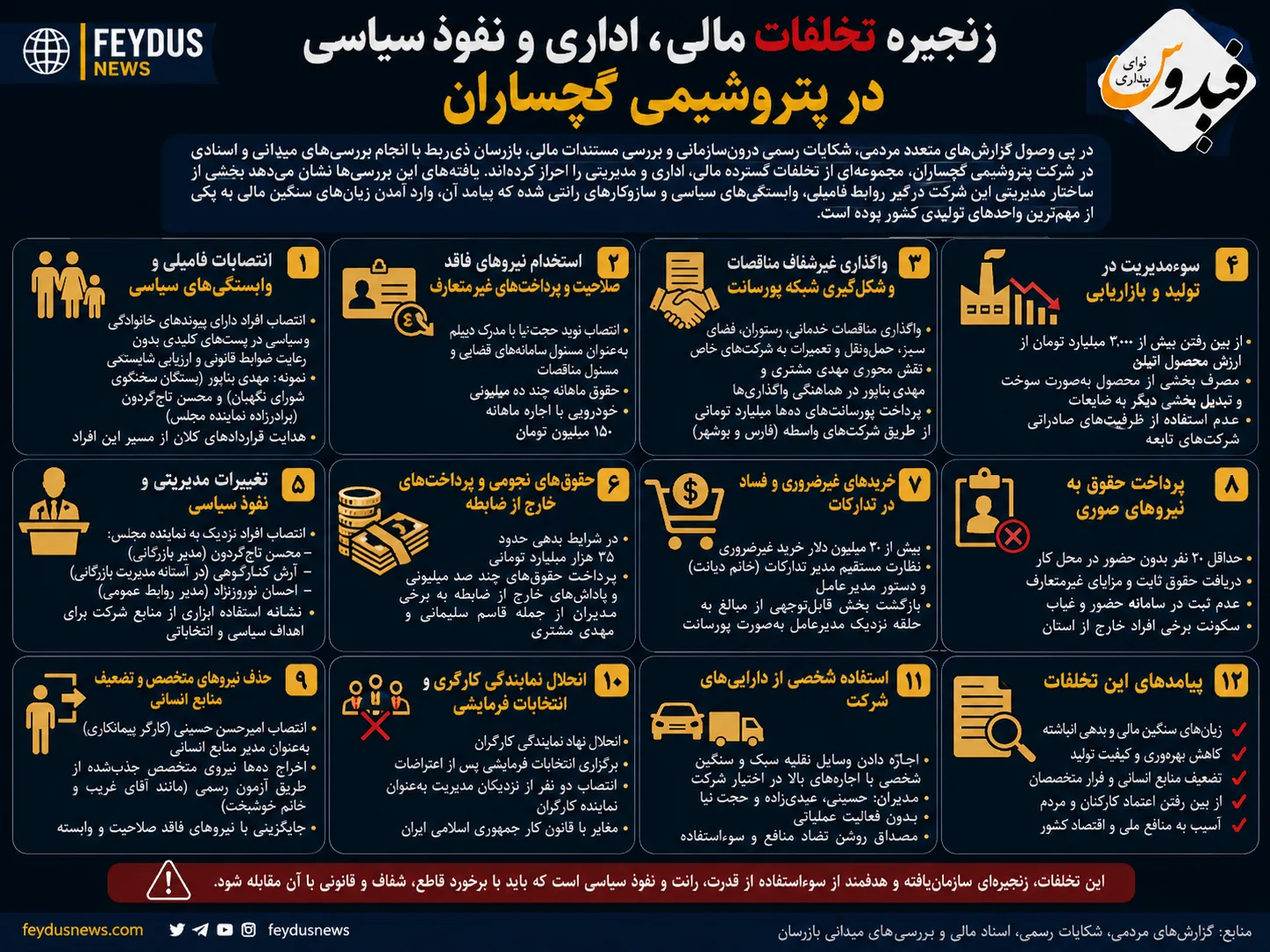
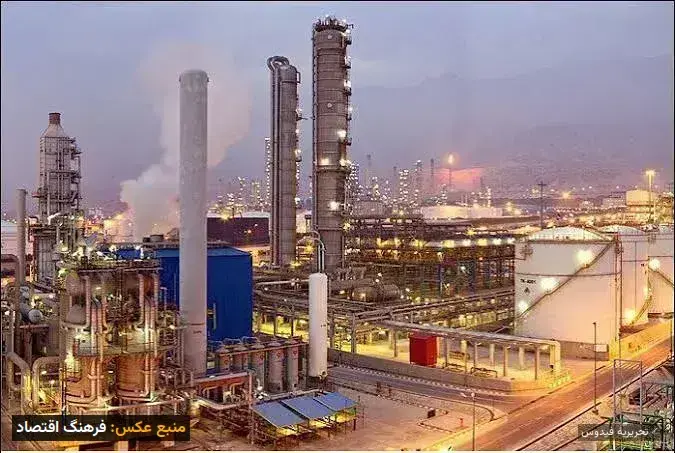
Following numerous public reports, official internal complaints, and financial document reviews, relevant inspectors have conducted field and documentary investigations at Gachsaran Petrochemical Company, uncovering a series of widespread financial, administrative, and managerial violations. The findings indicate that part of the company's management structure is involved in family ties, political dependencies, and rent-seeking mechanisms, resulting in significant financial losses to one of the country's most important production units.
According to initial reports, in recent months, the destruction of the company's professional structure, illegal tender allocations, employment of unqualified personnel, and systematic misuse of public resources have been established and institutionalized in this organization.
Family Appointments and Political Dependencies
Investigations reveal that a significant portion of the company's key positions, without adhering to administrative regulations, official evaluation processes, and technical qualification criteria, have been assigned to individuals with family and political ties. Among these individuals are Mehdi Banapour, a close relative of the Guardian Council's spokesperson, and Mohsen Tajgardoon, the nephew of the current member of the Islamic Consultative Assembly, who have been appointed to key financial and executive positions without going through legal processes.
Document reviews and available evidence show that these individuals have played a significant role in the company's financial decisions, with some major contracts being directly or indirectly influenced by them.
Employment of Unqualified Personnel and Unconventional Payments
One clear example of mismanagement is the appointment of Navid Hojatnia, with a high school diploma and no relevant work experience, as the "Head of the Company's Judicial Systems" and simultaneously the "Head of the Tender Unit." According to existing documents, he receives a monthly salary of several tens of millions and also benefits from a vehicle with a monthly rent of 150 million tomans.
This appointment and benefits lack any technical and administrative justification and represent a clear violation of the principles of productivity, meritocracy, and human resource management in state-owned companies.
Non-transparent Tender Allocations and Formation of Commission Networks
Examination of tenders related to service areas, restaurants, green spaces, transportation, and repairs shows that these processes were conducted without adhering to the principle of free competition and transparency and were often awarded to specific companies. Existing documents indicate that Mehdi Moshtari and Mehdi Banapour, in coordination with the CEO, played a central role in these allocations.
According to financial documents, commissions amounting to tens of billions of tomans were exchanged among some managers and intermediaries in return for these allocations. These payments were made through intermediary companies based in the provinces of Fars and Bushehr, and their financial paths are traceable.
Mismanagement in Production and Marketing
In the production and sales sector, the lack of effective planning and weaknesses in marketing have resulted in over three trillion tomans of ethylene, the company's main product, being lost. Part of this product was used as fuel, and another part was turned into waste.
Investigations show that the company's top management made unprofessional decisions in this area and did not utilize the export capacities of the subsidiaries of the Persian Gulf Petrochemical Industries Company for product sales; a matter that directly led to the company's losses.
Managerial Changes and Political Influence
After the election of Gholamreza Tajgardoon as a member of the Islamic Consultative Assembly,
widespread changes have been implemented in the management structure of Gachsaran Petrochemical Company. According to documents:
Mohsen Tajgardoon, without relevant scientific qualifications, has been appointed as the commercial manager and is now on the path to promotion to complex manager.
Ehsan Norouznezhad, a former employee of Tajgardoon's office, has been appointed as the public relations manager
These changes, according to experts, indicate the instrumental use of the company's resources and structure for political and electoral purposes.
Arash Kenarkouhi, Tajgardoon's former media manager, is on the verge of taking over the commercial management.
Exorbitant Salaries and Irregular Payments
While the company is facing a debt of approximately 35 trillion tomans, accounting documents show that some managers, including Ghasem Soleimani and Mehdi Moshtari, have received several hundred million in salaries and irregular bonuses. These documents are available in the company's accounting unit and can be immediately verified.
Unnecessary Purchases and Corruption in Procurement
All company purchase processes have been conducted under the direct supervision of Ms. Diyanat, the procurement manager, and at the CEO's instruction. According to financial documents, over 30 million dollars of unnecessary purchases have been made, with a significant portion returning as commissions to the CEO's close circle. This practice constitutes a clear violation of the state transaction regulations.
Payment of Salaries to Phantom Employees
A review of the payroll list shows that at least 20 individuals have received fixed salaries and unconventional benefits without being present at the workplace or performing organizational duties. These individuals are not registered in the attendance system, and some reside outside the province where the company is located.
Elimination of Skilled Personnel and Weakening of Human Resources
Following the appointment of Amirhossein Hosseini, a contractor worker with no administrative experience, as the human resources manager, the path for hiring recommended personnel has been paved, and the company's human resources structure has collapsed. Simultaneously, dozens of skilled personnel who were recruited through official exams have been dismissed without providing technical reasons; among them are Mr. Gharib and Ms. Khoshbakht. These individuals have been replaced by unqualified personnel affiliated with specific institutions.
Dissolution of Labor Representation and Sham Elections
With the dissolution of the labor representation body, the right to employee union participation has effectively been eliminated. Following protests, sham elections were held, during which two individuals close to management were appointed as worker representatives; an action contrary to the Labor Law of the Islamic Republic of Iran.
Personal Use of Company Assets
According to documented reports, several managers, including Mr. Hosseini, Mr. Abdizadeh, and Mr. Hojatnia, have rented out their personal light and heavy vehicles to the company at high rates, despite these vehicles having no operational activity. This action is a clear example of conflict of interest and abuse of job position.