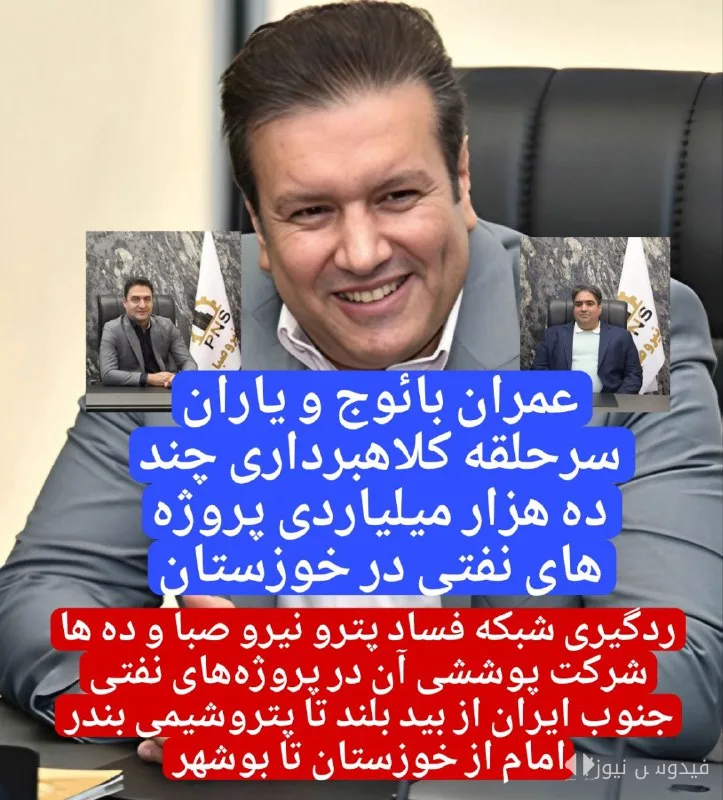
The management network formed around Omran Baoj in Petro Niroo Saba Company, using chain companies, cover accounts, and infiltration into the oil and gas structure, has managed to divert the path of major contracts in recent years and transfer a significant portion of project resources to suspicious financial cycles.
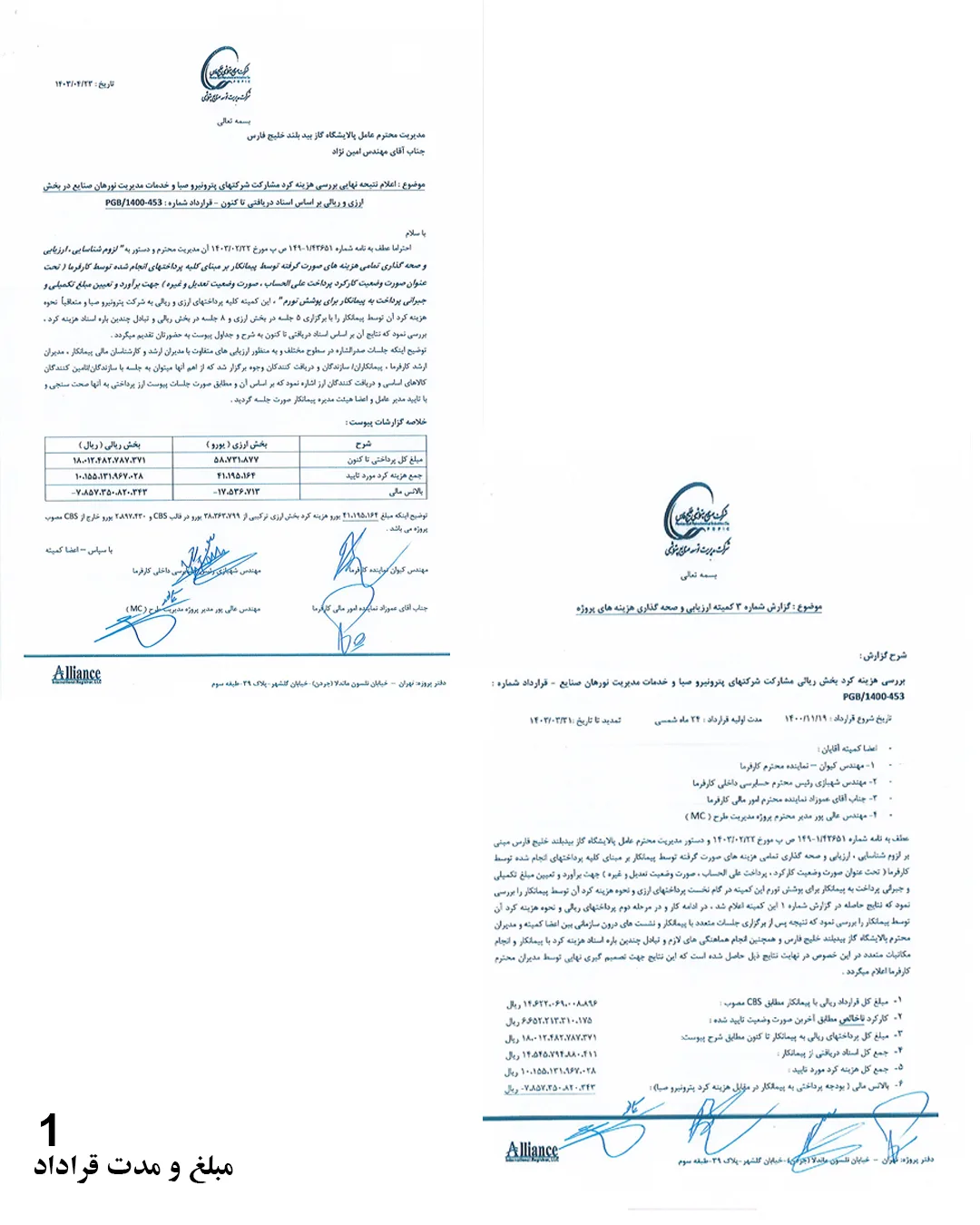
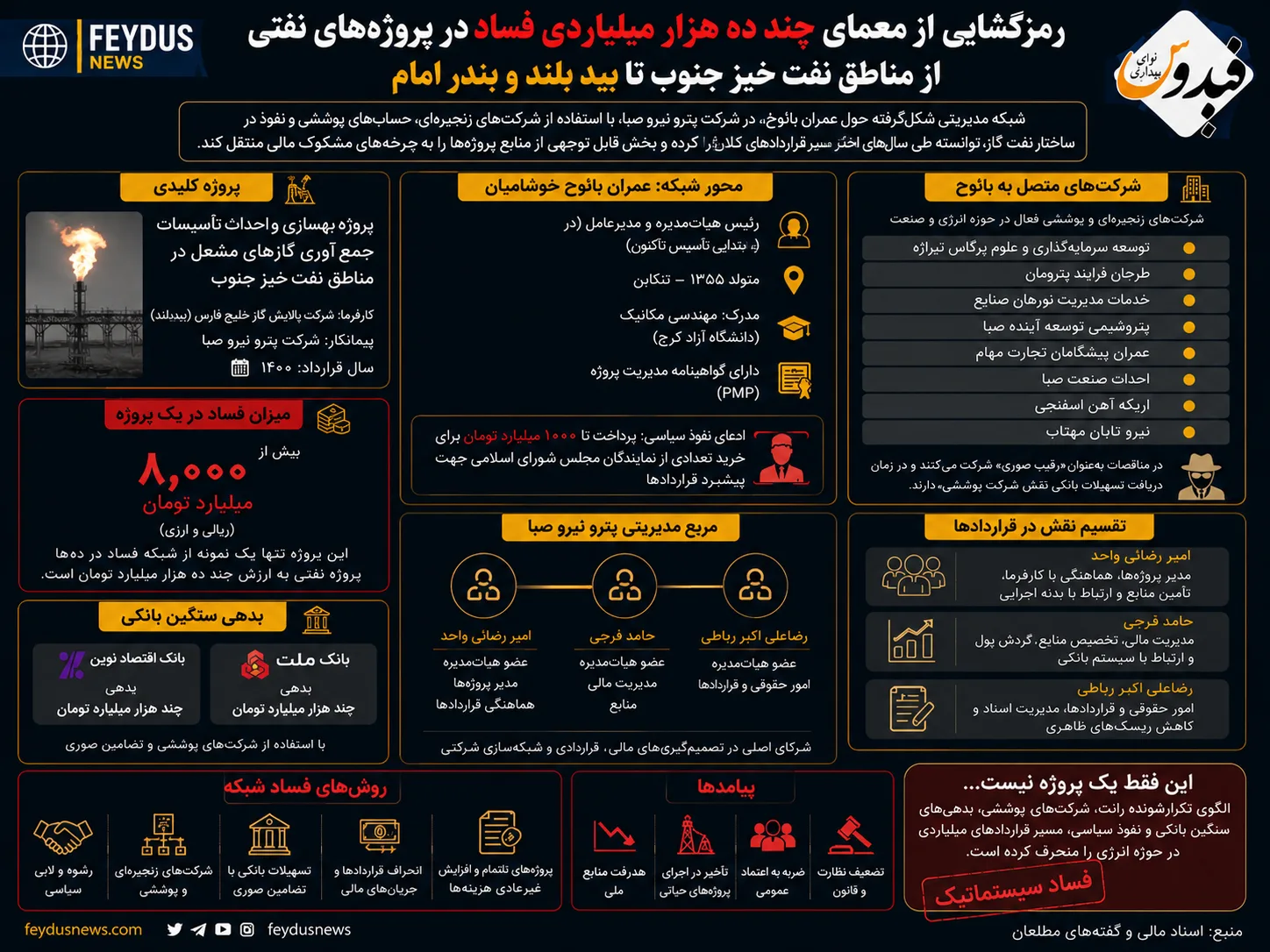
Amid the review of financial documents of the project "Improvement and Construction of Flare Gas Collection Facilities in Southern Oil-Rich Areas" concluded between Bidboland Persian Gulf Gas Refining Company and Petro Niroo Saba in the year 1400 a worrying picture of a multi-layered managerial and financial network emerges; a network that, according to available documents and informed sources, has raised the level of corruption in this contract to more than 8 trillion tomans, in both rial and foreign currency, and also sheds light on a network of corruption in dozens of oil projects worth tens of thousands of billions of tomans.
The review of ownership structure, managerial backgrounds, and the flow of money in Petro Niroo Saba and its affiliated companies shows that this contract is not just an isolated case; rather, it is a link in a recurring pattern of rent-seeking, cover companies, heavy bank debts, and the transfer of large sums under the shadow of weak oversight by the state employer and political influence in the Ministry of Oil and the Islamic Consultative Assembly.
It is noteworthy that in the next report, we will specifically and case-by-case address the violations of this company in contracting projects.
Bidboland Project and the Position of Petro Niroo Saba in the Corruption Map
Petro Niroo Saba Company, established in the year 1387 has, in a relatively short period, taken responsibility for some of the major projects in the energy sector. Some of these projects remain incomplete, and in others, a pattern of abnormal cost increases and recurring violations is observed; meanwhile, this company continues to participate in oil, gas, and petrochemical projects in the country.
The combination of these signs, along with the continued awarding of projects to this company, indicates a powerful rent for the owners of Petro Niroo Saba; a rent that, according to this report, is based on extensive connections with senior managers in the oil, gas, petrochemical sectors, and some influential political figures.
The 1400 contract with Bidboland is a clear example of this widespread corruption. According to informed sources and existing documents, the influence of this managerial and political network has raised the level of financial corruption in this project to more than 8 trillion tomans.
The Management Square Around "Omran Baoj Khoshamian" and Chain Companies
Network Axis: Omran Baoj Khoshamian
The network of Petro Niroo Saba managers is centered around an individual named Omran Baoj Khoshamian; someone who has held the position of chairman of the board since the company's inception and at one point also served as the CEO of the group. According to documents and informed sources, he has played a pivotal role in shaping the network pattern of corruption, cover companies, and financial deviation in energy sector contracts.
Baoj, born in 1355 in Tonekabon, had no prominent and meaningful industrial management background before entering major oil, gas, and petrochemical projects. He holds a mechanical engineering degree from Azad University of Karaj and a project management certificate; titles that are also used in his official introduction today. However, Baoj's real role in Petro Niroo Saba has been highlighted not in technical or managerial development, but in leading a network of chain companies, managing suspicious financial flows, and advancing contracts tainted with rent-seeking.

Baoj, who is referred to by his close associates within the company as "Mr. Special of Oil Projects", is more known for how he acquires projects and his claims about political influence than technical achievements. According to suppliers and creditors who have attended negotiation meetings with him, Baoj has introduced himself in these meetings as the "main person" of the group and has repeatedly claimed to have the financial power and influence necessary to buy "a number of members of the Islamic Consultative Assembly" with payments of up to 1000 billion tomans to advance contracts.
In more official conversations, Baoj presents a different story; he claims that the "seed of Petro Niroo Saba" was planted years ago in a 50-square-meter office on Ferdows Boulevard in Tehran, and today his company is a "capable private sector general contractor" that takes on large projects with "courage." However, financial documents, the status of incomplete projects, the volume of bank debts, connections with cover companies, and his role in the multi-layered management structure show that this narrative is more of a cover for consolidating his personal power in the corruption network rather than a description of a real path of industrial growth.
On the surface, Baoj presents himself as an entrepreneur who "believes in unlimited mental capacities"; an image that he has repeatedly emphasized in his speeches. However, in practice, this individual has become the central element of a network that, by utilizing satellite companies, proxy managers, money-laundering rings, and political influence, has diverted the path of billion-dollar contracts in the energy sector and transferred large financial resources to suspicious cycles.
Companies Connected to Baoj; Apparent Competitors and Credit Cover
Baoj is the central link in a chain of companies that work under the goals of Petro Niroo Saba with diverse areas of activity in the energy and industry sectors or appear in tenders as the "apparent competitor" of this company; tenders that, according to informed sources, have been purchased in advance with bribes and political lobbying.
In the list of these companies, names such as: Pergas Tirajeh Investment and Science Development, Petro Man Process Designers, Noorhan Industries Management Services, Saba Future Development Petrochemical, Omran Pishgaman Tejarat Maham, Saba Industry Construction
and also companies like Erikeh Sponge Iron and Niroo Taban Mahtab can be seen where Baoj has a history of being a CEO and a shareholder.
According to documents and informed sources, part of these companies played the role of "cover companies" when receiving bank facilities for Petro Niroo Saba, and in the massive debt of this network to the Novin and Mellat Banks, the pattern of their connection and coordination can be observed.
In the board of directors and management structure of these companies, the names of other board members of Petro Niroo Saba also appear repeatedly:
Amir Rezaei Vahed, Hamed Faraji, Reza Ali Akbar Rabati
These three, along with Baoj, form the main management square of Petro Niroo Saba and, according to informed sources, are his main partners in corporate networking and financial and contractual decision-making.
From Rezaei Vahed to Faraji and Rabati; Role Division in Contracts
The Key Role of Amir Rezaei Vahed
One of the most important figures in this structure is Amir Rezaei Vahed, who has held multiple positions in companies connected to Baoj, including:
Vice-Chairman of the Board of Directors of Pergas Tirajeh Investment and Science Development, Former Vice-Chairman of the Board of Directors of Saba Future Development Petrochemical, Vice-Chairman of the Board of Directors of Chemical Managers Chemistry, Board Member or Vice-Chairman in Petro Niroo Saba Exports and Saba Industry Construction, Shareholder in Erikeh Sponge Iron, Liquidator of some closed companies belonging to Baoj
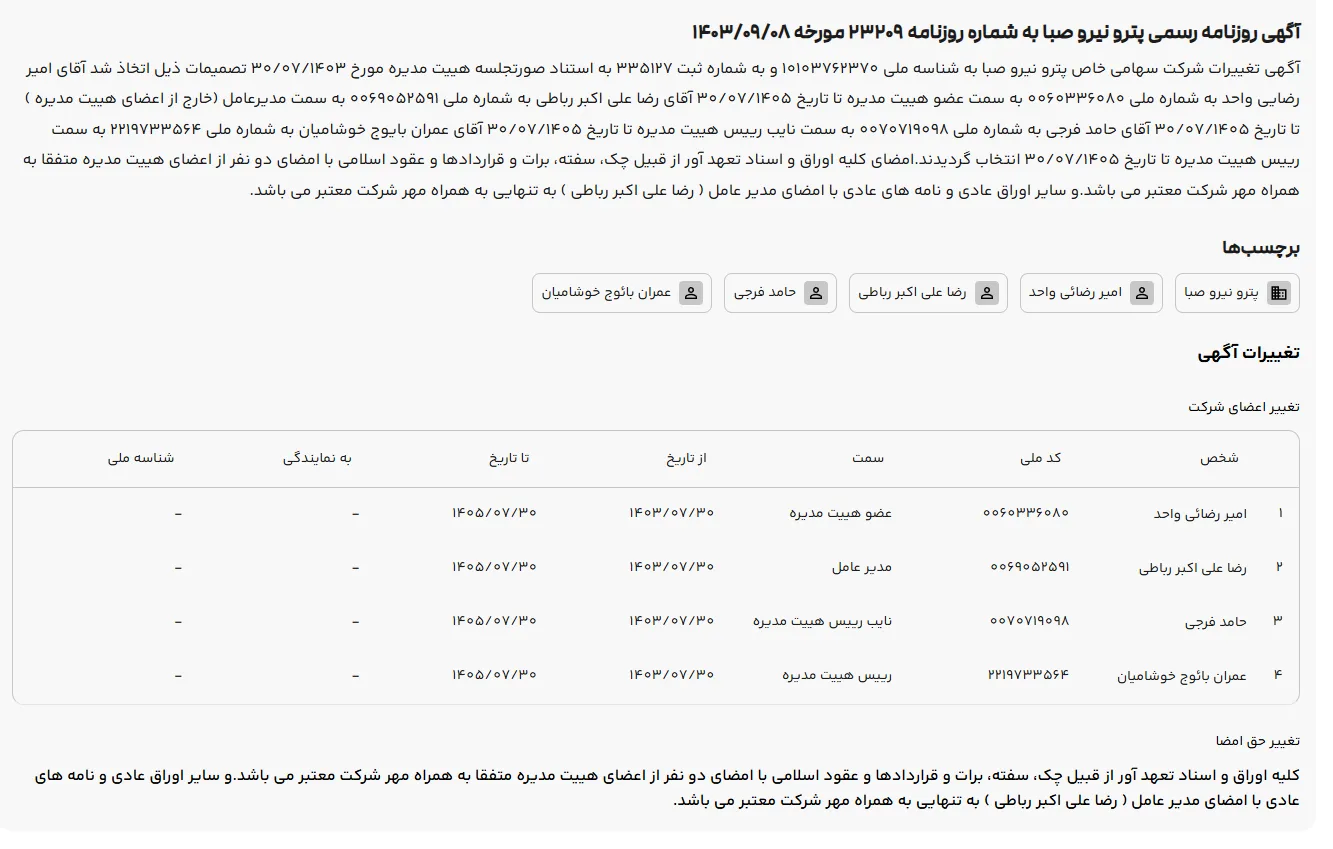
The importance of Rezaei Vahed's role becomes clearer when looking at the management status of Petro Niroo Saba during the contract with Bidboland. According to official documents and official newspaper announcements, although Reza Ali Akbar Rabati is mentioned as the CEO of Petro Niroo today, during the contract period and the receipt of foreign currency and rial amounts for the project, from the year 1400 to Azar 1402, the name of the CEO in official documents was Amir Rezaei Vahed.
According to these documents, Rabati was only introduced as the CEO from Azar 1402 while a significant portion of the payments to Petro Niroo Saba were made before this date and during the official management period of Rezaei Vahed.
Limiting Rabati's Official Responsibility
The announcement of Mehr 1403 clarifies another important point: In this announcement, it is stated that the implementation of board resolutions and the signing of all contracts, papers, and binding documents – such as checks, promissory notes, and bills – require the signature of two board members, and the CEO (Rabati) only has the authority to sign "ordinary papers and letters".
This arrangement shows that the circle of Petro Niroo Saba managers has tried to reduce the level of formal legal commitment for Baoj and Rezaei Vahed and to advance a significant portion of decisions and signatures under the cover of the new CEO's signature and other members.
Despite this, according to creditors and employees who have met with Rabati, he has always emphasized his "unawareness" of violations and money transfers in meetings with creditors; while according to financial documents, some of these transfers were made with his direct signature.
Hamed Faraji; Behind-the-Scenes Manager in Subsidiary Companies
Hamed Faraji is another side of the Petro Niroo Saba management square. He is currently the vice-chairman of the board of directors of this company and has been present in these groups simultaneously or at different times:
Petro Niroo Saba Employees Credit Company, Saba Future Development Petrochemical, Chemical Managers Chemistry, Niroo Tabesh Khavar, Niroo Taban Mahtab, Erikeh Sponge Iron
Faraji has held roles such as chairman, vice-chairman, simple board member, CEO, and shareholder in these companies. The level and diversity of his presence in subsidiary companies show that Faraji is not merely a ceremonial figure, but has practically played the role of a "behind-the-scenes manager" in some of the sensitive financial and contractual decisions of this network.
Second Layer; Managers of Cover Companies
In the second layer of the network, the names of managers appear who play roles in the board of directors or executive management of Petro Niroo Saba's subsidiary companies and appear repeatedly in several companies; individuals whose roles in covering the network's financial and contractual activities are described as important:
Mostafa Khodabandeh – CEO of Petro Niroo Saba Exports, Hadi Jafari Ziyareti – CEO of Saba Industry Construction and former member of the board of directors of Petro Niroo Saba until the year 1402, Mohammad Bagher Malek – CEO of Saba Future Development Petrochemical, Saeed Arouji – CEO of Pergas Tirajeh Investment and Science Development, Mehdi Malek Alaei – CEO of Petro Man Process Designers
This layer acts as the circle of managers of cover companies, and their names appear in various documents alongside companies that play intermediary roles in receiving facilities, signing contracts, and transferring financial resources.
Third Layer; Money Laundering Ring and Management of Money Transfers
In the third layer, according to informed sources and existing documents in the Bidboland project file, we are faced with a group of individuals whose main role is to manage the network of money transfers and conceal financial flows with personal benefits; a role that is clearly described as money laundering.
Majid Ahmadi; Workshop Manager or Main Money Transfer Link?
Majid Ahmadi's name is prominent in this layer. He was introduced as the "Rameshir Workshop Manager" in the final year of the project implementation and was responsible for managing the workshop and dealing with the complaints of workers who were dissatisfied with not receiving their wages.
However, in official contractual documents, another individual's name, Mohammad Ahmadi Khah, is registered; even the insurance declared in official documents is registered for Mohammad Ahmadi Khah, while the person present at the workshop, signing administrative and financial matters, and the contact point with contractors and forces, was Majid Ahmadi.
According to informed sources, Ahmadi is a retired law enforcement officer and, beyond workshop responsibilities, was introduced as the person responsible for receiving payments from contractors introduced by the representatives of Behbahan and Ramhormoz; payments that were made as bribes in exchange for awarded contracts to the network of Petro Niroo Saba managers.
Some informed sources say that contractors introduced by some members of the Assembly deposited monthly amounts of about 300 to 400 million tomans into Majid Ahmadi's account as a bribe for documentation purposes; without him having a direct and clear role in contracts in official documents.
Ahmadi's role was not limited to workshop management; according to informed sources, he was the network's liaison with provincial executive managers – from the governor to other officials – and the transferor of advertising costs for the current representative of Ramhormoz, Amir Hossein Nazari, and the current representative of Behbahan, Mazlumi; costs that Petro Niroo Saba has entrusted him with paying.
Chain of Intermediary Accounts; From Contractors to Main Managers
The money laundering network in this case does not end with Ahmadi. According to documents and statements from involved individuals, names such as Mona Askari and Ameneh Khosravi also appear in this cycle; individuals whose bank accounts and phone lines have been used for transferring amounts and coordinating activities outside the legal framework.
The narrative pattern from informed sources is as follows:
- The amounts received from contractors – which were supposed to be a percentage for the two main individuals of Petro Niroo, namely Baoj and Rezaei Vahed, for "contract awarding rights" – are first deposited into the account of his former wife, Ameneh Khosravi.
-Khosravi transfers these amounts to the account of Mona Askari.
- In the third stage, the money is transferred from Mona Askari's account to the accounts of other individuals.
This multi-layered path is practically a cover for the money cycle and a clear example of money laundering and even bypassing other company partners.
According to individuals related to the project, Mona Askari rented a house in Kianabad on the instructions of Petro Niroo Saba managers and was stationed there as an unofficial office. It has also been reported in the company's administrative and financial sections that at times, there was intense competition between Baoj and Rezaei Vahed to place their trusted individuals in charge of projects and plans; a competition whose main goal was to receive a larger share of contracts awarded to contractors.
Continuation of the report below the infographic image
Assets, Name Change, and Employees Sent to the "Sacrificial Altar"
Alongside these circles, the name of Omran Baoj's father is also raised in the financial circulation network. He operates under the former family name Baoj – before the name change – and according to this report, parts of the amounts have been allocated through his account for purchasing various properties; including several hectares of land in Tonekabon and other northern cities of the country.
Another individual that should be considered in this network is an employee who was present in the Bidboland project for nearly 5 months as a project manager and about a year as a project supervisor; an individual named Azizpour. According to informed sources, in each installment of money transferred from Bidboland to Petro Niroo Saba's account, 30 to 40 percent of the amount was transferred to Azizpour's account. He has played a similar role in other Petro Niroo projects and seems to be one of the key individuals in the company's money laundering circle.
The vital role of the second and third layers in this network becomes clearer when we look at examples of how the received amounts were spent; including:
Purchasing a building for the company, simultaneously with the start of the Bidboland contract, for about 400 billion tomans
Purchasing Kahan Asin Sazeh Tajhiz Company in Farvardin 1403 for 229 billion tomans
These transfers were made while, according to employees, Petro Niroo Saba managers have not paid their staff's salaries for months, claiming losses and lack of financial resources, and the company's debt to equipment and service contractual parties in the region has reached about 700 billion tomans.
Moreover, one of the strange cases in Petro Niroo Saba's work file is the export of 8 million euros of rebar from project assets to South Africa, which is just one instance of large-scale transfers in this company for personal illegal gain.
For example, another case of collusion and blatant fraud by Petro Niroo Saba is the Karun 2 project, whose contract was concluded with Karun Petrochemical Company, and by using a method similar to Bidboland and prolonging the work time relative to the contract, several times the initial amount of money has been received, and the project is still not fully completed.
According to these sources, on the other side of the story, the main owners of the company have converted part of this money into foreign currency, overseas properties, purchasing properties in the name of relatives, and buying foreign cars.
Role of State Oversight and Political Influence; Why is This Network Important?
What makes this network's influence in various energy sector projects a sensitive issue is not just the financial dimensions of corruption and project losses; rather, it is the blatant involvement of a network of Ministry of Oil managers and Assembly representatives in awarding projects to Petro Niroo Saba and its affiliated companies.
According to this report, this very network has provided the main rent for Petro Niroo and has taken a significant share of the disappeared amounts in the concluded contracts for itself; while the projects remain incomplete, workers and contractors are creditors, and heavy debts to the banking system and the private sector remain.
This case, although centered around the contract "Improvement and Construction of Flare Gas Collection Facilities in Southern Oil-Rich Areas" between Bidboland and Petro Niroo Saba, is actually an example of a broader pattern of structural corruption in the oil, gas, and petrochemical industry; a pattern based on chain corporate networks, cover companies, multi-layered money laundering, and political influence that, without real oversight and transparent accountability, can turn any project into a tool for transferring public resources into the pockets of a limited group.
This case is not just an exposé; it is an indication of structural corruption in Iran's energy industry. Corruption that, without serious oversight and transparent accountability, can lead to the plundering of national resources on a scale of tens of thousands of billions of tomans.
The full report and documents are in the attached PDF file