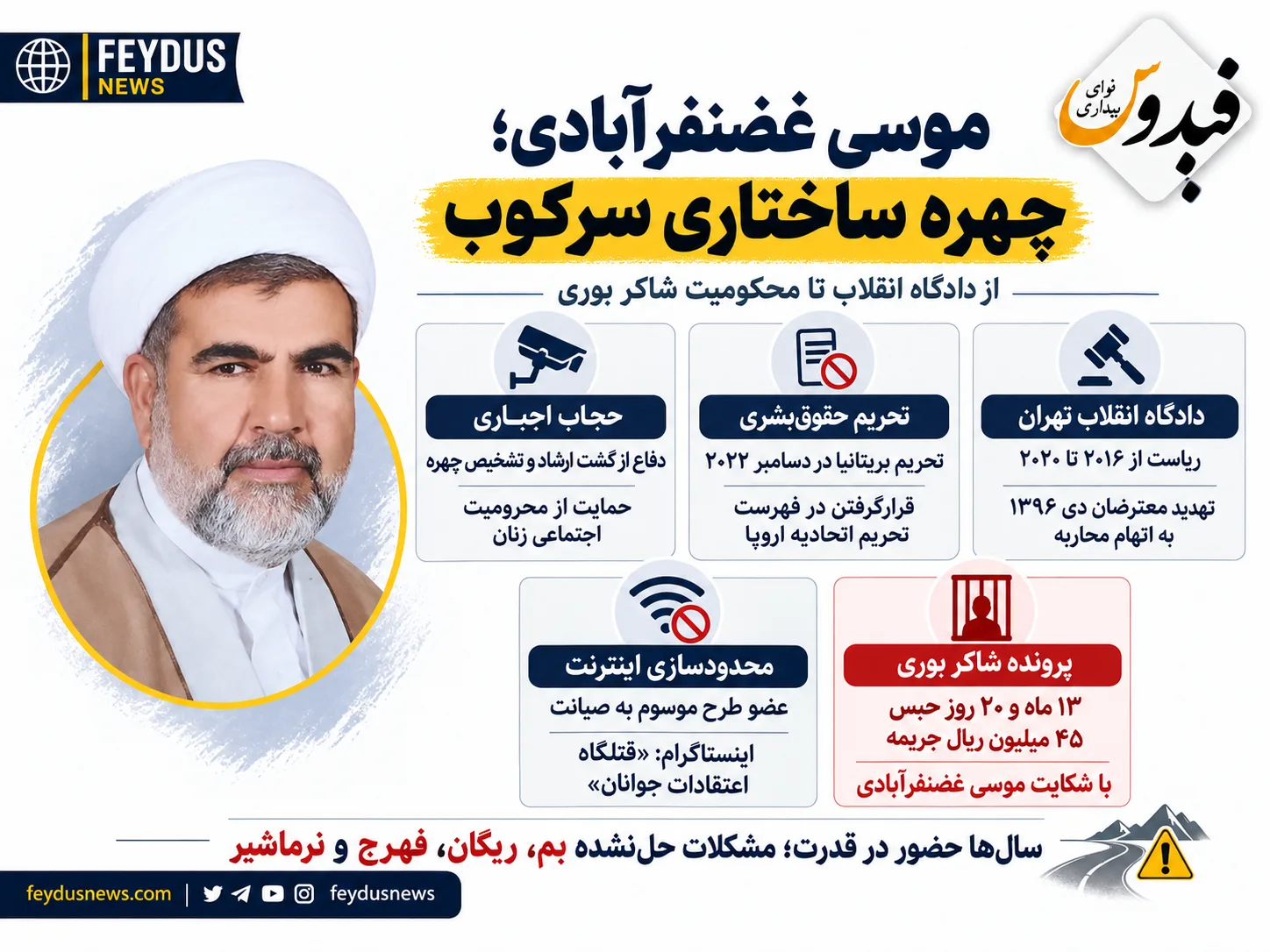
While the European Union and the United Kingdom have been sanctioning Iranian judicial and security officials for years due to "serious human rights violations," the name Mousa Ghazanfarabadi, former head of Tehran's Revolutionary Court and a multi-term representative of Bam County, has recently been at the center of a new controversy over freedom of expression. The conviction of Shaker Boori, an Iranian satirist, in a case initiated by Ghazanfarabadi, is a new link in a chain of decisions and positions that show a consistent pattern from the Revolutionary Court to the Parliament: defending repression, restricting the internet, and cracking down on protesters, alongside unresolved problems of the people of Bam..!
A Brief History of Structural Corruption and Suppression of Civil Rights
Since the early 2010s, a series of decisions and structures in the Islamic Republic of Iran have formed something beyond "individual corruption": structural corruption in the field of civil rights. This corruption is not only related to embezzlement and rent-seeking but also to the systematic use of the judiciary, laws, and security institutions to restrict freedom of expression, suppress protests, control the internet, and impose mandatory hijab.
Since 2011, the European Union has imposed human rights sanctions against Iran, and after the "Women, Life, Freedom" protests and subsequent waves of protests, it has significantly expanded the list of sanctioned individuals and entities. These sanctions include judges who have issued heavy sentences against protesters, officials involved in torture and inhumane treatment of prisoners, and those who have participated in restricting the internet and suppressing the media. In this structure, figures who play roles in both the judiciary and the parliament find a special place, and Mousa Ghazanfarabadi is a clear example of this connection.
From the Revolutionary Court to Human Rights Sanctions
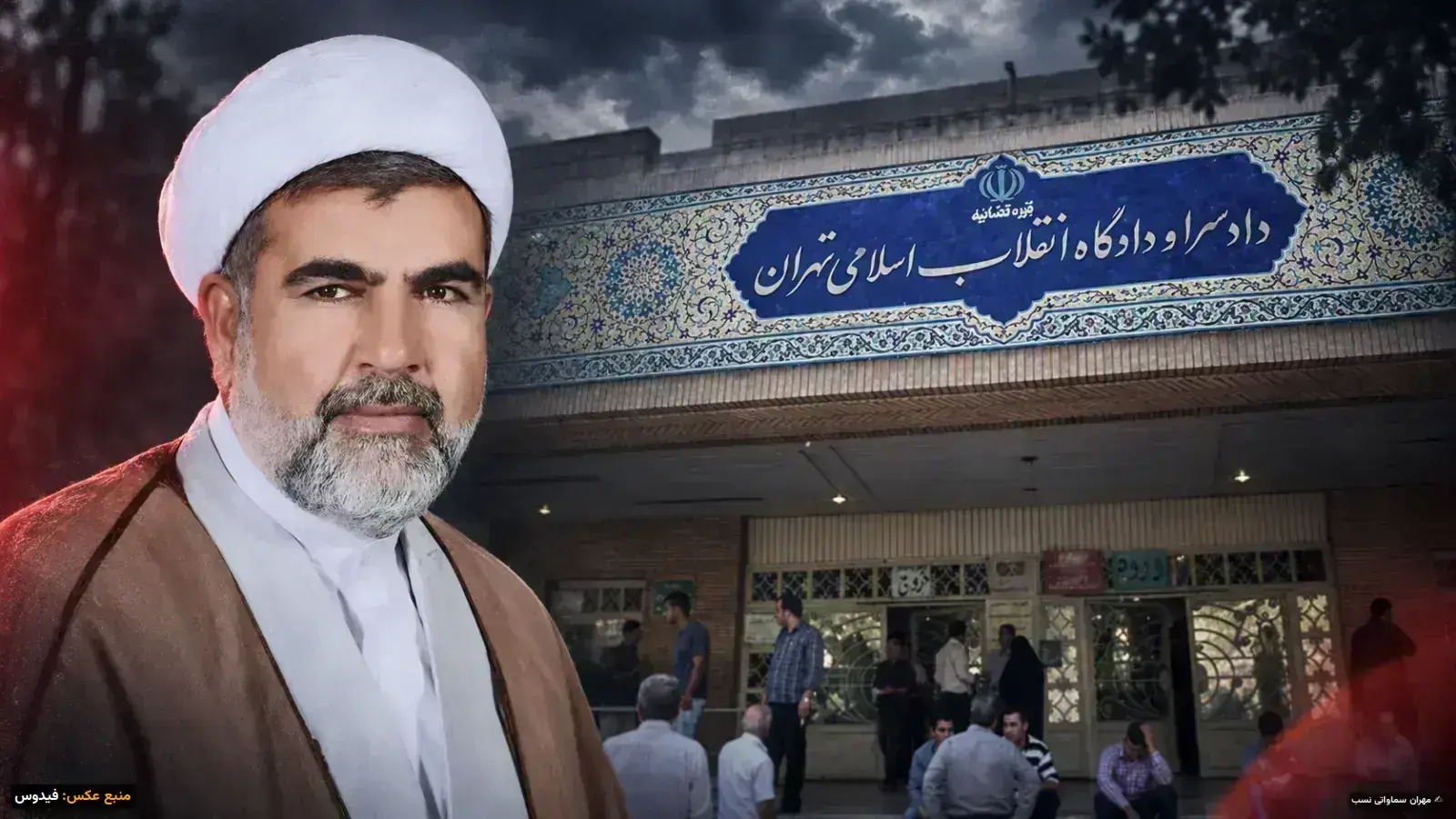
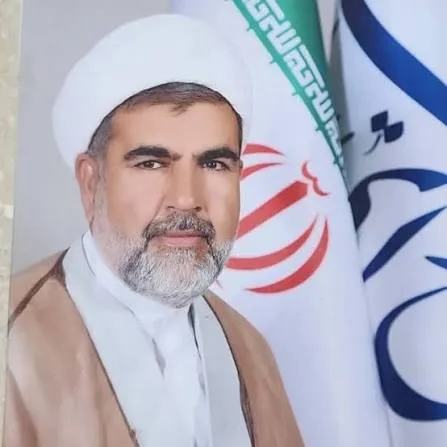
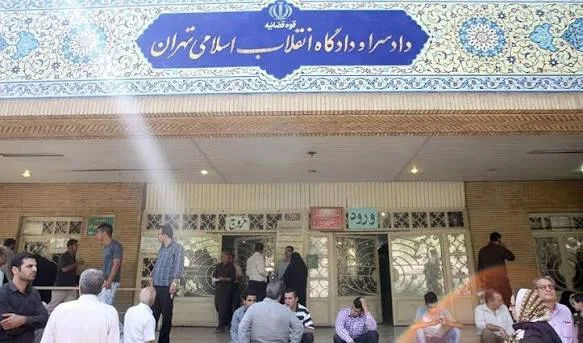
From May 2016 to November 2020, Ghazanfarabadi was the head of Tehran's Revolutionary Courts, an institution where many political and security cases, from protesters to civil activists, have been handled. In December 2022, the UK sanctioned him for his role in "serious human rights violations," and the European Union also included his name on its human rights sanctions list. The EU's official document specifically mentions his support for depriving women who violate mandatory hijab of social rights and defending the use of force against them.
During the December 2017 protests, as the head of the Revolutionary Court, he warned that some "ringleaders" might face charges of moharebeh, an accusation that can lead to the death penalty. He also stated that women protesting against mandatory hijab would be dealt with "severely." This record was later complemented by his role in the parliamentary judiciary commission and his support for strict social policies.
Ghazanfarabadi's support for mandatory hijab and the social deprivation of women, his proposal for facial recognition, defense of morality patrols, key role in the strict hijab bill, opposition to lifting social media restrictions, participation in so-called "protection" plans, history of threatening protesters with severe punishments, and inclusion in the UK and EU human rights sanctions list reveal a harsh figure opposed to any form of individual and civil freedom.
Hijab, Internet, and Legislation Against Civil Liberties
In the eleventh parliament, Ghazanfarabadi, as the head of the judiciary commission, was one of the main figures behind the "Chastity and Hijab" bill, which was passed with limited review in the commission and a three-year trial implementation. He defended mechanisms that allowed women without hijab to be identified by facial recognition cameras and deprived of social services and even access to national ID cards until they paid fines. This proposal was criticized by legal experts and independent media as a violation of civil rights.
In the realm of the internet, Ghazanfarabadi, the representative of Bam, called Instagram a "graveyard of youth beliefs" and high-speed internet a "highway for regime opponents." In the eleventh parliament, he was a member of the joint commission for the so-called "protection" plan, and in the twelfth term, his name appeared among the signatories of new plans for strict regulation of the virtual space and comprehensive audio and video, known as "Protection 2," which continues the policy of restricting people's free access to the internet.
These decisions place Ghazanfarabadi among those who have actively legislated to restrict civil liberties and control the online space, not merely as a passive voter.
The Latest Link; Conviction of Shaker Boori
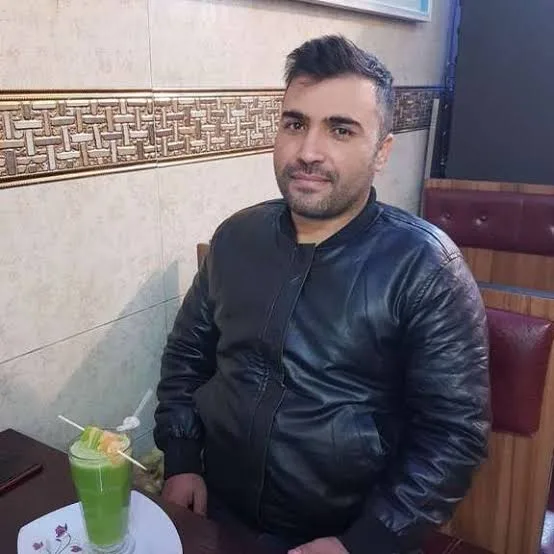
In September 2026, this record was tied to a new case. Shaker Boori, a popular satirist, announced that Branch 101 of the Abadan Criminal Court had sentenced him to 13 months and 20 days in prison for "spreading lies with the intent to harm others through computer systems" and fined him 45 million rials for "insulting a member of parliament." The case was initiated by Mousa Ghazanfarabadi. The verdict is still subject to appeal, but its issuance has sparked a wave of criticism on social media and among Persian-language media outside Iran.
In the electoral district of Bam, Rigan, Fahraj, and Narmashir, another picture emerges. Ghazanfarabadi has spoken in official channels and local media about pursuing gas supply to the east of the province, the Narmashir-Rigan road, issues with dates and exports, the Bam automotive industry, and preserving employment in Arg-e Jadid. In local reports, he has repeatedly demanded ministries address issues related to dates, employment, the automotive industry, and hazardous roads.
However, a significant portion of these issues remains unresolved. The Narmashir-Rigan road has become an "endless saga," and deadly accidents have prompted local media to criticize the slow progress of the project. National housing, unsold dates in cold storage, urban service issues, and basic infrastructure problems continue to be repeated in people's messages and local reports: "Just saying 'I followed up' is not enough to evaluate performance; results must be seen."
This gap between multi-term political power and unresolved daily problems shapes the local record of Ghazanfarabadi in an electoral district where the houses of Bam's earthquake victims remain unbuilt, and they live in temporary shelters.
A Structural Figure in the Repression Machine
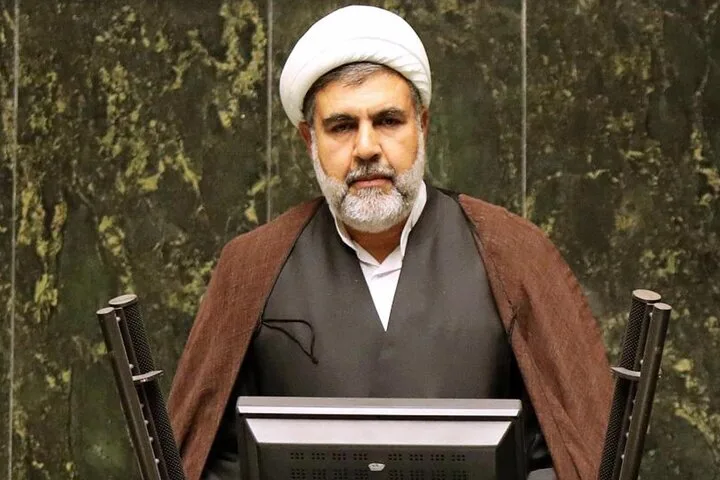
Putting these pieces together, the picture becomes clearer: Mousa Ghazanfarabadi is not merely a local representative but one of the structural figures in the repression machine of the Islamic Republic. From the Revolutionary Court to the head of the parliamentary judiciary commission, from the hijab bill to internet restriction plans, he has played a role in solidifying anti-civil liberties policies and has therefore been included in the EU and UK human rights sanctions list.
Meanwhile, in Bam and eastern Kerman, despite his years in power, a significant portion of the people's infrastructural and livelihood problems remain unresolved. The conviction of Shaker Boori, the latest link in this chain, shows how a structure built to control protests and silence critical voices today even brings satire and humor to court, and this may be the most accurate depiction of Mousa Ghazanfarabadi's relationship with the people and their rights.