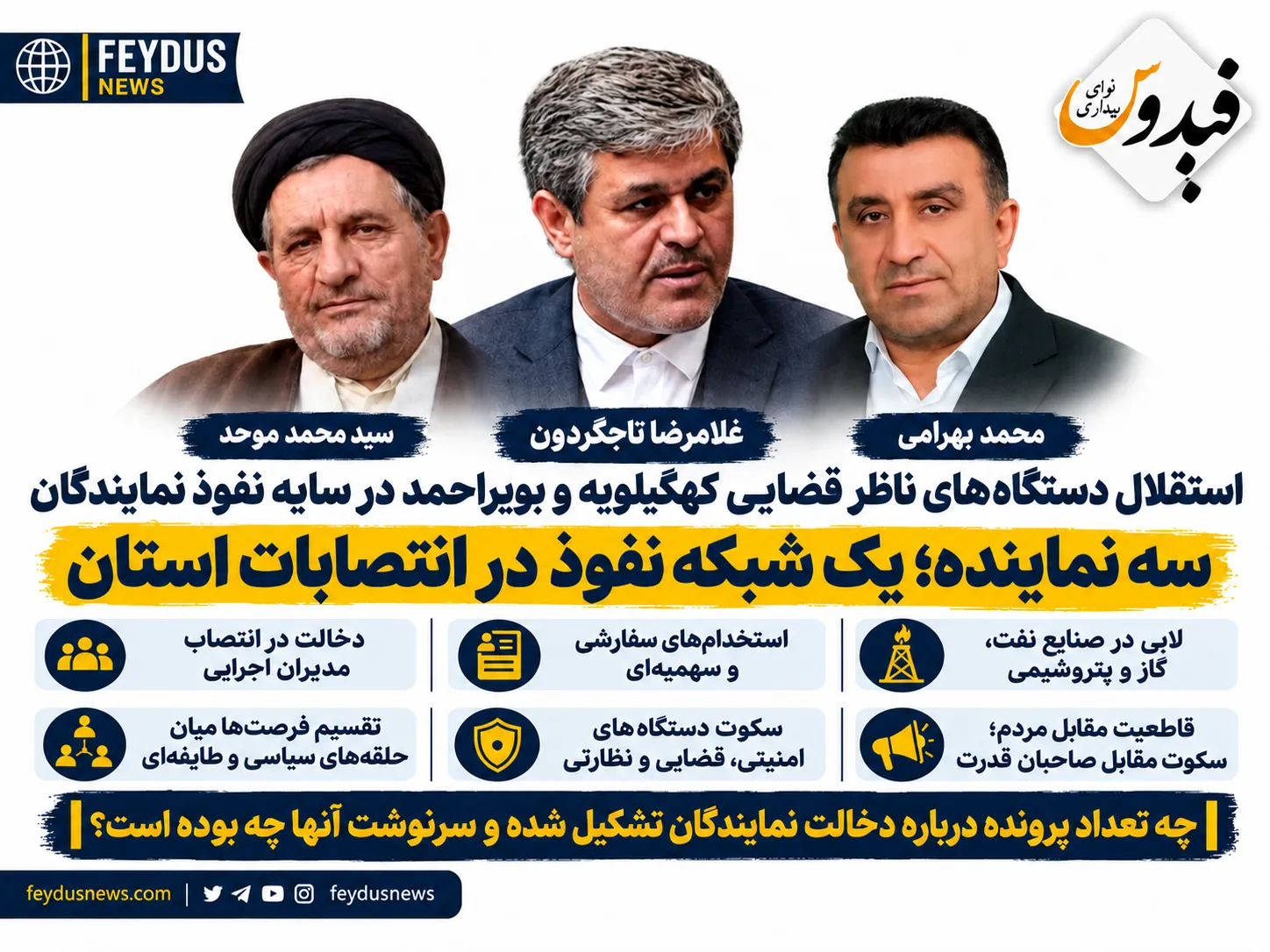
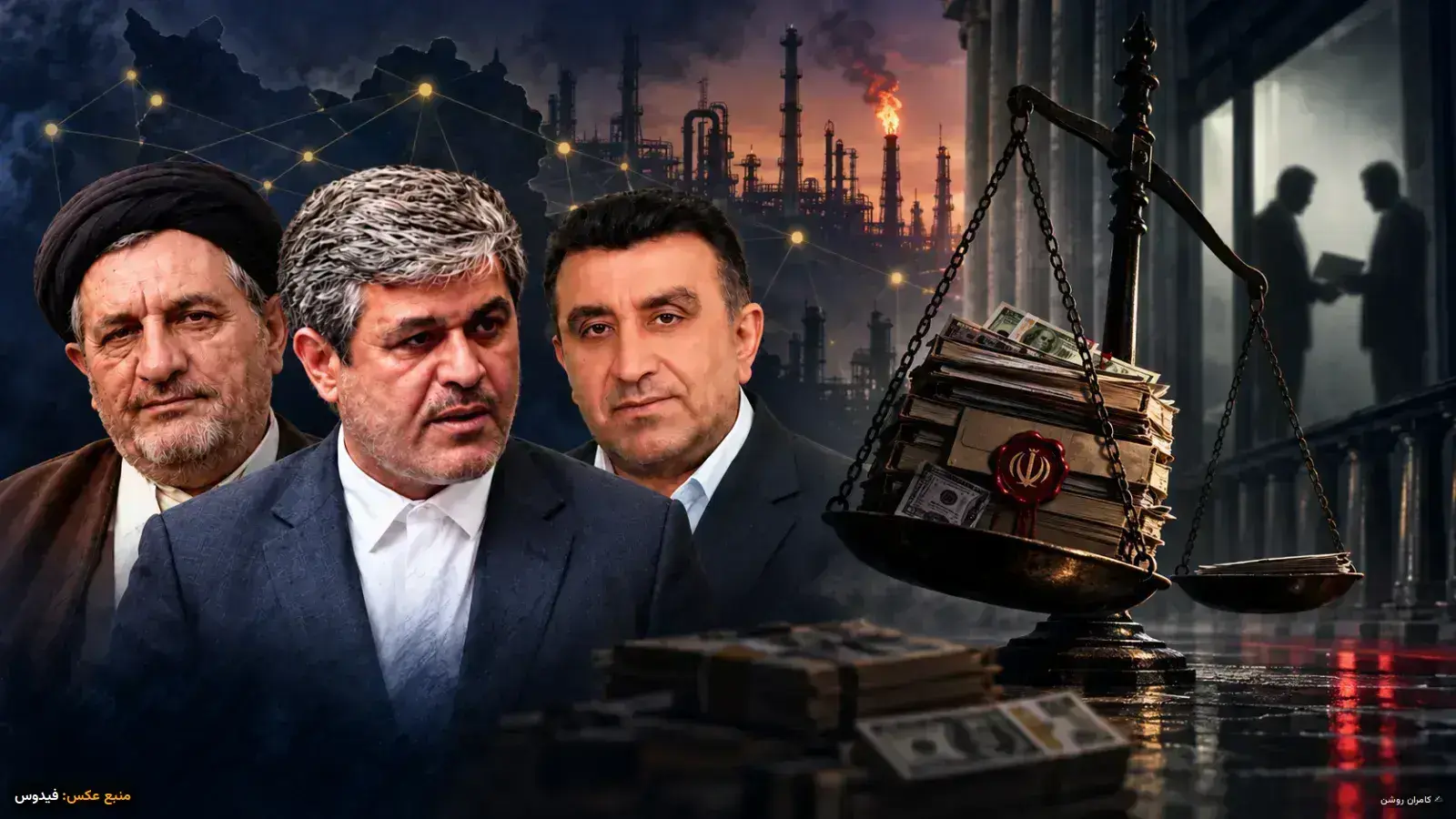
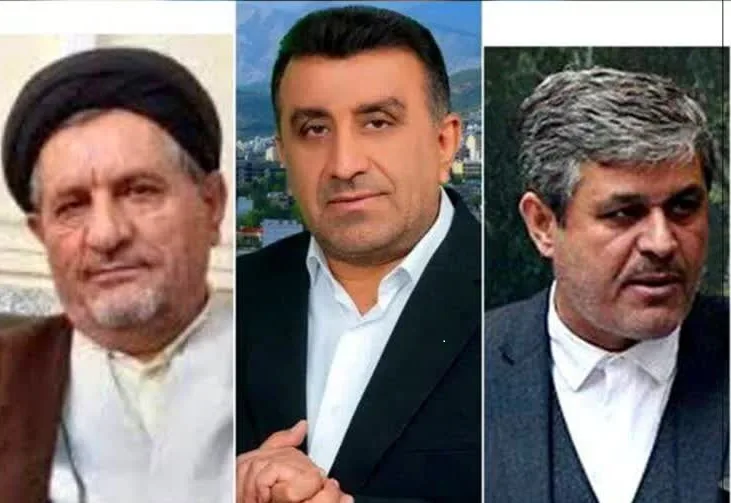
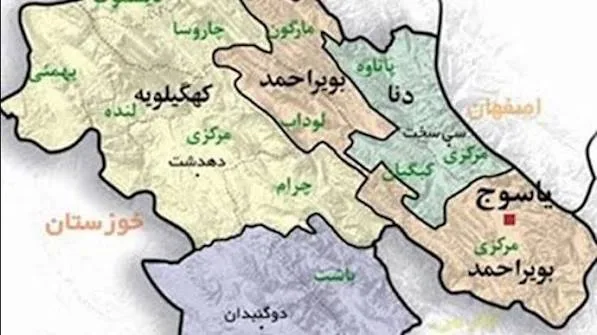
In Kohgiluyeh and Boyer-Ahmad, the issue is no longer limited to the corruption of a manager or the misconduct of a department; what has emerged before the eyes of the people is a deep-rooted mechanism where three provincial representatives—Gholamreza Tajgardoon, representative of Gachsaran and Basht; Mohammad Bahrami, representative of Boyer-Ahmad, Dena, and Margoon; and Seyed Mohammad Movahed, representative of Kohgiluyeh, Bahmei, Charam, and Lendeh—are accused of having extensive influence in executive appointments, job distribution, and economic relations in the province.
Representatives
who are supposed to oversee the government and executive managers have themselves become part of the process of selecting and sustaining these managers. In this structure, security, judicial, and oversight institutions, which have a legal duty to stand against political influence, have often either remained silent or facilitated its expansion through their inaction.
Local media
reports indicate that the selection of managers in the province has long deviated from the path of expertise, merit, and administrative regulations and has become part of the competition among the offices of Tajgardoon, Bahrami, and Movahed, their supporting tribes, and affiliated political circles. Governorships, directorates, state companies, or economic entities are no longer seen as institutions belonging to the public; each managerial position is a share of the spoils of power that must be divided among representatives, electoral headquarters, and loyal forces.
A manager who
sits in a position by the recommendation of a representative does not consider himself indebted to the people and the law. His survival depends on the satisfaction of the same circle that engineered his appointment. Such a manager, instead of being accountable for contracts, recruitments, and the performance of his department, becomes an agent for securing the interests of his political supporter. This is the point where the province's executive management becomes an arm of the representatives' electoral headquarters.
Three Representatives, Three Electoral Districts, and a Common Pattern for Power Division
The name Gholamreza
Tajgardoon is at the center of a significant part of this dispute. According to local critics, his influence in the budget structure, energy industries, and executive management has long exceeded the usual bounds of a representative's activities. The issue is not just supporting a manager or pursuing a project; it is about a network accused of extending from administrative and industrial appointments to workforce recruitment and economic opportunity distribution.
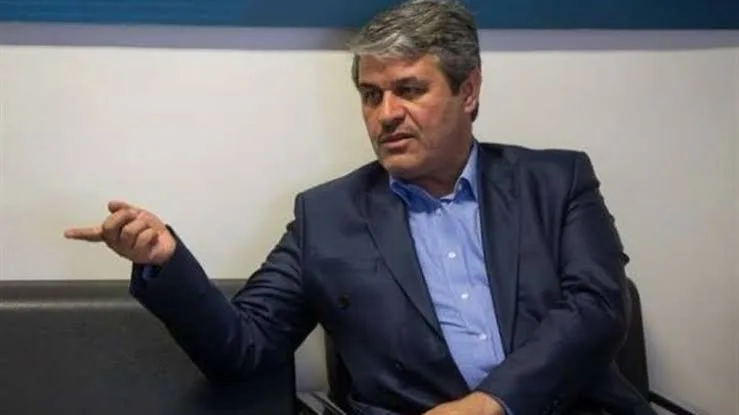
In 2020, Tajgardoon faced objections from several representatives regarding his credentials, and ultimately, the parliament rejected the credentials of the Gachsaran representative with 128 votes. This unprecedented event showed that the ambiguities raised about his economic relations and managerial network could not be reduced to a local electoral dispute. However, his return to parliament in 2024, without a transparent report on the fate of those ambiguities, raised a serious question: What exactly have the security, judicial, and oversight institutions been investigating over these years, and what were the results of their investigations?
But the
province's issue is not only Tajgardoon. In the Boyer-Ahmad, Dena, and Margoon area, critics accuse Mohammad Bahrami of trying to secure his political share in appointments and manager placements. The expectation for the representative's opinion on the selection of a director-general, governor, or manager of an economic entity is itself a sign of the collapse of the boundary between parliamentary representation and executive management. Bahrami must clarify what role his office has played in introducing managers, transferring officials, and employing or deploying forces in the province's executive bodies.
In the Kohgiluyeh, Bahmei, Charam, and Lendeh area, Seyed Mohammad Movahed's long-standing influence has become one of the constant elements of political and managerial equations. The prolonged presence of a representative in the power structure, if not accompanied by transparency and independent oversight, can create a network of indebted managers, electoral supporters, and local intermediaries that even changes in governments cannot dismantle. Local critics consider Movahed's alleged interventions in appointments and managerial claims as part of this structure; a structure where proximity to the representative's office sometimes becomes more important than expertise and professional background.
The difference
between Tajgardoon, Bahrami, and Movahed is in their electoral districts and the scope of their networks; but the result of the interventions attributed to all three is the same: weakening the independence of managers, turning public opportunities into political advantages, and tying people's job futures to the representatives' offices.
From Provincial Departments to Energy Industries; Employment as an Electoral Reward
The scope of
the representatives' influence is not limited to local departments. Gachsaran is one of the most important oil-rich areas in Iran, and the province's proximity to large oil, gas, and petrochemical complexes in Khuzestan and Bushehr has provided a wide field for lobbying over employment, contracting, and managerial appointments.
Among these,
Tajgardoon's influence in oil and petrochemical-related entities has received the most attention, but Bahrami and Movahed are also accused of using their representative status and local networks to exert pressure for recruitment, stabilize close managers, and claim shares of economic opportunities. All three representatives must explicitly state how many letters of introduction they have issued, who has entered government departments or industrial companies on their recommendation, and which managers have been appointed or dismissed following their lobbying.
The case of
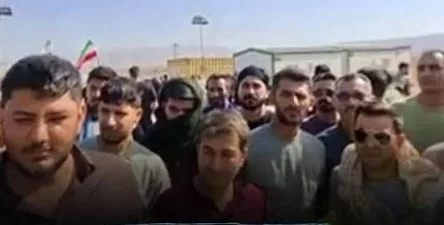
recruitments and workforce placements in projects and companies located in the Gachsaran and Lishter area is an example of this situation. When the list of personnel is allocated among political and tribal circles, exams, expertise, experience, and the real priority of local forces become meaningless displays. A young person without connections, tribal ties, or political endorsement remains unemployed next to the country's largest oil and gas resources; meanwhile, those connected to the representatives' network enter companies and industrial projects through short and non-transparent paths.
In the
Boyer-Ahmad area, executive department appointments and competition over management of departments have turned into a field of power struggle among political networks. In the Kohgiluyeh area, the continued influence of old circles and the transfer of managers based on electoral balances have reinforced the perception that government departments have become unofficial branches of the representatives' offices.
The repetition
of this pattern does not allow everything to be reduced to an "administrative mistake" or "a manager's decision." The Inspection Organization, the Prosecutor's Office, security departments, and intelligence agencies were obliged to investigate the path of personnel introduction, the list of those employed, their relationship with electoral headquarters, and the role of Tajgardoon, Bahrami, and Movahed in appointments. However, no transparent report has been published, the results of any potential investigations have not been made available to the public, and it is unclear who has been held accountable for this engineering of job opportunities.
Decisiveness Against the People, Silence Against Tajgardoon, Bahrami, and Movahed
The more
dangerous issue is the double standard behavior of the province's security and judicial apparatus. These bodies appear swift and ready to act when faced with protests from the people, workers, unemployed youth, and local critics; but when it comes to the interference of Tajgardoon, Bahrami, or Movahed in appointments, custom recruitments, pressure on managers, and non-transparent distribution of economic opportunities, suddenly there is no sign of the same speed and decisiveness.
This difference in behavior strengthens the public perception that the province's security apparatus is more of a guardian of controlling dissatisfaction and preventing accumulated demands from turning into organized protests than a protector of people's rights. The voice of a protesting citizen is quickly heard and recorded, but the case of a representative's influence may get lost in the corridors of oversight institutions for years.
Tribal
relations have also deepened this crisis. Politicians, instead of being accountable for their records, divide society among tribes, regions, and electoral headquarters. In this mechanism, tribal loyalty replaces civil demand, and a representative's inefficiency is hidden behind the noise of local competitions. Security institutions usually deal with the consequences of tribal conflicts but do not go after politicians who use these gaps to engineer elections and divide positions.

Now the
judiciary of Kohgiluyeh and Boyer-Ahmad must answer: How many cases have been formed regarding the interference of these three representatives in appointments, custom recruitments, pressure on industry managers, and conflicts of interest? What happened to these cases? Why are the results of the Inspection Organization's and the executive departments' security reports not published? Which managers have been appointed with the support of Tajgardoon, Bahrami, and Movahed, and have they been questioned about the contracts and recruitments during their management?
The province does not need a new body to issue statements and repeat promises to fight corruption; it needs the real independence of the Prosecutor's Office, the Inspection Organization, security departments, and security agencies from the offices of these three representatives. Judges, inspectors, and security officers should not be indebted to Tajgardoon, Bahrami, Movahed, or any other tribe or political circle.
As long as
managerial appointments are made behind closed doors, the list of those employed is not published, the role of representatives' offices in introducing managers is not clarified, and the results of political influence cases in energy industries are not made available to public opinion, public dissatisfaction will deepen.
An institution that shows power against the people but remains silent against Tajgardoon, Bahrami, Movahed, and their affiliated networks is not an oversight body; it is a protective shield for the very structure it was supposed to oversee.