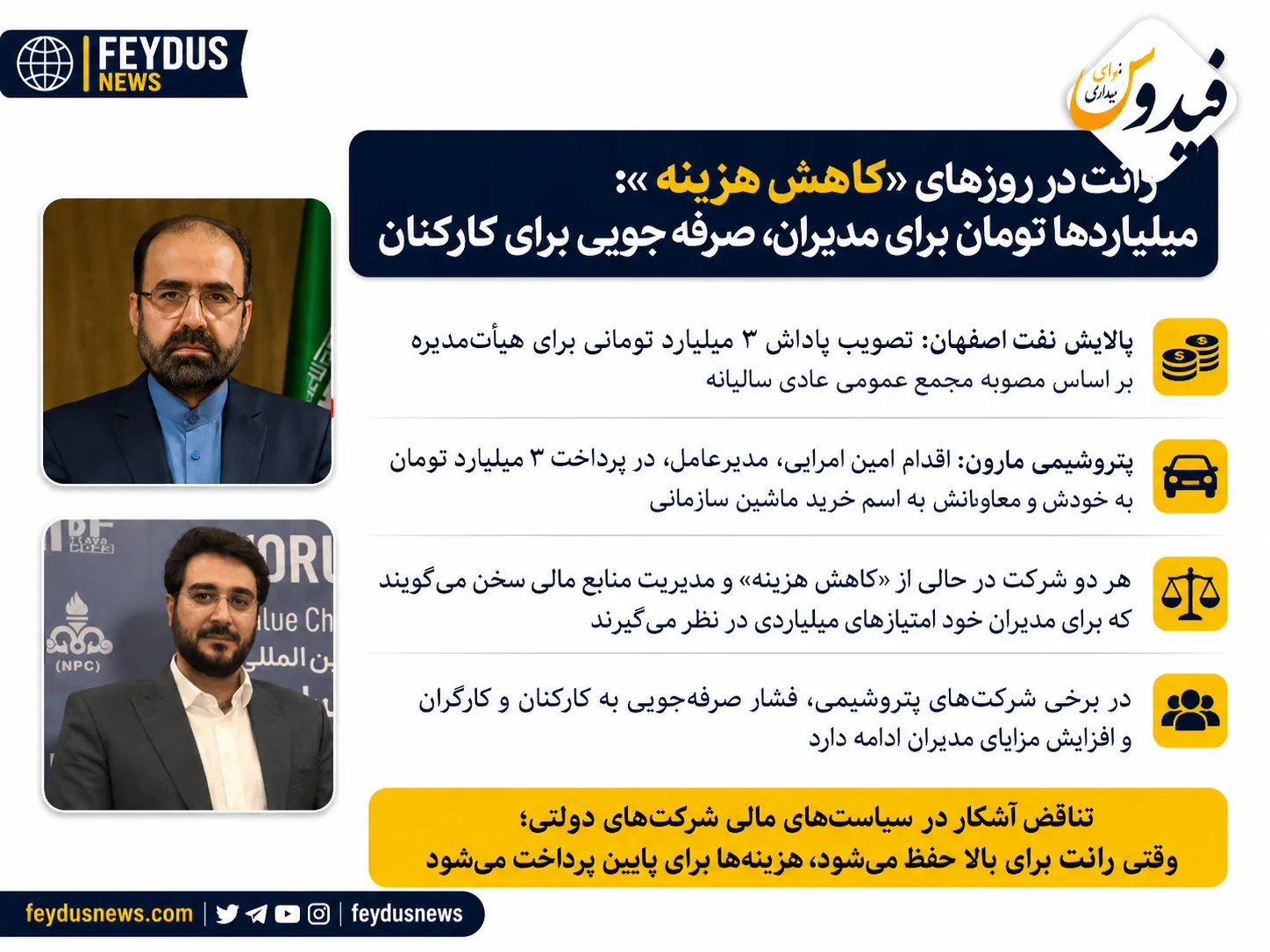

At a time when many large refining and petrochemical companies speak of reduced profit margins, increased production costs, and the necessity of financial resource management, the release of documents on managerial resolutions and payments has once again highlighted the gap between the austerity policies imposed on employees and the benefits for managers.
In recent months, "cost reduction" has become one of the frequently repeated keywords among managers in the oil, gas, and petrochemical industries. In some companies, this reasoning has been the basis for limiting welfare payments, bonuses, and employee benefits, with workers and operational staff being told that the company's financial situation does not allow for increased expenses. However, it seems these restrictions do not always reach the upper managerial levels.
Billion-Dollar Bonuses and Contradictions
Documents and information released about two companies, "Esfahan Oil Refining Company" and "Marun Petrochemical", show examples of this contradiction; where on one hand, resource management and cost reduction are discussed, while on the other hand, there is talk of billion-dollar bonuses or significant resources allocated for purchasing cars for managers.
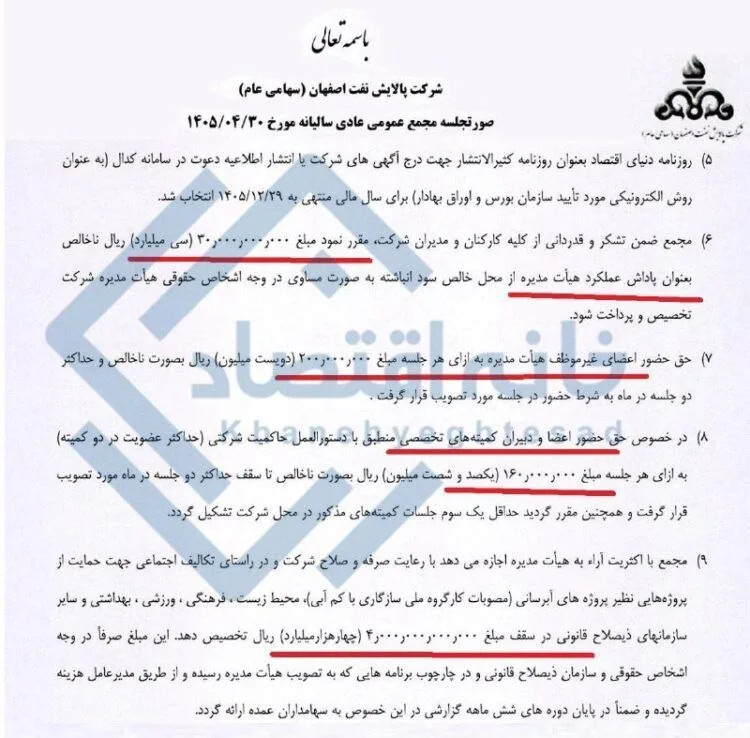
According to the minutes of the annual general meeting of Esfahan Oil Refining Company, the assembly approved an amount of 30 billion rials, equivalent to three billion tomans, as a performance bonus for the board of directors for the relevant financial year. The resolution emphasizes that this amount should be allocated and paid equally to the legal entities of the board of directors from the net accumulated profit. The publication of this section of the minutes in recent days has sparked reactions regarding the amount of bonuses for managers of large refining companies.
However, the managerial figures in the minutes do not stop there. According to the same document, the attendance fee for non-executive board members is set at 200 million rials, equivalent to 20 million tomans per meeting, approved for a maximum of two meetings per month, conditional on attendance. For members and secretaries of specialized committees, an amount of 160 million rials, equivalent to 16 million tomans per meeting, is considered; a figure that, according to the resolution, can be paid with a maximum cap of two meetings per month.

These figures may be defined within the framework of the assembly's resolutions and company regulations, but the main issue is comparing them with the policy implemented in many oil industry companies under the title "cost control" against employees. When resource limitations become a justification for controlling employee benefits, it is natural that the three billion tomans bonus for the board of directors and the tens of millions of tomans attendance fees also come under scrutiny.
Billion-Dollar Cars and Austerity Policies
Another example relates to Marun Petrochemical and the management of Amin Emraei. According to published information, in this company, the allocation of resources for purchasing cars for the CEO and some deputies has been raised, with the amount allocated for each of these individuals stated as three billion tomans. Notably, according to the same information, the CEO and the mentioned managers are currently using company-owned cars. In such circumstances, allocating several billion tomans more under the title of organizational car purchase or providing cars for managers raises serious questions about the necessity of such an expense.

This issue becomes more significant when critics of Marun Petrochemical management say that during Emraei's management, the reduction of some payments and employee benefits has been pursued under the necessity of reducing company costs. If this narrative and payment amount are confirmed, a simple question remains: why should the cost reduction policy start with employee rights and benefits, but stop when it comes to providing billion-dollar cars for managers?
Furthermore, there are discussions about the support of some upstream entities for the continuation of Emraei's management, with the Ministry of Defense also being mentioned in this context; a topic that requires clarification from relevant institutions and the publication of related documents regarding the shareholding structure and decision-making in Marun Petrochemical to become a definitive statement.
The issue is not just the three billion tomans of Esfahan Oil Refining or the car purchase costs in Marun Petrochemical. What makes these two cases noteworthy is a pattern that can undermine employees' trust in the announced policies for cost management. If the economic situation of companies truly necessitates cost reduction, it is expected that this policy is first seen in unnecessary payments and facilities at managerial levels; not that the pressure of saving is transferred to employees while the path for approving bonuses, attendance fees, and billion-dollar facilities for managers remains open.
Transparency about these payments, the precise announcement of the number of recipients, the legal basis for resource allocation, and the publication of details of managerial benefits can determine whether "cost reduction" in the oil and petrochemical industries is a general policy or a prescription mainly written for employees.