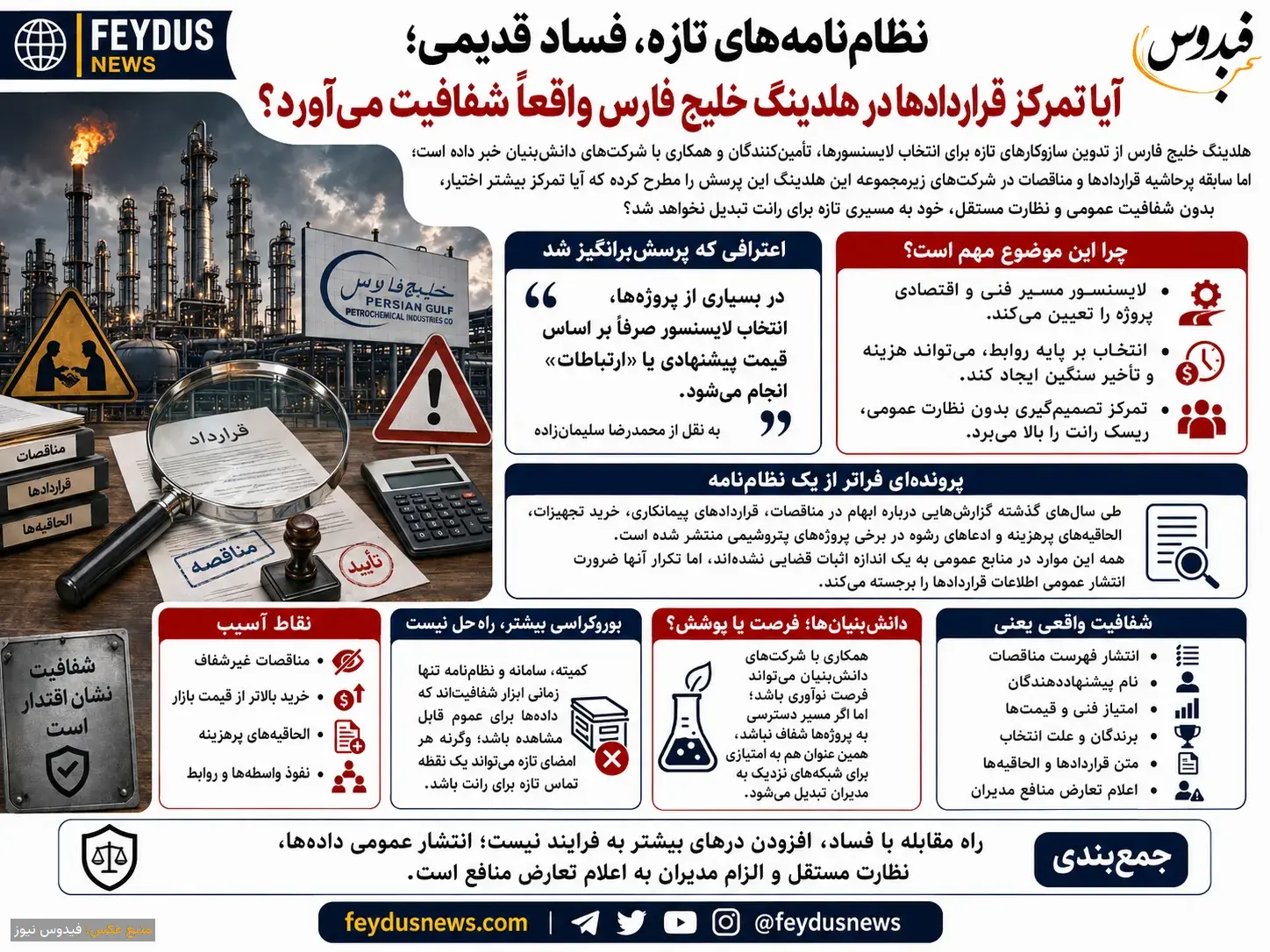

Persian Gulf Holding has announced the drafting of new mechanisms for selecting licensors, suppliers, and collaborating with knowledge-based companies; however, the controversial history of contracts and tenders in the subsidiaries of this petrochemical holding raises the question of whether more centralized authority, without public transparency and independent oversight, will itself become a new path for rent-seeking?
In recent months, the Persian Gulf Petrochemical Industries Group has announced a series of programs for streamlining the process of selecting licensors, suppliers, and technology and knowledge-based companies; programs that ostensibly aim to reduce project risks, remove choices from managers' preferences, and increase the presence of capable companies in large petrochemical industry projects.

The latest case is the drafting of a "Comprehensive Evaluation and Selection Regulation for Licensors in Petrochemical Projects" prepared by the Persian Gulf Engineering Innovation and Technology Development Company and presented to subsidiary company managers. Mohammadreza Soleymanzadeh, CEO of this company, even admitted that in many projects, the process of selecting licensors is conducted solely based on the proposed price or "connections," and choosing the wrong technical knowledge can impose years of delay and heavy costs on the project.
This admission might be more important than the new regulation itself. Because the main question is not whether the petrochemical industry needs a scientific framework for selecting licensors; the answer is clear. The question is why, in a complex with tens of billions of dollars in assets and projects, has the influence of "relationships" on one of the most sensitive investment decisions been possible so far, and what guarantee is there that the new regulation will not be implemented in the same administrative structure?
A Case Beyond a Regulation
Concerns about this structure are not new. Over the past years, there have been numerous reports about ambiguities in tenders, contracting agreements, equipment purchases, and the selection of certain commercial partners in petrochemical companies.
Independent Persian, in a report about corruption in the petrochemical industry, pointed to instances of purchasing goods from specific individuals at prices higher than the market and disputed contracts in projects under the Persian Gulf Holding; including claims about awarding a contract EPS at a price several times the expected estimate, costly project addendums PP in Ilam, and purchasing foreign equipment in the Apadana project. These cases have been reported and claimed in the media, and judicial proof of all of them is not available in public sources, but the repetition of such reports highlights the necessity of publishing contract information.
Even in November 1404, the "Naftema" media reported that Mohammad Shariatmadari, the CEO of the holding, ordered the halt of awarding a project during a tender; an action that the same media linked to concerns about "potential corruption" in the awarding process.
A few months later, industry media reported the arrest of the owner of a contracting company and allegations of bribery to several senior managers. The details of this case and the legal status of the individuals mentioned have not been fully and independently published, but the mere publication of such a report once again brought the issue of the relationship between contractors and managers to the forefront.
Feydus News had previously published reports on the allegations surrounding the connections between some managers and intermediaries with contractors and called for transparency of contracts, stakeholders, and financial flows of projects.
More Bureaucracy Does Not Necessarily Mean More Transparency
In such conditions, creating a central company or adding several committees and regulations to existing processes is not in itself a guarantee against corruption.
On the contrary, the experience of administrative structures in Iran has shown that the more complex the decision-making process and the more signatures required, if the information is not visible to the public, the more points of contact between the applicant and the manager increase.
Systems, specialized committees, regulations, and technical evaluations are only tools of transparency when it is clear which companies have applied, based on what criteria they have been scored, who the decision-making committee members are, what each company's financial proposal was, and the reason for selecting the winner.
In recent months, the holding has issued calls for identifying suppliers and launching various systems. For example, in August 1405, companies were asked to submit their technical and financial proposals for designing and implementing an "Integrated Production Management System." Previously, calls had been issued for identifying suppliers of HSE systems and risk management.
Issuing calls is a positive step, but real transparency begins after the call: who won, why they won, what the final contract amount was, and whether the manager or committee member had a financial, familial, or professional relationship with the contractor?
Knowledge-Based Companies and the Risk of New Brokers Emerging
The issue of knowledge-based companies is also important from this perspective. For years, Persian Gulf Holding has been talking about increasing cooperation with knowledge-based companies, and in June of this year, the largest "First Time Production" contract was signed between Nouri Petrochemical and a knowledge-based company for developing flare gas desulfurization technology.
However, if the path for technology companies to access projects is not transparent, the title "knowledge-based" can also become a new advantage for networks that have greater access to managers.
The way to counter such a risk is not to create more bureaucracy; it is to publicly release data.
If Persian Gulf Holding truly seeks to end relationship-based selections, it can publish a complete list of tenders, bidders, technical scores, prices, winners, contracts, and addendums, and require managers involved in decision-making to declare conflicts of interest.
Otherwise, a regulation intended to block the influence of personal relationships may only increase the number of doors a contractor must pass through to secure a contract; and in a non-transparent structure, each new door can become a fresh opportunity for brokerage instead of a barrier to corruption.