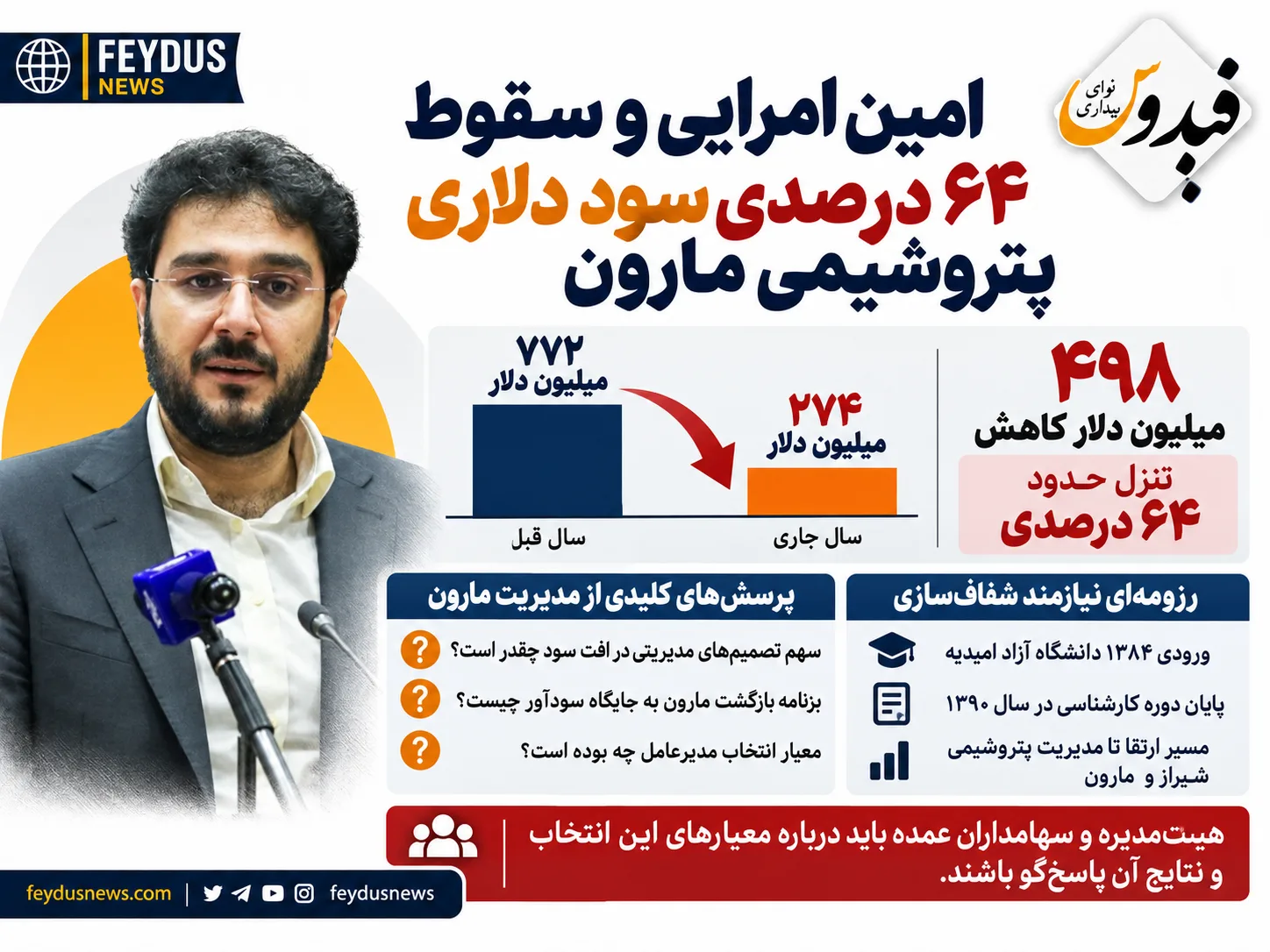

Amin Amraei's track record at Marun Petrochemical has come under further scrutiny with the release of data showing an unprecedented decline in the company's dollar profitability. According to a chart published on the performance of Marun's CEOs over the past decade, the company's dollar profit, which was around 772 million dollars in previous periods, has dropped to about 274 million dollars in the recent period; in other words, a decrease of nearly 498 million dollars, representing a decline of about 64%.
Reasons for Profitability Decline
Such a significant drop cannot be solely attributed to external factors. Marun's management must clarify how much of this decline is due to general industry conditions and how much is the result of managerial decisions, inappropriate sales mix, increased costs, production stoppages, or underutilization of the complex's capacities. Shareholders have the right to know what Amin Amraei has done to prevent this trend from continuing and what his plan is to restore Marun to its previous profitable position. Providing general reports and attributing all failures to sanctions and energy restrictions cannot replace transparent accountability regarding management performance.

One of the examinable reasons for this profit decline and weak performance of Marun Petrochemical is the appointment method of managers who do not have a clear resume and successful track record in managing large petrochemical industry enterprises. It is said about Amraei's educational background that he entered Islamic Azad University of Omidiyeh in 2005 and completed his bachelor's degree in 2011. His path of advancement from academic and organizational activities to managing Shiraz Petrochemical and then Marun Petrochemical also requires clarification.
This issue becomes meaningful when we recall that before Amraei's entry into Marun, the company's performance was positive and in 2019, it recorded a net profit of 5,118 billion tomans. This figure, in the fiscal years 2020 and 2021, with annual growth of 130% and 22%, respectively, reached 11,639 billion and 14,159 billion tomans.
Need for Transparency in Management
When the specialized resume and managerial achievements do not match the importance of a large company, it is obvious that the presence of weak managers like Amraei will ultimately result in the company's downfall. The question that is always repeated regarding Amraei is: how was a manager with such a limited resume and a track record now associated with a significant decline in profitability chosen to lead one of the major companies in the petrochemical industry? Marun's board of directors and major shareholders must transparently announce the criteria for this selection and their responsibility for its outcomes.