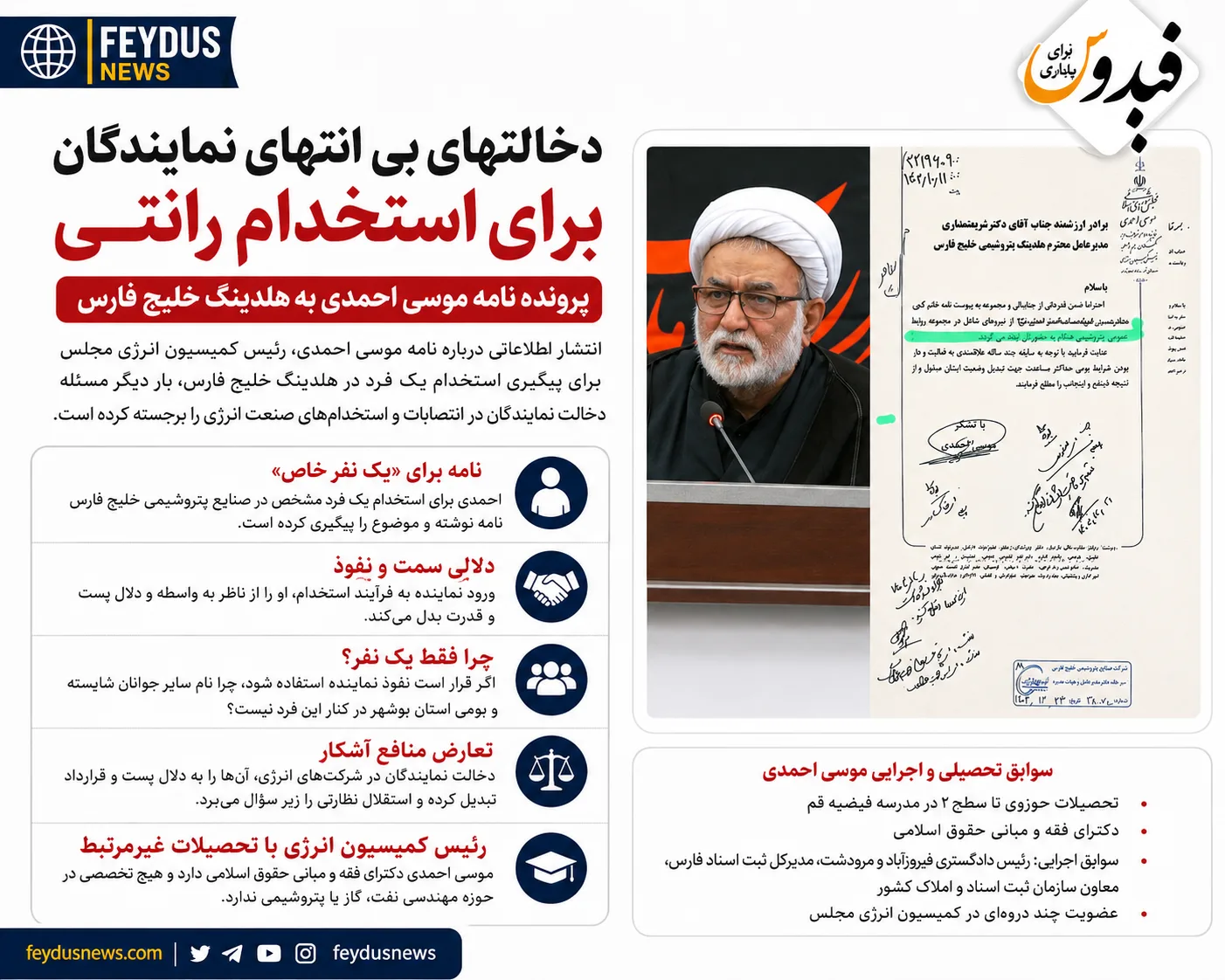
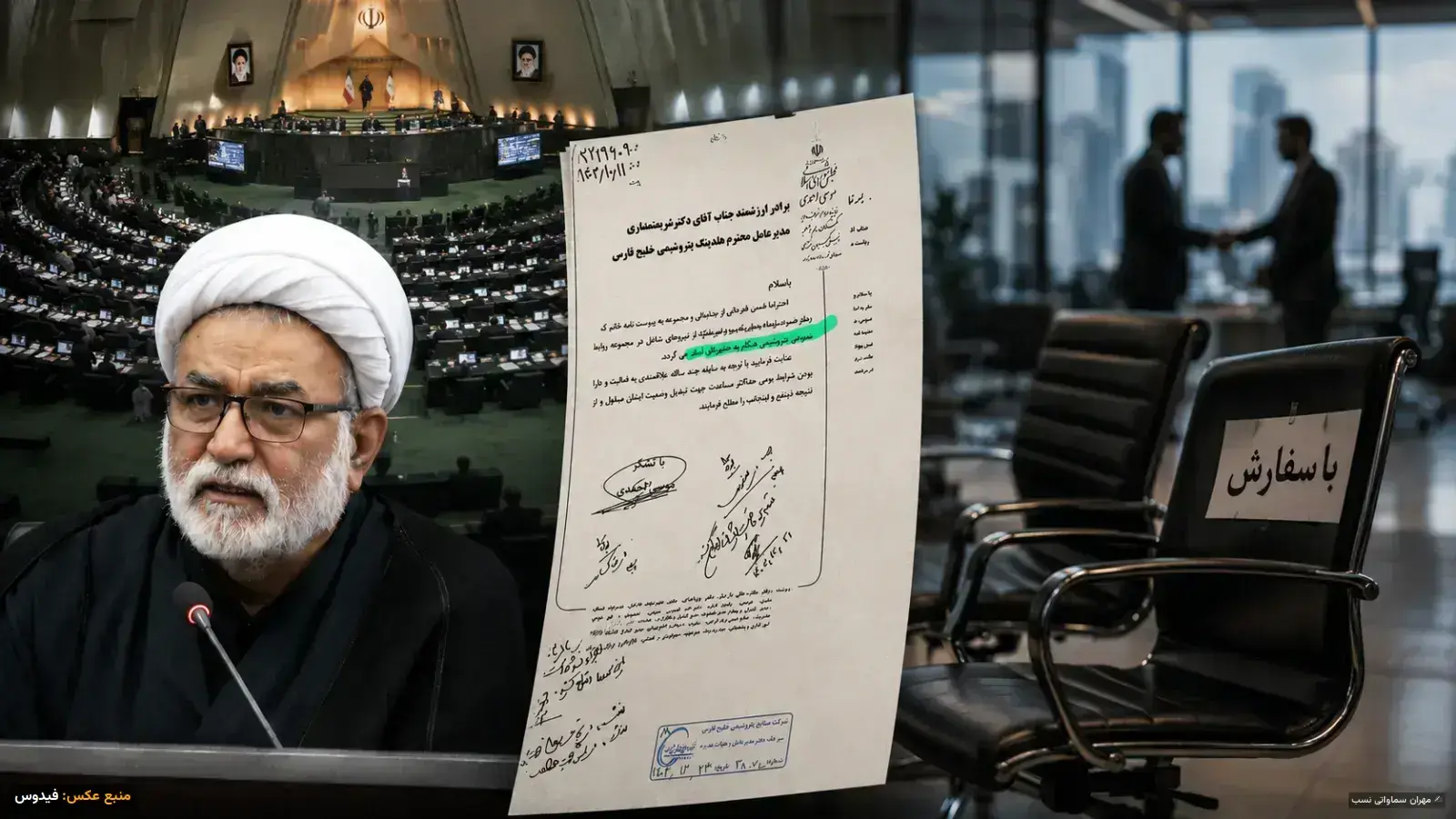
The release of information about a letter from Mousa Ahmadi, the head of the Energy Commission of the Islamic Consultative Assembly, to Persian Gulf Holding to pursue the hiring of an individual has once again brought the issue of parliamentary interference in appointments and hiring in the oil, gas, and petrochemical industry into focus. This practice raises serious questions about the boundary between a representative's oversight duty and exerting influence within economic company structures.
According to the published information, Ahmadi wrote a letter to facilitate the hiring of a specific individual in the Persian Gulf Petrochemical Industries Company and followed up on the matter. Regardless of the individual's relationship with the head of the Energy Commission or which person or group requested this follow-up, the core issue raises an important question: Why should the head of one of the most important specialized commissions of the parliament use his political and administrative position to facilitate the hiring of a specific individual in a large economic enterprise?
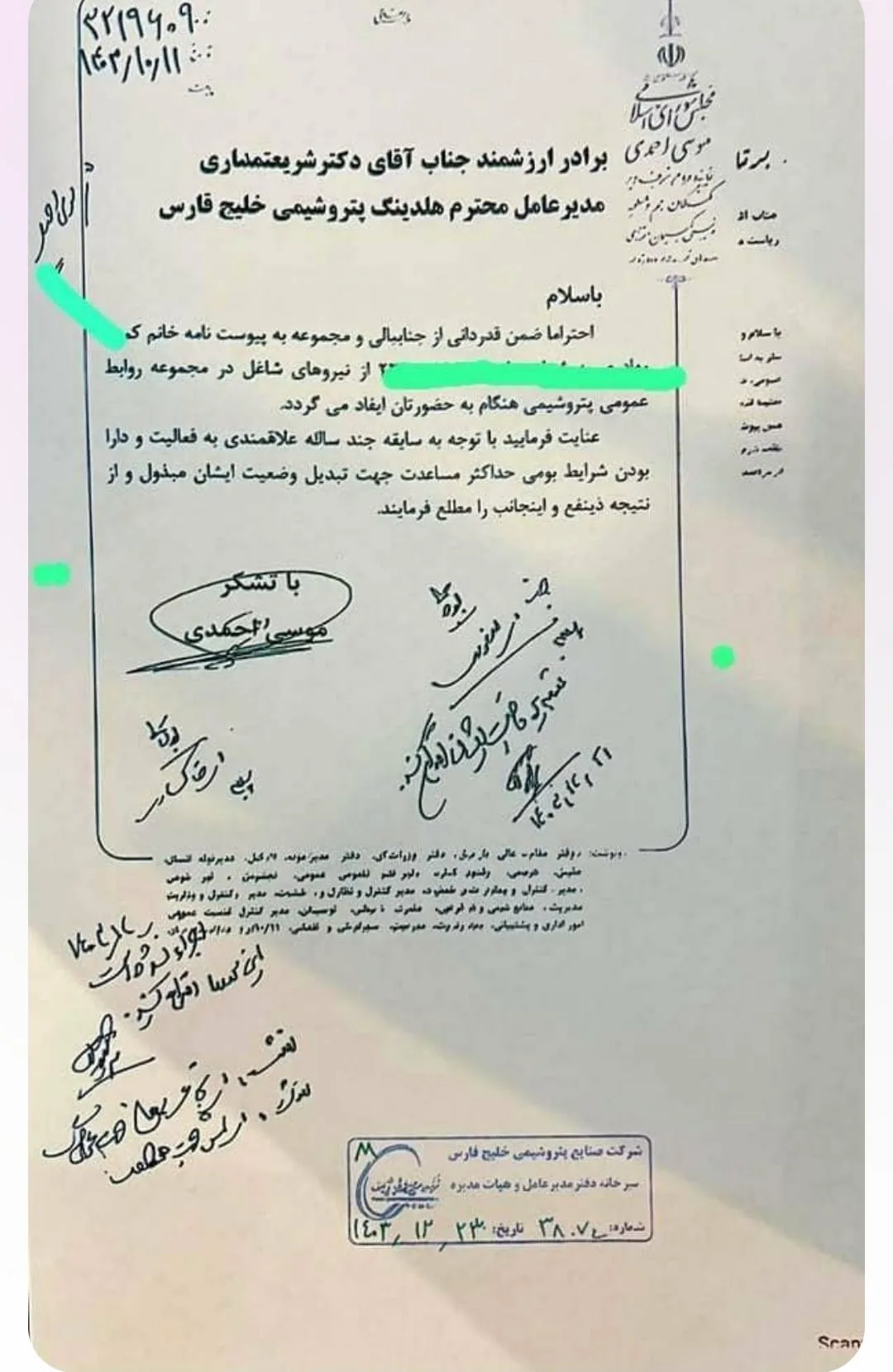
Such recommendation letters are not merely "following up on constituency matters," but rather a direct entry of a representative into the hiring process and a form of mediation for occupying a job position. From this perspective, the main question is if such follow-ups are possible, why isn't this capacity transparently and equally available to other skilled and local youth of Bushehr province?
Representative or Appointment and Hiring Mediator
The issue of Mousa Ahmadi is just one example of a broader issue in Iran's energy industry. Over the past years, there have been numerous reports about parliamentary interference in the selection of managers, board members, hiring of staff, and even the relations of oil and petrochemical companies. The continuation of such a trend can practically place representatives, who should legally oversee the performance of the Ministry of Oil and affiliated companies, in the position of appointment, hiring, and even contract mediators.
This conflict becomes more significant when the person pursuing the matter is the head of the Energy Commission of the parliament. A commission that should oversee the performance of the Ministry of Oil and various sectors of the energy industry faces the question of how it can independently perform its oversight duty if its members are involved in the process of appointing managers or introducing human resources.
Therefore, the issue is not merely the hiring of "one person." The main issue is transforming political influence into a tool for specific individuals to access job and managerial opportunities; opportunities that should be distributed based on transparent, competitive, and merit-based mechanisms.
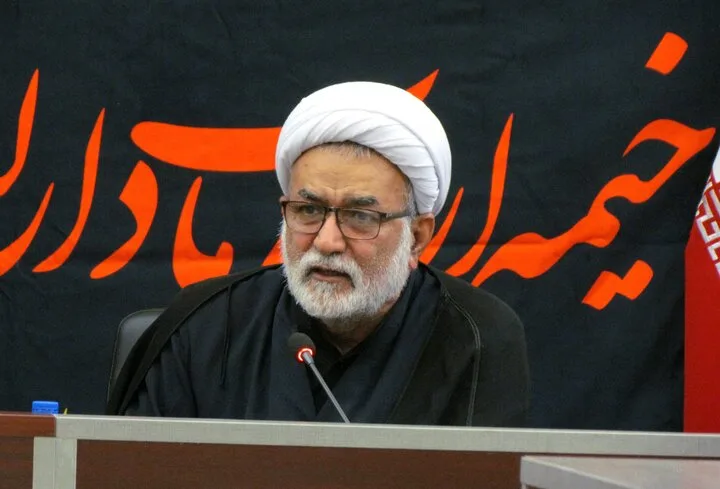
Head of the Energy Commission with Education in Jurisprudence and Law
This issue arises while there have been previous criticisms about the alignment of Mousa Ahmadi's academic specialization with the headship of the Energy Commission. A review of published records shows that Ahmadi's specialized education has no direct connection with oil, gas, petrochemical engineering, or other technical energy fields.
According to published records, Mousa Ahmadi has seminary education up to level two at the Feyzieh School in Qom, and his PhD is in "Islamic Jurisprudence and Principles of Islamic Law." His executive background is mainly judicial and registrational, including head of the judiciary in the cities of Firouzabad and Marvdasht, director general of the Registration of Deeds and Properties of Fars Province, and deputy of the Organization of Registration of Deeds and Properties of the country.
This indicates that Ahmadi's education "has no connection with the Energy Commission," and his most relevant experience is his repeated presence and membership in this commission.
Nevertheless, the discussed letter once again raises a question beyond Ahmadi's academic degree: Why should the head of a commission, whose duty is legislation and oversight of one of the country's largest economic sectors, pursue the hiring of a specific individual in Persian Gulf Holding?
If a representative's influence is to be used for the employment of Bushehr's youth, why isn't there a public and transparent process for introducing the province's skilled forces? Why isn't the name of 9 other deserving and unsupported young people placed alongside one individual's name?
The issue is precisely here; the boundary between "pursuing people's demands" and "mediating for specific individuals." The more this boundary fades in the oil and petrochemical industry, the more a representative who should oversee managers is exposed to the accusation of becoming part of the network of distributing positions, hiring, and contracts.