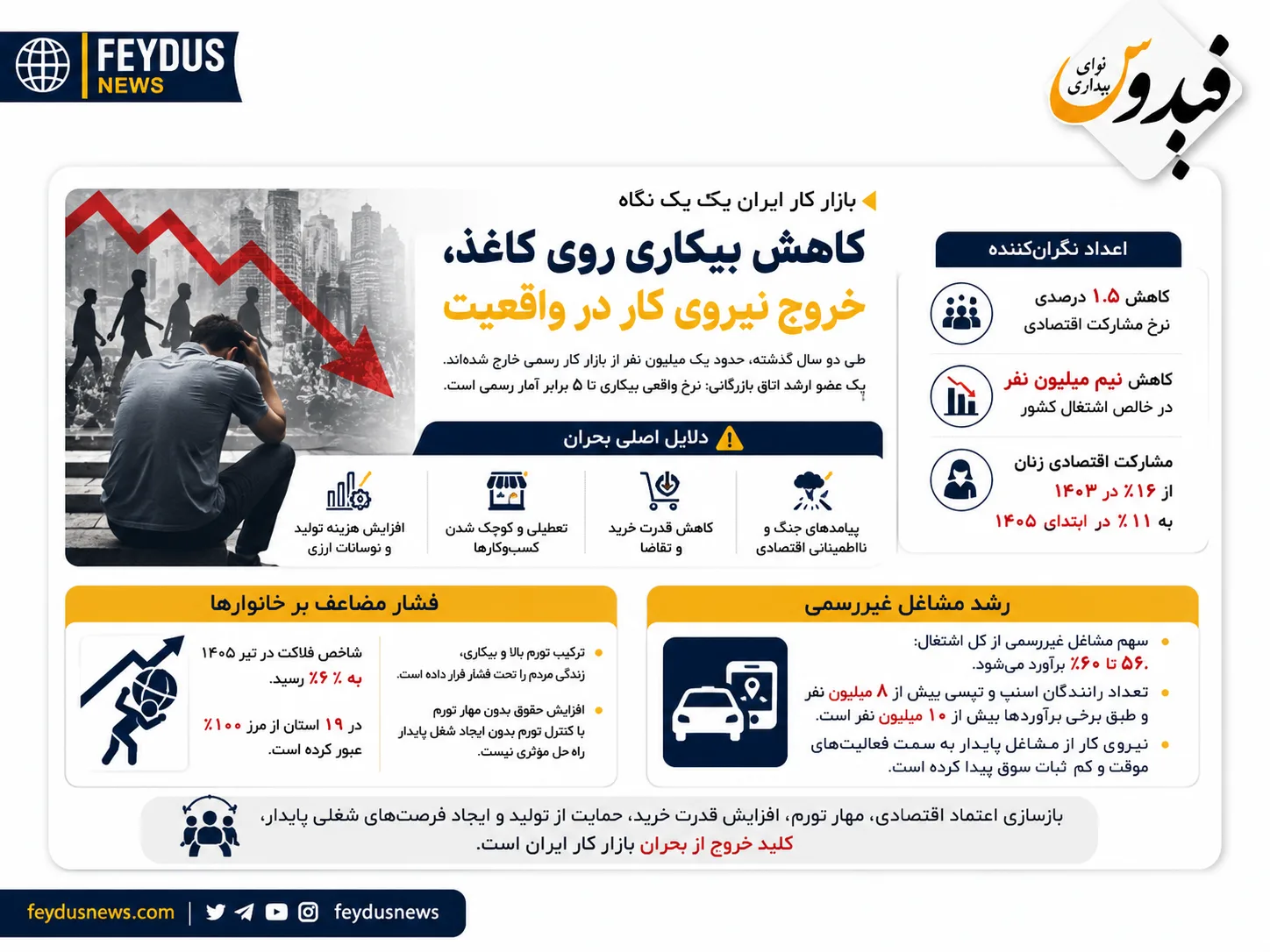

The Iranian job market is facing deep challenges that go beyond the official unemployment rate. Reduced economic participation, people leaving the active population, and increased informal employment indicate that part of the workforce has lost hope in finding stable jobs.
Reports indicate that about one million people have exited the formal job market. A senior member of the Chamber of Commerce estimates the real unemployment rate to be up to five times the official figures and reports an unprecedented 1.5% drop in economic participation and a half-million decrease in net employment. The situation for women is even more concerning; their economic participation rate has dropped from 16% in 2024 to about 11% at the beginning of 2026.

Employment No Longer Brings Security
Increased production costs, currency fluctuations, difficulty in securing raw materials, reduced demand, and the consequences of war have forced many businesses to reduce capacity, lay off staff, or halt hiring. At the same time, the gap between inflation and wages means that even having a formal job does not necessarily cover living expenses.
Ali Hayatnia, an economist, considers the migration of skilled and young workers a threat in these conditions. From this perspective, the challenge for Iran's economy is no longer just creating job opportunities; retaining skilled workers in the job market has also become a serious issue.
Simultaneous Heavy Inflation and Employment Crisis
The pressure in the job market, along with inflation, is reflected in the rising "misery index." According to published statistics, this index reached about 90% in spring 2026 and 96% in July, surpassing 100% in 19 provinces.
This situation shows that households are facing a sharp increase in living costs and reduced income security; therefore, raising wages without controlling inflation or reducing inflation without creating stable employment cannot solve the crisis alone.
Another aspect of labor market changes is the expansion of informal jobs. The Deputy Minister of Entrepreneurship and Employment Development announced that this sector accounts for about 56%, while some estimates put it close to 60%.
The growth of internet taxis is an example of this change. Mohammad Bahreinian, a development researcher, stated that the number of Snapp and Tap30 drivers exceeds 8 million, with some unofficial estimates even suggesting this number exceeds 10 million.
As a result, Iran's job market is experiencing a significant shift: reduced presence in formal jobs and a move towards temporary, platform-based, and unstable activities. Continuing this trend could, in addition to reducing household economic security, lead to human capital flight and weaken the economy's long-term growth capacity.