

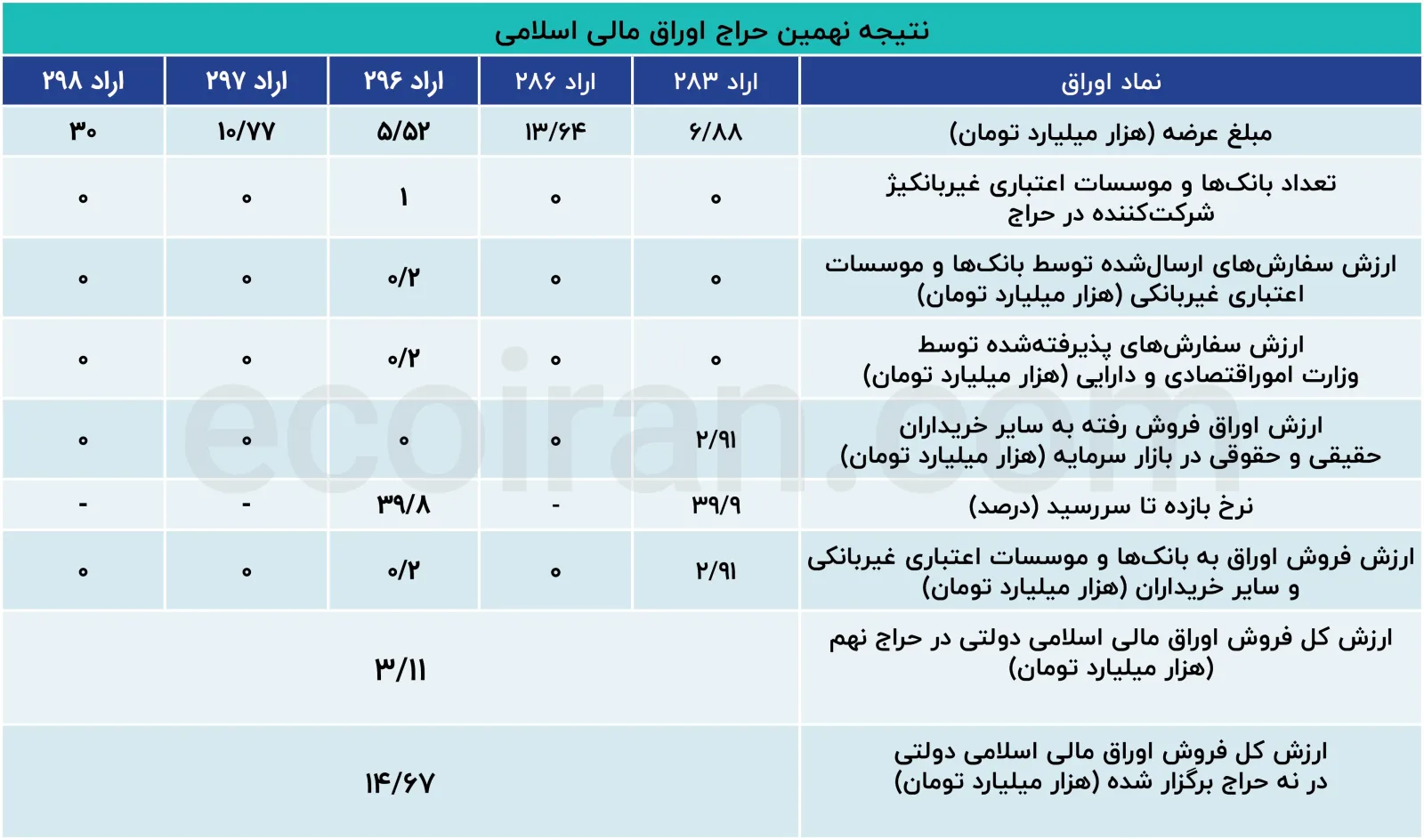
The ninth auction of government financial bonds concluded with an unexpected result. Out of more than 66 trillion tomans worth of bonds offered, only about 3.11 trillion tomans were sold. This means the government managed to sell only 4.6% of the bonds it offered for financing. This statistic indicates the continued weakness of demand in the debt market and further difficulties in the government's financing path from this source.
According to published statistics, in the auction on the 14th of Mordad, five symbols of government financial bonds with a total value of 66.81 trillion tomans were offered. Despite the high volume of offerings, buyer interest was very limited, and only one bank participated in this stage of transactions. The banking network's participation in this auction was limited to purchasing 200 billion tomans of bonds, all of which pertained to the "Arad 296" symbol. Conversely, the main purchases were made by capital market participants, and stock market investors purchased a total of 2.91 trillion tomans of bonds. Ultimately, the total value of bond sales in this stage reached about 3.11 trillion tomans, a figure that is significantly lower than the offered volume.
Significant Gap with Past Auction Performance
Reviewing the performance of 9 stages of government bond auctions shows that the result of this stage was below the usual trend of recent months. According to Central Bank data, the total sales of bonds in the 9 auctions held to date have reached 146.7 trillion tomans. This figure means an average sale of about 16.3 trillion tomans per auction. Comparing this number with the performance of the ninth auction shows that the government managed to sell about 13 trillion tomans less than the average of previous auctions in this stage. The sharp decline in sales indicates that the existing problem is not limited to a specific stage of offering but relates to the overall conditions of the debt market.
One of the main factors for the reduced interest in government bonds is said to be the low attractiveness of their yields compared to other investment opportunities. Investors show interest in buying bonds when their interest rates can compete against inflation, fluctuations in parallel markets, and other investment options. Currently, some capital market participants, expecting that the government will be forced to offer bonds with higher interest rates in the future, have postponed their purchases. This outlook has led to a decrease in demand in recent auctions, with buyers waiting for more attractive conditions.
Reduced Bank Presence in the Bond Market
On the other hand, uncertainty about the path of interest rates has also affected investor decisions. When the interest rate outlook is unclear, buying bonds at current rates becomes less attractive for some market participants, as they consider the possibility of higher-yield financial instruments being offered in the future. The behavior of banks in the ninth auction was another noteworthy point. In past years, the banking network was considered one of the main buyers of government bonds, as these bonds, in addition to yielding returns, played an important role in open market operations and liquidity provision for banks.
However, changes in the money market conditions and existing limitations in using this tool have reduced banks' motivation for extensive bond purchases. When holding bonds cannot serve the same function for banks as before, it is natural for demand from this sector to decrease. The debt market is considered one of the most important tools for the government to finance budget deficits and manage financial flows. Reduced demand for government bonds can challenge this path and force the government to resort to other methods to secure the necessary resources.
The continuation of the current trend could be a sign of weakness in the incentive mechanisms of the debt market; a market whose success depends on investor confidence, the attractiveness of rates, and coordination between monetary and fiscal policies. The sale of only 4.6% of the bonds offered in the ninth auction now raises the question of whether the current bond offering structure can meet the government's financial needs or if there is a need to review policies related to interest rates and bond issuance conditions to restore demand.