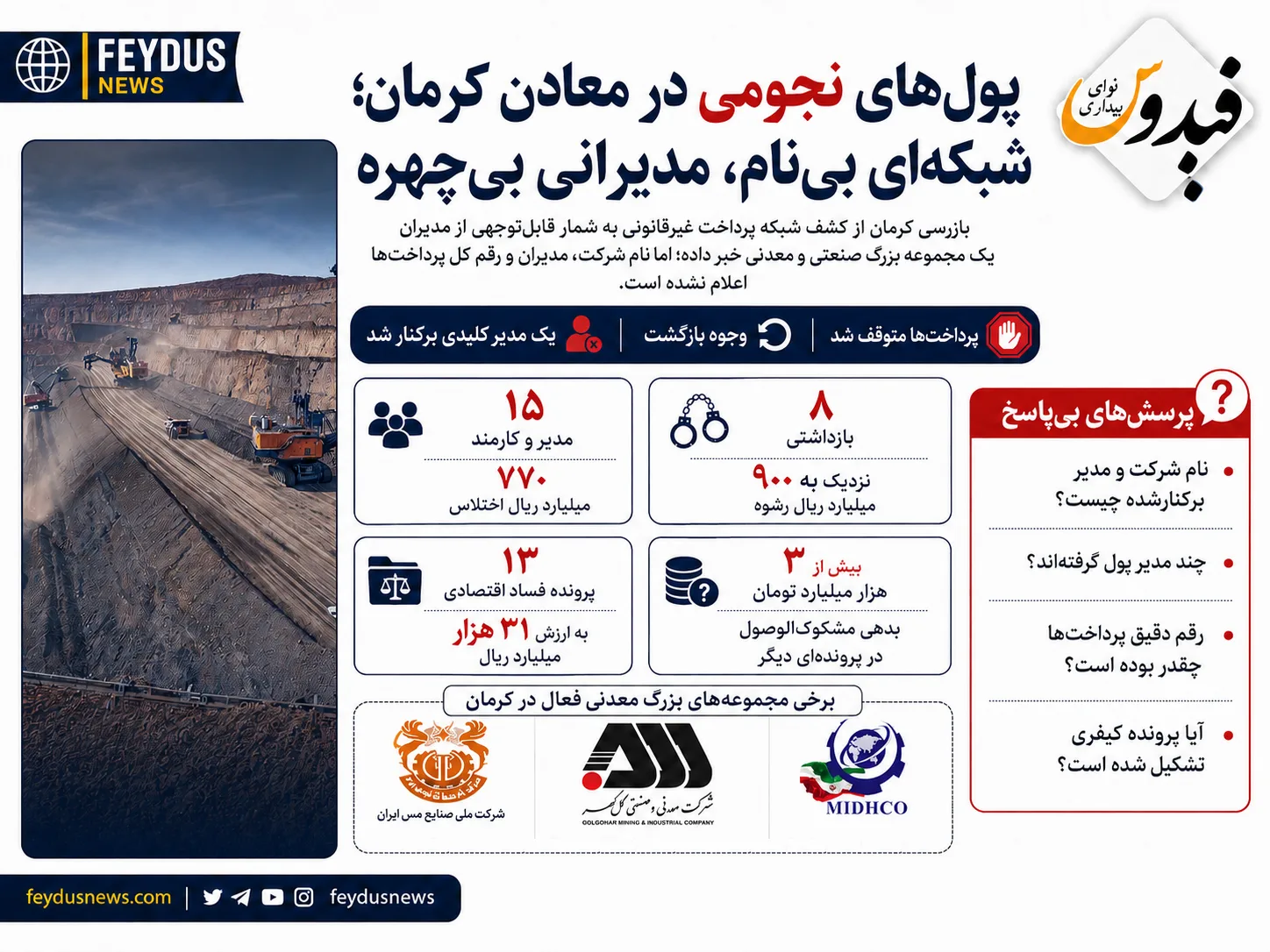
Judicial officials of the Islamic Republic have identified an organized network for paying "unconventional and sometimes astronomical" amounts to managers of one of the major industrial and mining complexes in Kerman province; a network that apparently extended to a "significant number of managers and decision-makers." It is said that the payments have been stopped, the transferred funds returned, and one of the key managers dismissed.
Despite this, almost all the main components of the case remain hidden from the public: the name of the industrial complex, the subsidiary company, the dismissed manager, the recipients of the money, the total amount of payments, and the positions of those who authorized these payments. The judiciary speaks of discovering corruption but does not release the necessary information to assess its accuracy and scope.
The reason for this, according to local sources, is the extensive influence of powerful families with political backgrounds in the ownership of mining companies in Kerman province, which essentially turns such a case into an exposure of corruption among current and former high-ranking officials of the regime.
Previously, in mining corruption, the media spoke of the vastness of the mining mafia network and believed these family networks had become influential cartels with authority beyond mining companies, making confrontation with them very costly.
Exposure of a Corruption Network; Without Naming Names
The story began with statements by Dadkhoda Salari, the chief judicial inspector of Kerman province, on August 3, 2026. He announced that the examination of financial documents of major companies in the province led inspectors to an "illegal payment network" in one of the companies affiliated with the industry and mining sector.
According to the official account, amounts outside the rules and regulations were deposited into the accounts of a group of managers or were about to be paid. Salari described the number of people on the list as significant, indicating that the issue was not limited to the misconduct of one manager or a single payment and probably involved several levels of management in the complex.
The provincial inspection says it has stopped further payments, dismissed a manager who had a "key role," and returned all paid amounts to the company and ultimately to the public treasury. But the official narrative cuts off right where transparency should begin.
The strange point is the effort to keep the names of offenders and corrupt individuals hidden, raising the question of why the judiciary, unlike similar cases, is not willing to disclose the names of corrupt individuals in this case. Even the deliberate ambiguity and silence in the news have made it unclear which holding or company this network operated in, how many managers received money, the total amount of payments, under what title the payments were made, and which authority or entity approved them. It is also unclear whether a criminal case has been filed against the involved individuals or if the dismissal of one manager marks the end of dealing with this misconduct.
Corruption Announced, Corrupt Individuals Not!
The main contradiction in the case lies in the method of information dissemination. An entity affiliated with the judiciary speaks of discovering an illegal network involving a significant number of managers but simultaneously omits the names and details that would allow independent verification of its claims.
Returning the money, if the official narrative is accurate, is only one step in addressing the misconduct. The fundamental question is how the resources of a large industrial and mining company were transferred to managers' accounts and based on what decision? Were the payments recorded in the financial statements? What roles did the board members and financial and auditing units play? How did the independent auditor not notice these payments? Why did internal oversight mechanisms not act before the inspection's intervention?
Without answers to these questions, the term "illegal payment network" becomes more of an ambiguous announcement than a comprehensive report on a corruption case; an announcement that neither clarifies individuals' responsibilities nor allows the media and public to compare judicial statements with company documents and managerial changes.
Official Figures; A Picture of Expanding Economic Corruption
The new case cannot be seen separately from other statistics released by judicial and law enforcement officials in Kerman in recent months. Dadkhoda Salari stated in June 2026 that over the past year, 15 managers and employees in the province were prosecuted in embezzlement cases involving a total of 770 billion rials.
According to the same statements, eight individuals were also arrested in cases related to bribery with total amounts close to 900 billion rials. The provincial inspection was also pursuing cases against 16 individuals on charges of misappropriating public funds.
Less than two months later, the police commander of Kerman reported the formation of 13 economic corruption cases worth 31 trillion rials. These figures do not necessarily imply that all cases are related to mining companies, but the density of cases announced by official authorities indicates that we are not dealing with scattered and exceptional violations.
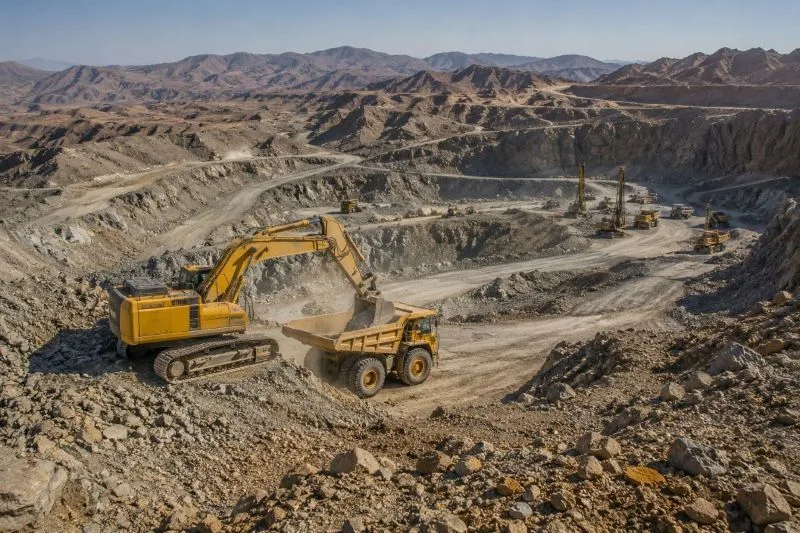
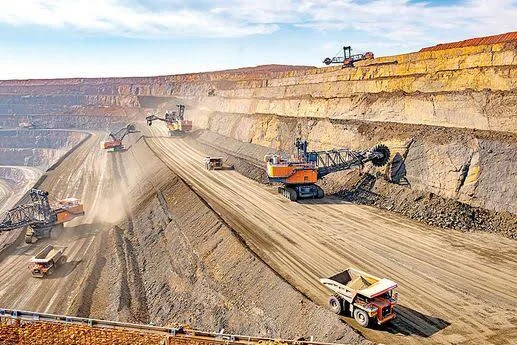
Kerman is one of the most important mining and mineral industry hubs in Iran. The activities of large companies, extensive financial turnover, heavy contracts, and accumulation of resources in this sector have made oversight of managers' performance and the use of mining revenues a public issue; especially since a significant portion of these complexes are directly or indirectly connected to public resources, stock market shareholders, and governing entities.
From Mineral Export to a 3-Trillion Debt
Previous statements by the chief judicial inspector of Kerman reveal another aspect of the mining chain's vulnerability. Salari reported in November 2025 about a case involving an individual who established several companies outside the province, ostensibly purchasing minerals for use in the production process.
According to the inspection, part of these materials, instead of entering the production cycle, ended up in the brokerage market, and another part was transferred for sale to southern ports. In the same case, the "deviant and doubtful" debts of the main suspect in banks outside the province were estimated to exceed 3 trillion tomans.
Juxtaposing this case with the astronomical payments issue presents a more concerning picture: on one hand, there is the possibility of mineral diversion and the creation of heavy banking debts, and on the other, the resources of a large complex are distributed among managers outside the regulations. In both instances, information about the identity of companies and key individuals is either incomplete or released with delay and ambiguity.
Why Should Major Kerman Companies Be Accountable?
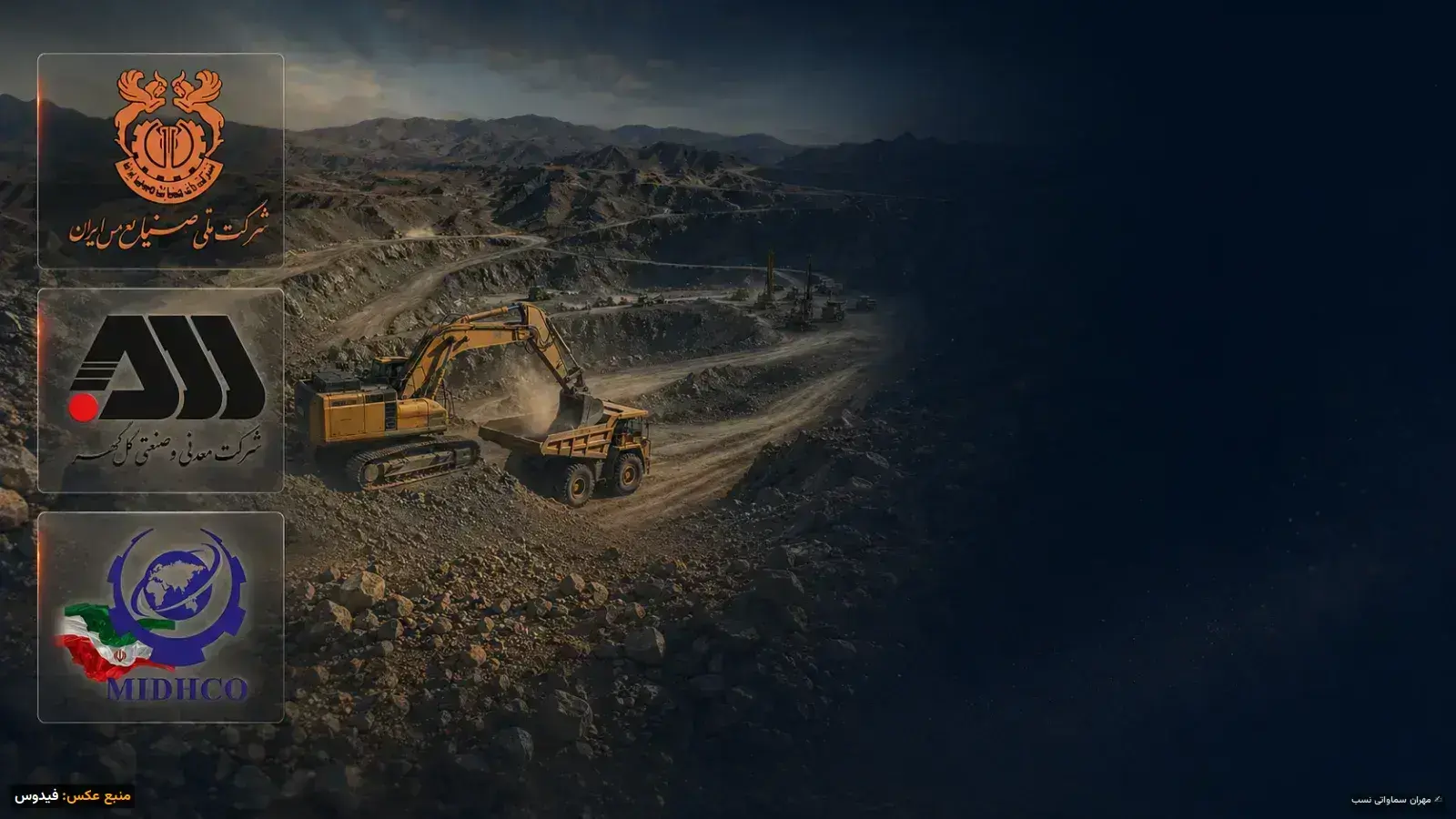
Names like Golgohar, Goharzamin, National Iranian Copper Industries Company, and MIDHCO are among the most important industrial and mining complexes active in Kerman province; however, the information released does not provide any credible basis for attributing the new case to one of these companies. Precisely for this reason, keeping the name of the intended complex hidden can expand the space for rumors and accusations against all major companies in the province.

Publishing the company's name is not just a media demand. Shareholders, employees, auditors, financial institutions, and the public have the right to know which complex's resources were distributed among managers, under what title, and based on whose decisions.
Until the company's identity is announced, it will not be possible to review financial statements, board resolutions, auditor reports, stock exchange notices, and managerial changes. The judiciary's secrecy effectively removes the most important tool for independent verification from the media and, in contrast, leaves room for rumor-mongers to accuse various complexes.
The Money Returned; Where Are the Network Designers?
The official narrative says the money has been recovered and a manager has been dismissed; however, returning the funds cannot replace judicial investigation, responsibility determination, and publication of the case results. A network capable of designing illegal payments and advancing money transfers to managers' accounts likely required the decision and cooperation of more than one person.
Now the question is who were the designers of this network, who issued the permits, and why is there only talk of dismissing one manager. Should the recipients of the money merely return the funds, or will they also be held accountable for accepting illegal amounts?
If the officials of the Islamic Republic truly claim to have "no red lines" in protecting public funds, they should publish the company's name, the exact amount of funds, the list of officials, the mechanism for approving payments, and the judicial status of the involved individuals. Otherwise, the public faces a case where corruption has been discovered, money returned, and a manager dismissed, but neither the corrupt individuals have names, nor the offending company, nor even the amount that was to be distributed among managers.