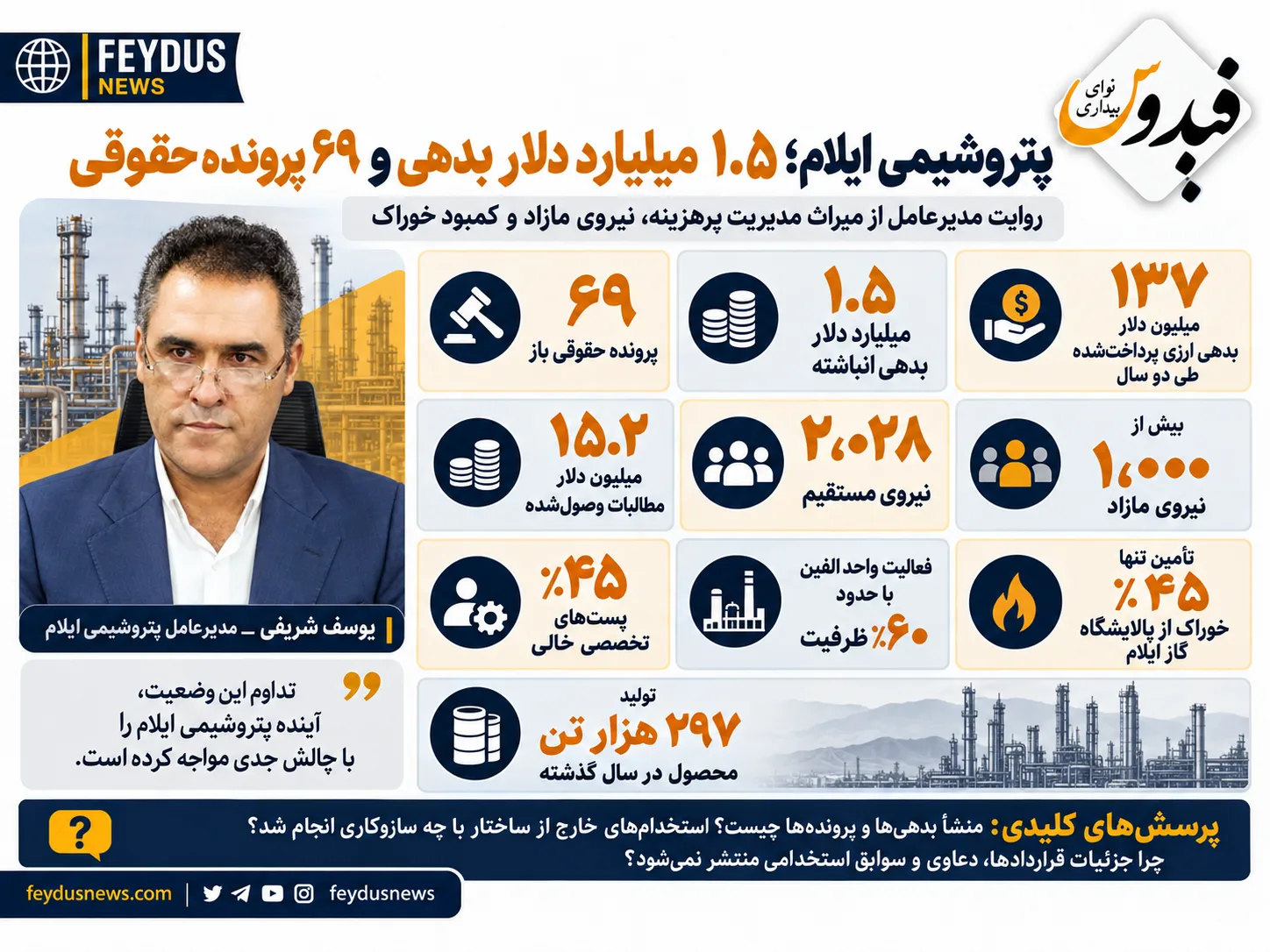

From $1.5 billion in accumulated debt and 69 legal cases to over a thousand surplus employees, the latest statements from the CEO of Ilam Petrochemical paint a picture of the legacy of years of costly management in one of the most important industrial complexes in western Iran.
Ilam Petrochemical, one of the largest industrial investments in western Iran, continues to struggle with the consequences of heavy debt, legal cases, feedstock shortages, and an imbalanced workforce structure that was politically pressured into employment, a set of problems that the company's own managers have now revealed in unprecedented dimensions.
Yousef Sharifi, CEO of Ilam Petrochemical, stated in August 2026 that the complex faced 69 open legal cases and about $1.5 billion in accumulated debt when he took over management. He also announced that the petrochemical company has over a thousand surplus employees, while 45% of its specialized positions are vacant, meaning individuals without specific expertise sit idle and receive exorbitant salaries.

69 Cases; The Legal Legacy of a Complex
The dimensions of the company's legal problems are also significant. According to the statements of Ilam's CEO, 69 legal cases are ongoing at the start of the new management period, adding that one of these cases could have cost the petrochemical company around 36.7 million euros. The company also announced that after years of pursuit, it managed to collect $15.2 million of its claims.
However, public information about the origin of each of these 69 cases, the contracting companies, the responsible managers at the time of contract signing, and their potential damages is limited. This lack of transparency makes independent assessment of how such a large volume of legal disputes arose difficult.
Billion-Dollar Debt
The bigger issue is the debt. Sharifi announced the complex's accumulated debt as approximately $1.5 billion and said that over the past two years, $137 million of foreign currency debt has been paid. However, some internal reports have provided different details, mentioning about $1.05 billion in foreign currency debt alongside heavy local currency debt. The discrepancy between the published figures highlights the necessity of referring to audited financial statements and distinguishing the principal debt, financing costs, and local and foreign currency obligations.
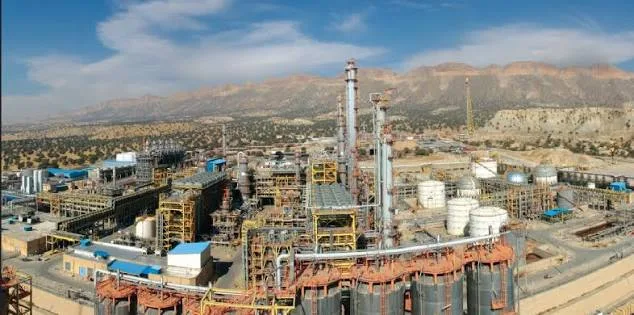
The current management considers the shortage of feedstock as one of the main reasons for the debt accumulation, a problem that itself indicates a weakness in planning within the investment chain: creating large industrial capacity without a stable guarantee of the input needed for economic activity, in a country that itself produces feedstock and exports oil.
A Thousand Surplus Employees, But Few Specialists
Perhaps the strangest part of the story is the human resources. Ilam Petrochemical now has 2,028 direct employees. According to management's statements, after the project phase ended, about 740 to 800 people were added to the workforce outside the predicted framework.
The result is an unprecedented contradiction: the company has over a thousand surplus employees, yet at the same time, about 45% of its specialized chart is vacant, with some receiving what is colloquially called free salaries.
How exactly did hundreds of employees outside the approved structure enter the complex, and based on what mechanism? In an economy where employment in large state and quasi-state industries has always been a sensitive area of political and local influence, publishing the list of hires, recruitment conditions, and actual organizational needs can determine whether this situation is the result of technical decisions or interventions outside industrial logic.
A Factory Without Enough Feedstock
The problems are not only financial and administrative. The Olefin Unit of Ilam Petrochemical, despite being designed for full capacity, operates at about 60% of its capacity. According to management, only about 45% of the required feedstock is supplied from the Ilam Gas Refinery, and part of the remainder must be transported by tanker at additional cost from other regions.
This issue reveals another contradiction: billions of dollars are invested in an established industrial complex, yet there is not enough feedstock to fully utilize its capacity. Nevertheless, the company says it produced about 297,000 tons of product last year and broke its production record, indicating that structural problems do not necessarily mean a halt in operations.
An Issue Beyond a Petrochemical Plant
The case of Ilam Petrochemical is ultimately not just the story of a company's debt. This complex serves as an example to assess the management of large industrial investments in the Islamic Republic.
69 legal cases, a billion-dollar debt, and a structure that simultaneously has a thousand surplus employees and hundreds of vacant specialized positions raise questions that cannot be answered solely by production statistics.
What decisions led to these debts and cases? Who signed the contracts? And why did the human resource structure deviate so much from the factory's specialized needs? Why is the training unit of this industrial complex unable to upgrade the technical skills of these unused individuals in operational units? Do these people even have a physical presence at the workplace, or are they just a national ID and bank account number that gets credited monthly?
Until contracts, details of the 69 legal cases, financial statements, and employment records are verifiably available to the public, the full answers to these questions will remain behind the walls of the same structure protected by vested security agencies.