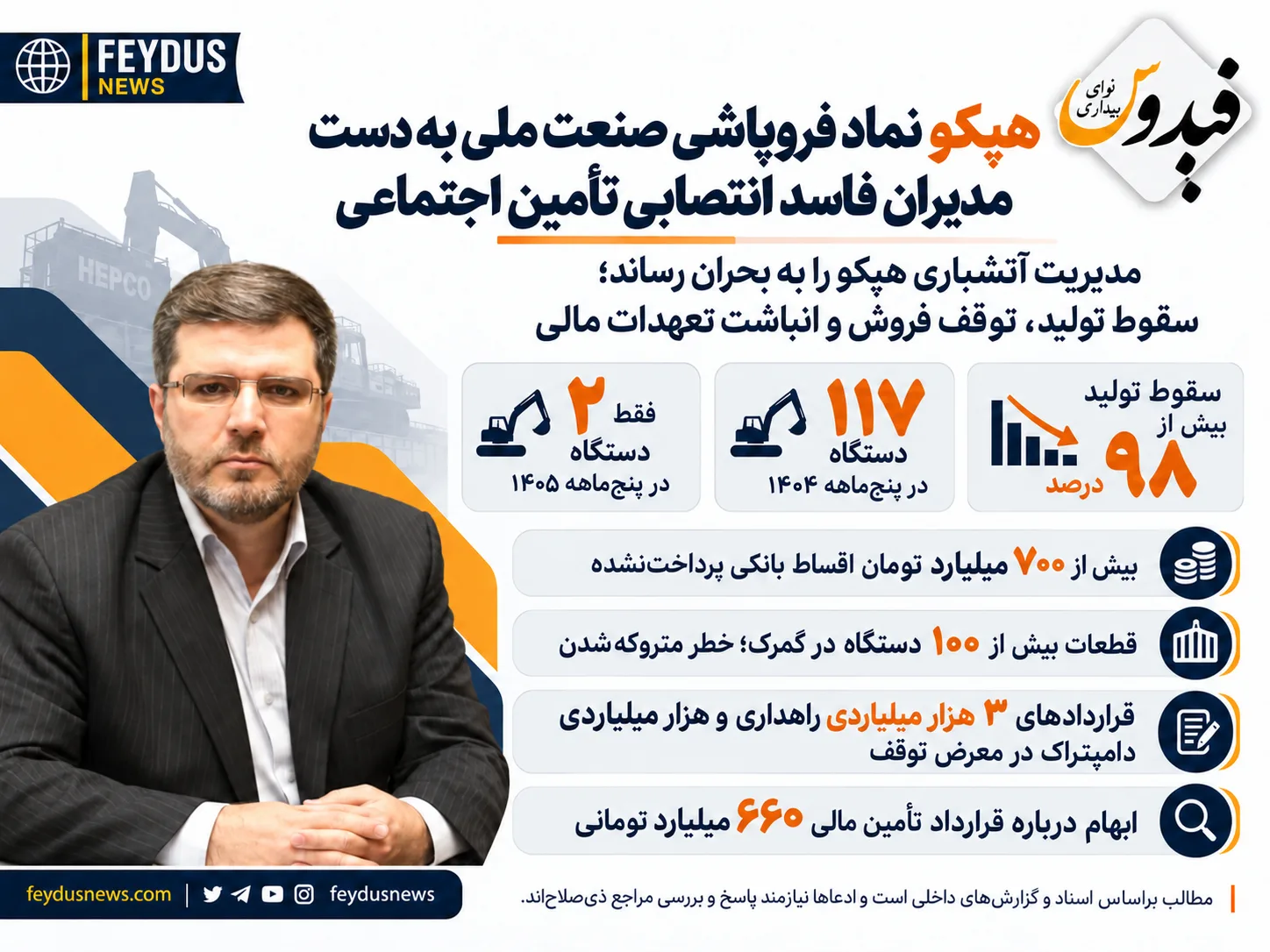
Documents and reports obtained from inside the heavy equipment manufacturing company HEPCO by Fidus News, paint a worrying picture of the state of this industrial entity in recent months; a company that, after years of crisis, labor protests, and ownership changes, had gradually returned to the production path, is now once again facing an unprecedented production decline, delayed salary payments, halted product sales, and uncertainty over imported parts.
The main criticism is directed at the performance of Saeed Atashbari, the caretaker of HEPCO, who was appointed by the Social Security Organization to manage the company since May 2026. Critics do not consider his expertise and relevant experience in the heavy machinery industry sufficient and believe that his decisions in the first four months of his tenure have halted HEPCO's growth trajectory.
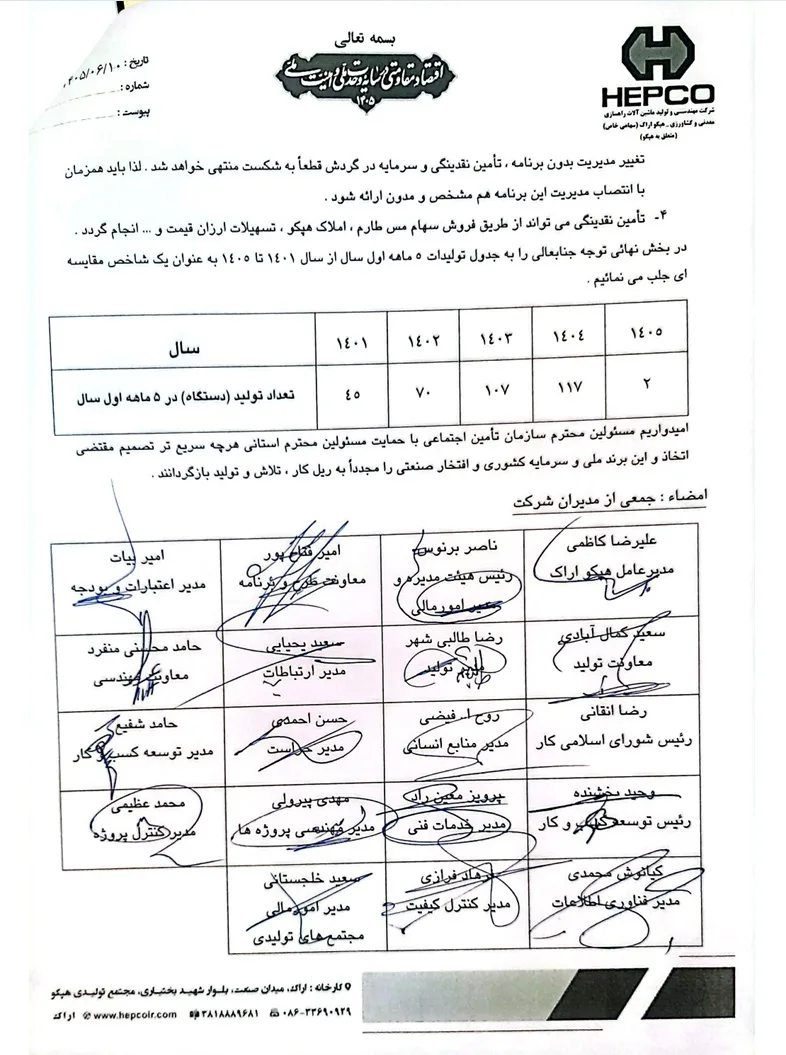
These claims have not yet been proven in any judicial or supervisory authority, and their publication does not mean a definitive confirmation of wrongdoing; however, the collective signatures of HEPCO managers on one of the letters and the figures mentioned in the documents double the necessity for transparent explanations from HEPCO's management and the Social Security Organization.
Production Drop from 117 Units to Only Two Units
The most significant sign of the crisis can be seen in the production statistics. According to a table in a letter dated August 31, 2026, HEPCO produced 45 units in the first five months of 2022, 70 units in the same period of 2023, 107 units in 2024, and 117 units in 2025.
This number has dropped to only two units in the first five months of 2026. In other words, HEPCO's production has decreased by more than 98% compared to the same period last year. Farzad Mokhlesolameh, the governor of the central province in Ebrahim Raisi's government, also warned about this situation in a note, stating that HEPCO's production has been only two units since the beginning of the year; a statistic that raises serious questions about the company's recent recovery trend.
The authors of the internal HEPCO letter have identified the halt of assembly lines, lack of liquidity, and disruption in parts supply as the main factors for this decline. They believe that the continuation of the current situation could return HEPCO to the critical conditions of the 2010s; a period when the company's name was more associated with protests, line closures, and unpaid wages than with machinery production.
Sales Halt and Return of Delayed Salaries
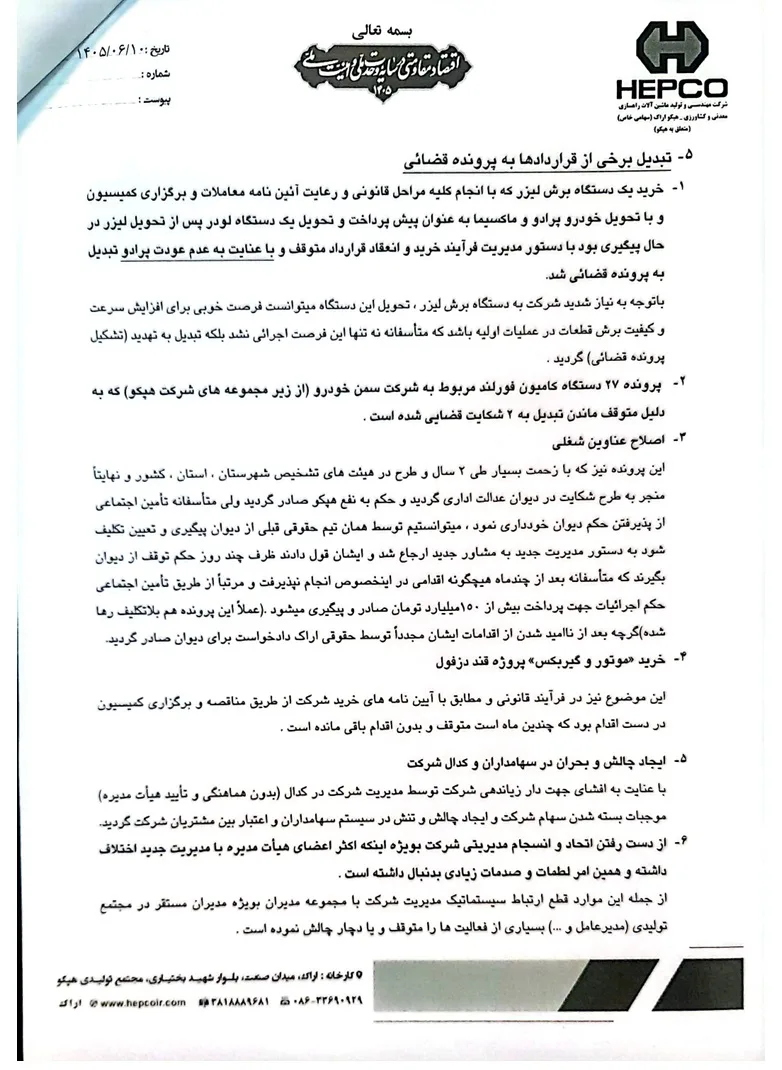
Another focus of the report is the halt in the sales process of products. According to the document known as the "Report of Violations and Negligence," the sales committee must determine the product prices each month and communicate them to the sales unit after board approval; however, it is claimed that this process has not been carried out during the new tenure, and product sales have effectively stopped.
In the initial text sent to Fidus News, it is stated that only one loader was sold in four months. The internal report also claims that the sales halt has disrupted the company's cash flow, and more than 700 billion tomans of HEPCO's bank installments have not been paid.
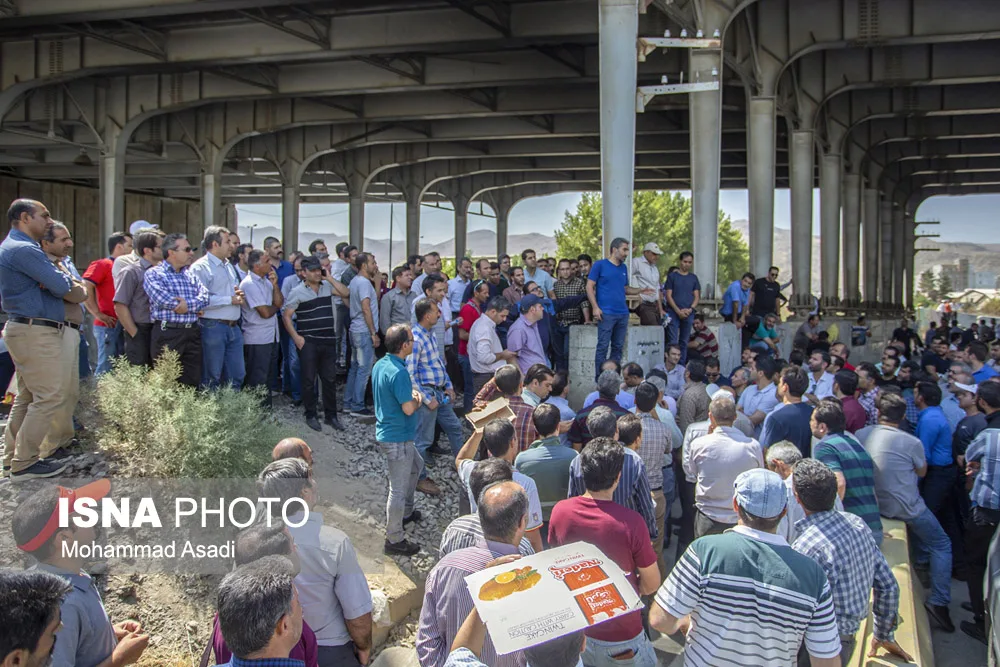
At the same time, the payment of employee salaries, which had become regular in recent years, has again faced delays. According to documents, July salaries were paid late, and August salaries were delayed by at least 14 days. Another report speaks of unpaid September salaries, severance pay, and retirees' claims, as well as the suspension of labor coupons and special packages.
In one of the letters, it is emphasized that HEPCO employees have once again resorted to protests and multi-day strikes after several years. The letter's authors believe these protests are not only due to salary delays but also due to concerns about idle lines and workers' job security.
Parts Stuck in Customs
The fate of CKD parts is another ambiguous point in the case. There is a discrepancy in the reports regarding the number of units: one document mentions parts for 108 units, while another text speaks of 128 units. The letter from HEPCO managers also states that the number of parts and assemblies remaining in customs exceeds 100 units.
Regardless of this numerical discrepancy, all documents agree on one point: the imported parts have remained in customs for several months, and the necessary resources for their clearance have not been provided. The demurrage and storage costs are estimated at around 60 billion tomans in the initial text; a figure that needs to be verified with customs and company financial documents.
One of the reports states that grader and bulldozer parts have been in customs for over four months, and some shipments have become abandoned or are on the verge of being abandoned. This is while HEPCO's production lines need these parts to continue operations.
It is also said that in recent months, no new order for CKD purchase has been placed. Given that the foreign supply process takes at least six months, the letter's authors have warned that even if the current parts are cleared, no new product will enter the production cycle from the beginning of 2027. The delay in fulfilling foreign currency commitments to foreign partners could also destroy the commercial credit built over the past three years.
Multi-Billion Contracts at Risk of Halt
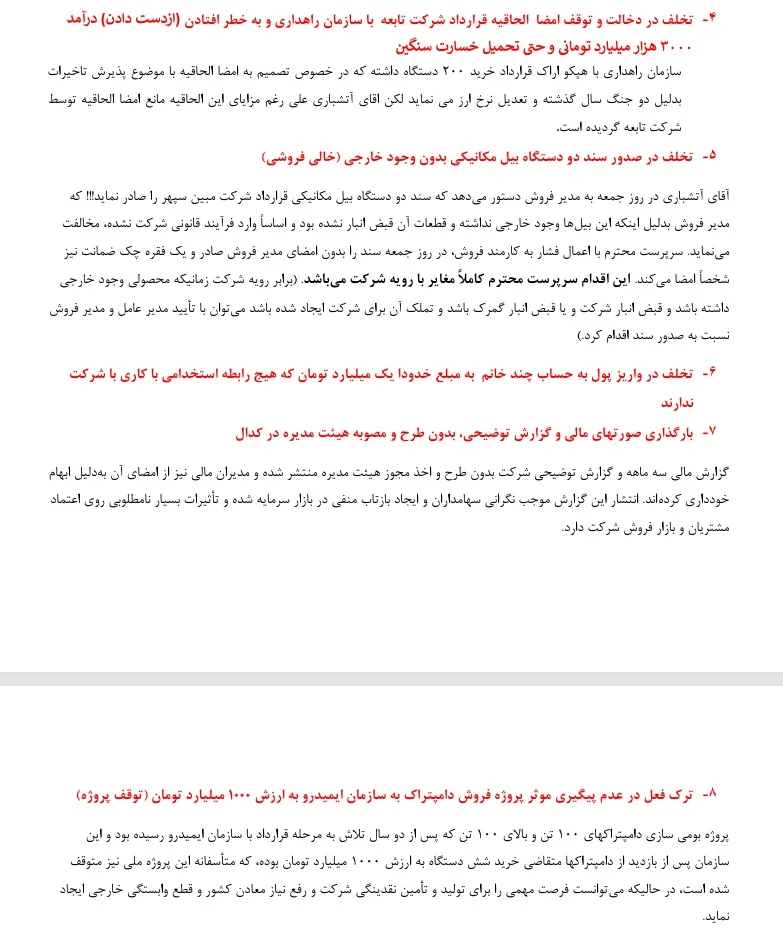
Another issue raised is the status of HEPCO's contract with the Road Maintenance Organization. According to documents, the Road Maintenance Organization had previously contracted with HEPCO to purchase 200 units, and it was supposed to sign an addendum to adjust the effects of delays caused by wars and exchange rate changes. Critics claim that preventing the signing of this addendum has put an income of about three trillion tomans at risk.
The mining dump truck construction project is also facing similar ambiguity. According to the internal report, after about two years of follow-up, IMIDRO had expressed readiness to purchase six dump trucks of 100 tons or more. The value of this order was announced to be around one trillion tomans, but it is said that the project has been halted in the new tenure. Another letter even mentions the possibility of attracting at least five trillion tomans for the development of this project.
The case of purchasing a laser cutting machine, selling 23 units belonging to Samanco Company, and the contract with Mobin and Sepehr Company are also other issues where the document authors have identified managerial intervention or halt as causing legal disputes and loss of liquidity.
Ambiguity Over 660 Billion Toman Contract
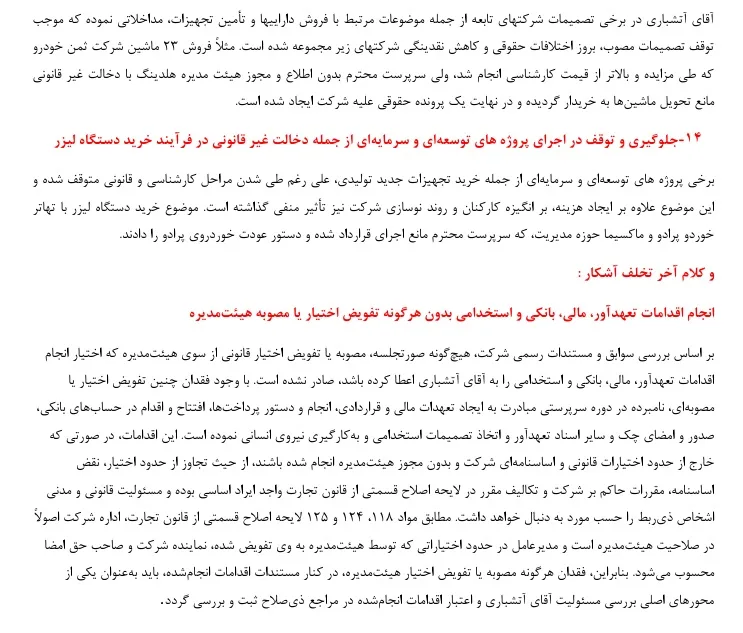
The most sensitive part of the report relates to a 660 billion toman financing contract. According to the claim, this contract with a private company, with an effective rate of over 60%, was pursued without fully completing the transaction commission procedures and without a board resolution.
The document states that checks equivalent to eight percent of the contract were issued in the name of two individuals as a fee, and HEPCO's guarantees were placed in the name of individuals instead of the contracting company. The report's authors claim that the General Inspection Organization of Iran, after being informed of the matter, prevented the contract's execution. The accuracy of this claim and the details of the Inspection Organization's involvement should be announced by this body or HEPCO's management.
It is also claimed that some banking, financial, and employment actions were carried out without clear delegation of authority from the board. According to Articles 118, 124, and 125 of the amended Commercial Code, the CEO is considered the company's representative within the scope of the board-delegated powers; therefore, clarifying the caretaker's authority scope is necessary to assess the validity of these actions.
The documents also mention the possibility of Atashbari's simultaneous employment at the National Iranian Oil Company and membership in the board of directors of Tarom Copper Company. Determining this issue and examining its compliance with Article 141 of the Constitution and the law prohibiting holding more than one job is the responsibility of competent supervisory authorities.
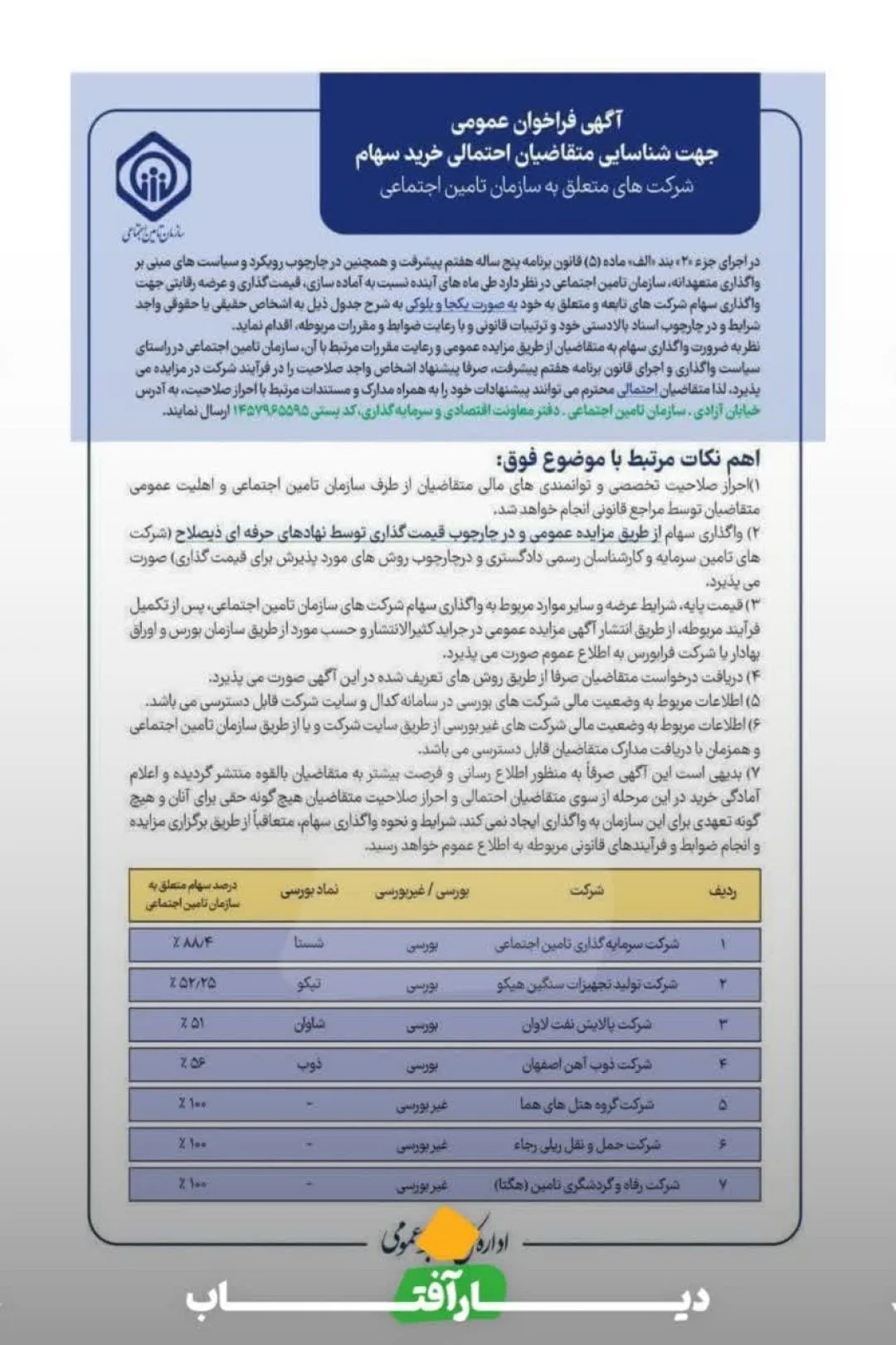
Is HEPCO Being Prepared for a Cheap Sale?
All these events coincide with the government's plan to exit state-owned and public entities from business management. This coincidence has raised concerns among some employees and managers that weakening production and increasing debts may reduce HEPCO's valuation and pave the way for the sale of its management shares at a low price.
The drop in production from 117 units to two units, sales halt, salary delays, parts remaining in customs, and uncertainty over major contracts are realities that the major shareholder cannot ignore without a response.
The Social Security Organization must explain the reason for continuing to manage HEPCO with a caretaker, the sales status, the amount of bank debt, the fate of CKD parts, the 660 billion toman financing contract, and the production plan for the second half of the year. HEPCO's management also has the right to respond to the claims made, and Fidus News is ready to publish the documented response from this entity and Saeed Atashbari.
HEPCO remains one of Iran's most important capacities for producing road construction, mining, and agricultural machinery. The company's return to a crisis point is not just the failure of an economic entity; it means the waste of industrial capital, increased dependency on imports, and a threat to the livelihood of hundreds of working families. The main question now is which entity will take responsibility for saving HEPCO again before the production lines are completely empty and widespread protests return?