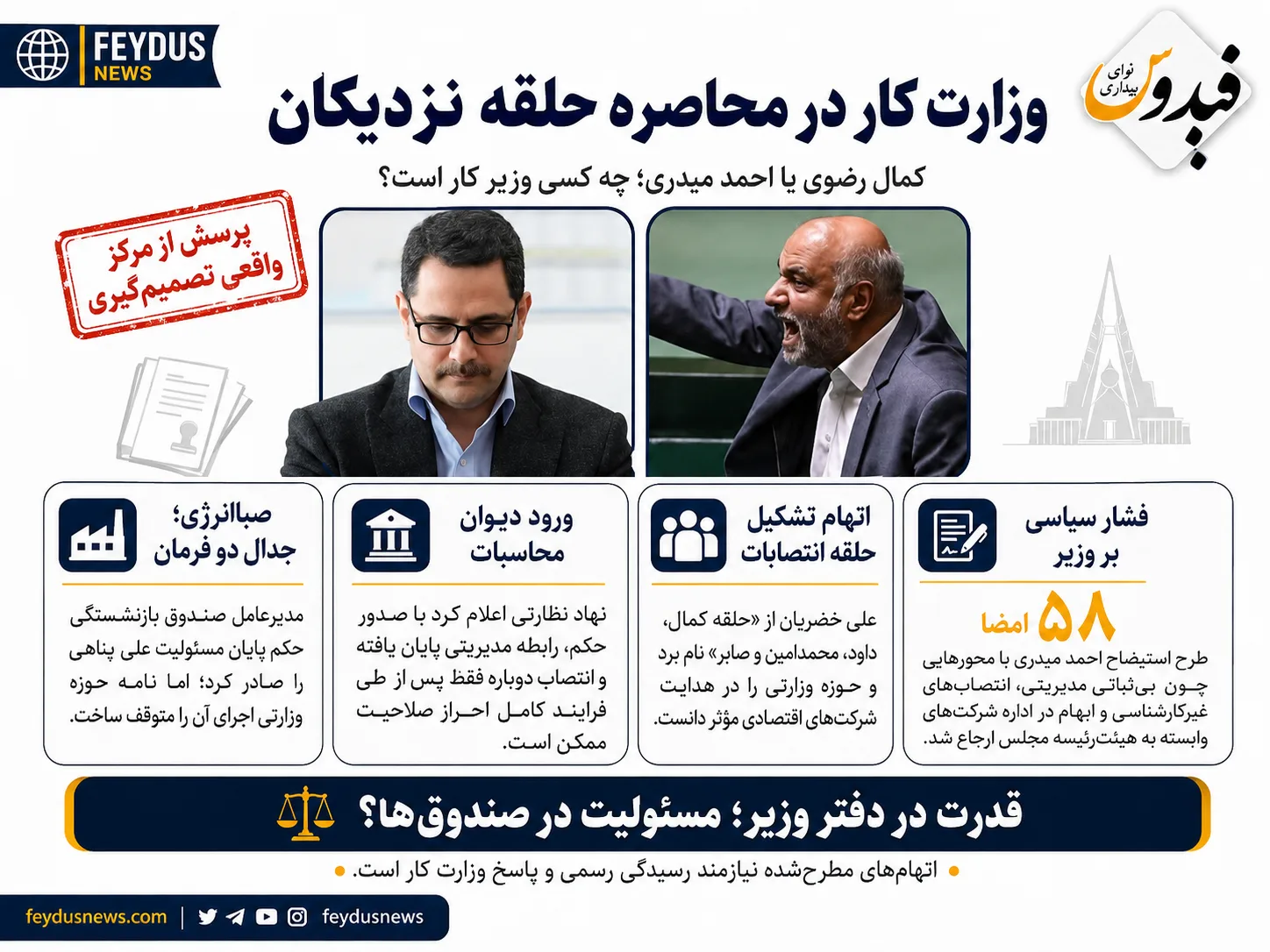
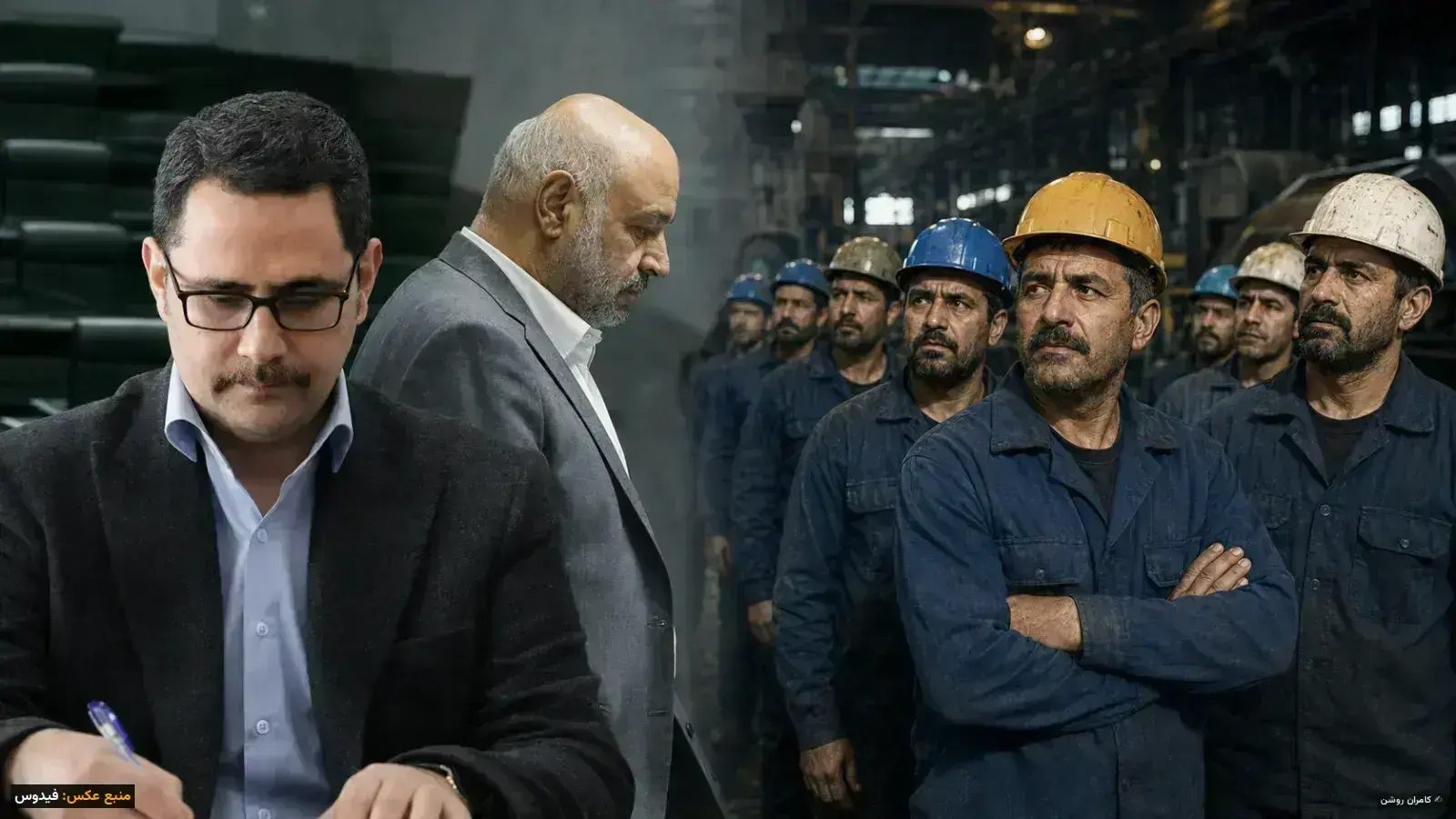
The ambiguity regarding the decision-making mechanism in the Ministry of Cooperatives, Labor, and Social Welfare is no longer limited to a few controversial appointments or usual dissatisfaction within a government agency. Piecing together administrative correspondences, positions of parliament members, warnings from oversight bodies, and managerial changes in the National Pension Fund indicate the formation of an informal power center around Ahmad Meidari; a center said to play a role in selecting managers, controlling holdings, and even halting decrees issued by the legal managers of the funds..
At the center of this network, the name Kamal Razavi, advisor to the minister and director-general of the ministerial office, is repeated more than others. A position that should be a coordination link between the minister and various parts of the ministry is now introduced by critics as one of the main centers of intervention in economic companies. The main question also starts from here: Is Razavi merely following Ahmad Meidari's orders, or has he become a parallel authority for decision-making regarding the economic complexes of the Ministry of Labor due to his proximity to the minister?
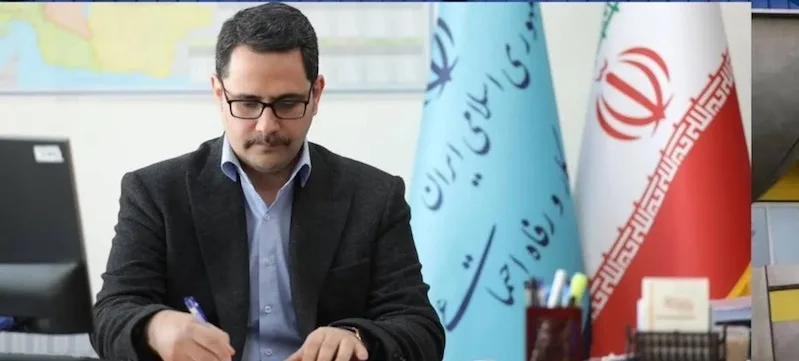
The answer to this question is not only important for understanding the internal relations of a ministry. Shasta, the Social Security Organization, the National Pension Fund, and their affiliated holdings manage the assets of millions of workers, insured individuals, and retirees. In such a structure, any non-transparent appointment can change the path of circulating vast economic resources, and any informal intervention can weaken the accountability of legal managers..
The Saba Energy Case; The Battle of Two Commands in a Management Structure
The dispute over the continuation of Ali Panahi's activities in Saba Energy Holding is the clearest example of the existing chaos in the Ministry of Labor's command chain. Saba Energy is the investment arm of the National Pension Fund in sectors such as oil, gas, petrochemicals, steel, and the capital market, and its management directly affects part of the retirees' assets..
The issue became public when Aladdin Azouji, CEO of the National Pension Fund, ended Ali Panahi's responsibility. It was expected that the management change of a subsidiary company would be done according to the statute and after completing legal procedures; however, a letter signed by Kamal Razavi effectively halted the implementation of this decision..
The director-general of the ministerial office stated in this correspondence that any change in the management composition of the investment company of the National Pension Fund and other affiliated holdings must be done with prior coordination with the ministry. He also questioned the CEO's authority to dismiss and appoint CEOs of subsidiary companies based on the fund's statute and emphasized that Panahi's termination order cannot be executed until receiving the minister's high-level approval..
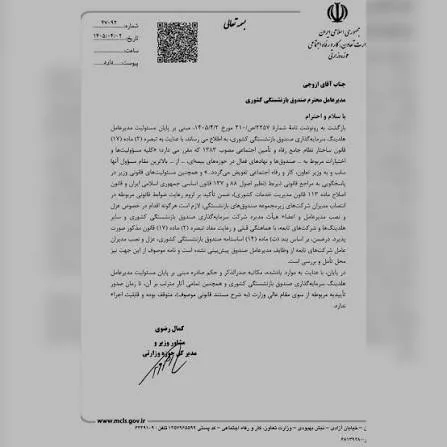
This letter was significant in two ways. First, a staff official was stopping the execution of the CEO's order; second, the final decision-making authority was introduced as the "minister's high authority," not the company's board of directors, the fund's bodies, or the qualification committee. However, it was not clarified whether Razavi issued this letter with Meidari's direct order or entered the case with a broad interpretation of the ministerial office's powers..
If the letter reflected the minister's order, Ahmad Meidari must take responsibility for the decision and its consequences. If there was no such order, the issue goes beyond a legal dispute; because, in that case, the director-general of the ministerial office suspended the CEO's decision without having clear authority..
The entry of the Court of Audit took this conflict to a new stage. According to the letter published by this body, with the issuance of Panahi's termination order, his managerial relationship with the holding had ended, and his return or reappointment was only possible after completing the qualification process. In other words, the effects of the dismissal order could not simply be ignored with an administrative correspondence. The details of these correspondences are included in the reports published about the Saba Energy case.
This case also revealed a structural contradiction. Aladdin Azouji had been appointed as the acting head of the National Pension Fund and the Steel Fund by Ahmad Meidari's decree. The government's information base described this appointment as part of a plan to organize and integrate the funds. However, the minister's appointed manager faced a stop order from the same minister's office in his first serious encounter with the management of one of the important subsidiary holdings..
Such a situation places the CEO of the fund in a dual position: he is held accountable for the performance of the subsidiary companies, but he does not have enough independence to change the managers of those companies. As a result, legal responsibility remains with the fund, and real power may be transferred outside the official bodies..
The Chain of Problematic Appointments and the Minister's Different Narrative
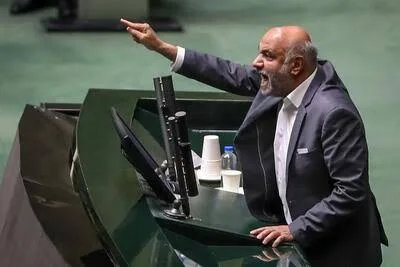
Sensitivity towards the role of the ministerial office is not only the result of Ali Panahi's case. Previously, Kamal Razavi's name was also mentioned in protests against the appointments of Saber Sheikhloo and Mohammad Amin Nikjou. Ali Khezrian, representative of Tehran and member of the Article 90 Commission, introduced Razavi as the one pursuing Sheikhloo's appointment and Nikjou's liaison in the ministry..
Sheikhloo was one of the controversial examples in the managerial changes of this period. According to published reports, he held several economic positions simultaneously at one point and was briefly on the path to managing Saba Energy. Khezrian referred the issue of holding multiple responsibilities simultaneously to the Article 90 Commission and considered it against the law..
The criticized appointments were not limited to these individuals. In Esfand 1403, a correspondence attributed to the General Inspection Organization was published, warning about issuing decrees for several managers without obtaining inquiries or before receiving responses from oversight bodies. This correspondence included names of individuals in the Social Security Organization, the Cooperative Development Bank, the National Pension Fund, the Board of Trustees of the Funds, and Sadr Tamin..
These documents were not consistent with Ahmad Meidari's statements in parliament. The Minister of Labor, in defense of his performance, stated that the managers' backgrounds are reviewed and appointments are made after receiving approval from oversight bodies. The publication of the General Inspection Organization's letter raised the question of whether the minister was not fully aware of the issuance of decrees or had introduced a process that was not yet complete as definitive in parliament.
In either case, the responsibility lies with the head of the ministry. A minister unaware of the issuance of decrees without completing inquiries does not have sufficient control over his managerial network; a minister who is aware of this process but presents a different image to parliament must explain this contradiction..
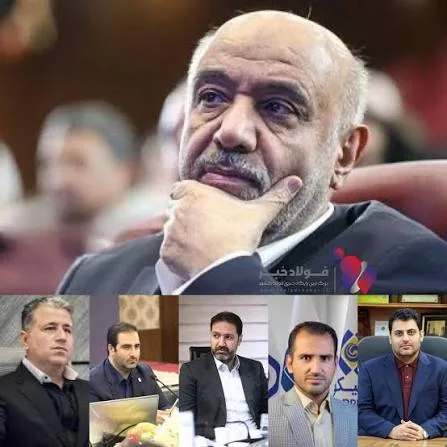
Khezrian expanded his criticisms in Khordad 1404 and mentioned a group called "Kamal, Davood, Mohammad Amin, and Saber." He claimed that the CEOs of some affiliated companies, instead of following the organizational path, are directly connected with the head of the ministerial office, and Razavi's office has become a place for directing economic and political activities.
Reports have also been published about the presence of the director-general of the ministerial office in meetings related to Shasta and the Pension Fund and his role in approving managerial options. It has also been claimed that the change of one of the board members of the Pension Fund was accompanied by a process similar to a lottery, resulting in Mahmoud Mortazavi-Far being removed from the board and Ali Hossein Shahrivar being added..
To confirm these matters definitively, meeting minutes, invitations, and decision-making documents must be published. Until these documents are released, not all media narratives can be considered proven facts. However, the ministry cannot remain silent in the face of this volume of questions. Publishing meeting minutes and delegation of authority orders can easily clarify the extent of Razavi's role..
The Main Crisis is the Weakness of the Accountability Structure
In the official structure, the CEO of the fund must be accountable for his decisions, the board of directors should oversee the companies, and the managers of the holdings should be selected based on professional qualifications. But if managerial options are first approved in the minister's office and the CEO of the fund is merely the executor of agreements made at another level, the boundary between authority and responsibility disappears..
This issue has more serious consequences for pension funds. The resources of these funds are not the personal budget of the minister or ministry managers. A large portion of these assets is created from insurance premiums and investment of resources from millions of employees and retirees. Therefore, appointing weak, political, or legally unqualified managers is not just a potential administrative violation; it can reduce the value of assets belonging to the insured..
The government has also approved the directive for qualifying CEOs and board members of companies affiliated with pension funds to prevent such a situation. This directive emphasizes professional backgrounds, managerial experience, and following specific evaluation procedures. The National Pension Fund announced in Tir 1405 that the qualification process for about 80% of the managers of subsidiary companies has been finalized.
However, it is unclear when and with what documentation the options supported by the ministerial office were approved. The Ministry of Labor must publish the list of managers, the time of sending inquiries, the date of receiving responses, and the results of their qualification evaluations. Without such transparency, the government's directive can also become a formality that later legitimizes decisions made in informal circles..
Meidari Cannot Hide Behind Kamal Razavi's Name
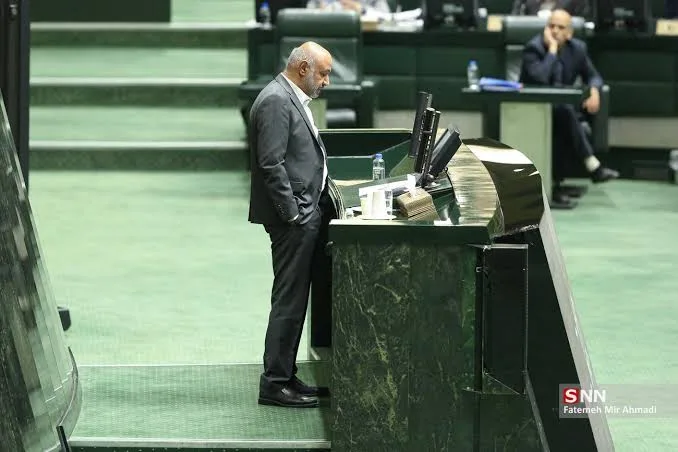
Parliament had warned about Ahmad Meidari's performance before the recent dispute became public. In Esfand 1403, he received the first yellow card from Masoud Pezeshkian's government. In Ordibehesht 1404, he once again went to parliament to answer for political appointments; although this time, the representatives were convinced by his explanations. A few months later, the motion to impeach the Minister of Labor was referred to the parliament's presidium with the signatures of 58 representatives..
Managerial instability, unprofessional appointments, weakness in fulfilling employment duties, and ambiguity in managing economic complexes were the announced axes for impeachment. This trend shows that the protest against the administration of the Ministry of Labor is not limited to one representative or one media stream.
Meanwhile, the existing documents alone do not prove financial corruption or criminal acts by Ahmad Meidari, Kamal Razavi, or other mentioned managers. Determining violations or crimes is within the jurisdiction of oversight and judicial bodies. What currently exists is a set of clues, conflicting correspondences, and ambiguous decisions that necessitate formal investigation and public explanation..
Meidari must explicitly state whether Kamal Razavi had written authority to intervene in the appointments of subsidiary companies, attend management meetings, and halt fund decrees or not. It should also be clarified whether the letter regarding Ali Panahi was issued with the minister's order or was the initiative of the director-general of the ministerial office..
Whatever the answer, the ultimate responsibility does not absolve Ahmad Meidari. If Razavi is executing the minister's orders, all his actions are part of Meidari's management style. If he acted without the minister's knowledge, the bigger question is how someone at the level of director-general could influence the ministry's most important economic enterprises without the minister noticing or preventing it..
As a result, the main issue is not which of Ahmad Meidari or Kamal Razavi has more power. The issue is how much the official structure of the ministry has retreated in the face of an informal circle. The Minister of Labor must now choose between two paths: publishing documents, restoring authority to legal bodies, and accepting responsibility for decisions; or continuing a silence that increasingly reinforces the perception that the Ministry of Labor has an official minister and an informal command center..